Moqawama.orgs Exclusive Interview with Alastair Crooke

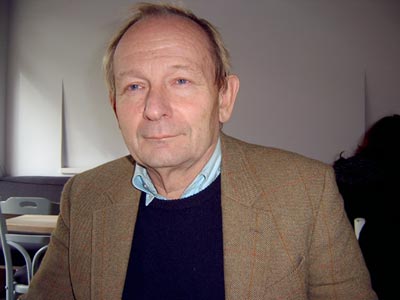
On the week of resistance, Moqawma.org interviewed Mr. Alastair Crooke, Founder of Conflicts Forum ,organiser of US and European unofficial dialogues in 2005 with Hizbullah, Hamas and other Islamic movements; former special Mid-East adviser to European Union High Representative, Javier Solana; staff member of President Clinton's Fact Finding Committee, on his controversial book "Resistance: The Essence of the Revolution".
Q: How do you address those who accuse you of being an apologist for Islamiscs and a justifier for terrorism?
I think it was a philosopher who attended the anniversary of Iranian revolution and he was so heavily criticised for his reporting from the revolution. He wrote about how in modern western societies it is not so much a sense of what is right and what is true that drive western thinking. It is very often, the discipline of an institution which normalizes not only what to think but also what to say and how to say it.
It controls and manages it, this is one of the ways which we see conversations being disciplined and managed. Westerns try to set a framework in which the debate of Islamism is held .As for those who say something which doesn't fit with that are then being pushed out. In the 18th century perhaps, I would be described as insane, but now you are called an apologist for Taliban. If that is the case, I have no problem for I believe that in order to see where you are and where the west is; you have to step out of the western sphere.
What I am trying to do in writing the book and in the work here generally is to step out of the western sphere. I don't think that you can step out 100 percent from a culture that you have spent particularly your young age. Yet I think u can step out of it, and I am not sure that we can step totally into another culture. So we try to occupy a space that is between the two spheres, far from apologizing that is the only blame that you can make comment about what happening and what Islamism is. I can't believe that you can even think Islamism through the western partisan viewpoint.
Q: You distinguish between the "emancipator resistance" of movements such as Hamas and Hizbullah from the "burn-the-system-to-build-anew philosophy of Al-Qaeda and the eschatological [ie concerned with End Times] leanings of some Salafi groups. Did the west fail to distinguish between resistance movements and extremists or it simply ignored such distinction?
I think there are a number of elements to answer the question, one element in fact is that some of the leaders in America and Europe don't want to make that distinction. It suited them, because Islam wasn't their enemy. It was a just tool to use to try undermining liberalism and a way of thinking which they thought even more dangerous to their concept of near liberal secular state. It was so important in their philosophy, part of that is justified absolutely and any threat to it should be demonized. Any area of accommodating it was an example of weak liberally, I think in one sense it serves the purposes of the philosophy of power.
It was also the need to have an absolute enemy, in that sense, understanding that they got the wrong extremist and the wrong moderate, didn't really matter. The second element is that if you are inside the west, the west is dogmatic, literal, intolerant and intellectual construct. It is also narrowly rational and it is dogmatic so the west cannot understand that the part that is called extremism like Shi'ism and like movements such as Hamas actually represent the non dogmatic and the rational in Islam. This shapes them since like knows like, literalism understands literalism, but doesn't understand the form of Islam that abides by for example shi'ism.
Q: What underlies the conflict between Islam and the west?
I think what underlies it is something extremely deep; it is about a process of thinking. It is about the way of thinking in the west which has entirely destroyed the ground of sacred. It has completely destroyed the thinking of the concept, leaving only a very narrow concept of methodological reason. It flattened everything into horizontal so there is no thought for ascending, in terms of the type of consciousness that has existed in Islam. I think the difference in the west is a difference about a process of thinking.
A great disaster took place in 16th century with Cartesian narrow thinking, destroying the whole concept of thinking which was developed by Ibn al Arabi and Sarwade. I think more deeply that we see a clash between two forms of monotheism. On one hand, there is the monotheism of Judeo-Christian, an abstract absolute monotheism, monotheism of vengeful and angry God who is capricious and whose distance from human being is very great. On the other hand, there is the monotheism of Islam which is different. For it has many values and layers within it which directly connect human being to the invisible world beyond.
In your book, you wrote that "There is no one Islam or Islamism - there are many." Can you elaborate more on that?
There are currents and we are seeing struggle for the future direction of Islam. The main current at the moment is the current of Erfan. Then, there is the current of the Islamic movements like Muslim brotherhood. Finally, there is the dogmatic and literal Muslims with a very narrow interpretation on the Holy Quran and the Hadeeth. I suppose that one most that I describe of the broad range of the Islamic movement has a little bit of both of them that are not clear cut of one, two, and three. I see that those are the currents that are taking place.
You call upon the west to listen to the message of the Muslim world, while the west seeks to brand Islam as nothing more than terrorism. What is the message of the Muslim world and will this message reach the west amid escalating fear and rising misconceptions?
I think that the message to the west is essentially a rejection of western secular literal consciousness. It is also an attempt by Islam to describe an alternative consciousness which has a different way of thinking and a different way of conceiving the human being. That message actually provides important insight for the west, as well as, the world at large. The recovery of this way of thinking which has been very much dominating by the western mode of partisan thought; it is the message that the west should get.
Will it hear it? I am quite doubtful, if I look back at the history of the last two thousand years. The same antagonism appears time and time again .From the pattern that was established at the time of the prophet, at the crusade, in the 18th century. All of these are repeating patterns of hostility towards the thinking and the message of Islam.
Will it get worse? I think it will get worse now in the short front, because of the economic crisis in addition to an intellectual crisis. The westerns are aware of being vulnerable and they are feeling afraid.
Moreover, their mission is increasingly questioned by the majority of this globe, so it reacts defensibly and with hostility to what it sees a threat to its thinking. I think we will see a period of increase tension with Islam .Besides, I think that the intellectual message and the practical idea is the reason I turn to the orientation of Erfan .It will have their impact on the western thinking even if it is taken in a different form . The west in a sense is experiencing a crisis which goes back to the 19th century in terms of the consequences of the Cartesian thought.
I believe that they are closer ties today between Plato before he was christened, the Alexandrian school of thinking that Al Sawani took and the early renaissance of Europe. All those were based on consciousness which was destroyed in 16th and 17th century. The consciousness of Plato, the consciousness of the renaissance, and the consciousness that was exemplified by Islamic thinkers including Imam Khomeini, are closer to each other than the west is close to its own roots today.
"Israel's" expulsion from south Lebanon under resolute attacks of the Islamic Resistance has focused attention on the Lebanese Hizbullah that spearheaded this courageous and victorious resistance movement. So, how do you explain that such evolving Islamic movement has helped infusing a sense of mission into the hearts and minds of many?
I can't give the answer in two sentences; the origins of the resistance originally to the alienation of people and the imposition of a system of prejudice and sectarianism.
As for the party it is something much great. I believe that particularly Sayyed Hassan is using the classic Islamic intuition in a new way in order to transform human being. When he speaks, the whole region stops to listen to him. He is transforming the consciousness in a way people perceive themselves from the way they perceive the world around.
I think that the importance of that is also that he is putting these ideas into the practical form within the secular society. It is both an experiment and it is in itself an important intellectual event that is taking place.
Q: On the week of Lebanese resistance, what would you say to the leaders of the resistance and its martyr's?
I believe that the resistance is as Sayyed Hassan said a form of destiny and it operates on many levels. I also believe that to think simply in military terms is not enough, since it is psychological, cultural, and intellectual. It is also about creating conditions which another consciousness escapes from western thinking. Only in that way, Muslims are escaping from western thinking, only through resistance to that thinking. Resistance allows Muslims to return to the classical Islamic thinking which is not the same as many modern Muslims believe.
Comments