
“Israeli” Press: “Israel” Still Faces 2006 War Phantom After Five Years

"Hizbullah has not made a single aggressive move since the war ended five years ago, but the deterrence established in that conflict may not be the only reason."
On the fifth year anniversary of the 2006 July war between Lebanon and "Israel", Amos Harel from the "Israeli" daily Haaretz, recalled in his article the status of the borders between Lebanon and the occupied territories, last August (during the Odaisseh incident), and during the 2006 war.
 However after the Odaisseh incident, during which clashes took place between the "Israelis" and the Lebanese army leading to the death of several Lebanese army soldiers and one "Israeli" commander, the Lebanese army is doing all it can to keep the border calm, avoiding any sort of retaliation.
Five years after the war, the Haaretz article said that Hizbullah is now monitoring the "Israeli" military forces from over the borders.
An "Israeli" senior officer in the 91st division in charge of the border, told Haaretz, "What may seem as petty insistence to enter every meter of Israeli territory sends a sharp message to the other side". He also added, "I served here before the war, and looking back, I'm ashamed at how we conducted ourselves. At the time we would tell soldiers our goal was to create no targets for Hezbollah abductions. There's been a tremendous psychological shift in our border activity since."
The daily's article mentioned that Hizbullah has not made any aggressive move since the July 2006 war, and affirmed that Hizbullah had nothing to do with the Odaisseh incident between the "Israeli" enemy and the Lebanese army. The article also added that several other attacks and ammunition fired to the Galilee were not triggered by Hizbullah, but rather by other militant groups like the Qaida.
"Five years later, Lebanon is one of "Israel's" quietest borders. For the first time in 40 years, Kiryat Shmona first-graders never will have experienced sirens or Katyushas, said former Chief of Staff Gabi Ashkenazi", the article read.
"The longer the quiet lasts, the stronger "Israel's" deterrence seems and the more we are inclined to forgive the mistakes of that summer", the article clarified, in reference to that "Israel" has committed mistakes during the 2006 war.
On his part, former "Israeli" Air Force Commander Eitan Ben Eliyahu stated, "That war was an unforgivable scandal because of how it was managed and especially because the actual war was justified". "It's dangerous to use the quiet to blur the war's conclusions. Let's see what Hizbullah achieved: Nasrallah ordered abduction in order to force "Israel" to carry out a prisoner swap, and he was 100 percent successful. Hizbullah wanted to harm "Israel's" strong image and succeeded there as well. It has since equipped itself with tens of thousands of missiles and completely took over South Lebanon. The war was a stunning success for Hizbullah and a bitter failure for us", he further added.
Since the war, the "Israeli" military army has worked hard to fix its weaknesses, including intelligence, ground forces and home front preparedness. It can be seen as a tactical failure that brought about a partial strategic success, in terms of the quiet.
__________________________________________________
Yaakov Katz, the Jerusalem Post- Assessing quiet on Lebanon front, 5 years after 2006 war
Analysis: For "Israel", the 2006 war was a wakeup call and helped it realize that the war of the future is usually nothing like the war of the past.
On its part, the Jerusalem Post published an article in which it referred to the quite Lebanese-"Israeli" front on the "Israeli" northern borderline, and to the change in the commander structure which is responsible for following up an upcoming war with Hizbullah.
"On Monday, Maj.-Gen. Yair Golan took up his post as head of the Northern Command in a ceremony in Tel Aviv, replacing Maj.-Gen. Gadi Eizenkot, who after almost five years stepped down ahead of his appointment in a year as deputy to Chief of General Staff Lt.-Gen. Benny Gantz."
Until a month ago, Golan was the head of the Home Front Command, experience that some senior officers said recently would prove to be beneficial to the head of the Northern Command (Lebanese borders).
At the Home Front Command, it was Golan's job to prepare the country for the missile onslaught that it will face in a future war with Hizbullah, which is believed to be capable of firing hundreds of missiles a day into "Israel". At the Northern Command, it is now Golan's job to prevent that from ever happening.
"Knowing the devastation and destruction the war you are asked to plan and fight will have on "Israel" before it even occurs is a humbling experience," one of the officers explained.
The article affirmed that there are two ways for the "Israeli" military forces to evaluate the five years that have passed since the July 2006 war. "On the one hand, they have been very quiet - 10 rockets have been fired from Lebanon into "Israel" but not a single one by Hizbullah. On the other hand, it is impossible to ignore Hizbullah's massive and unprecedented military buildup amounting to around 50,000 missiles and rockets", the article read.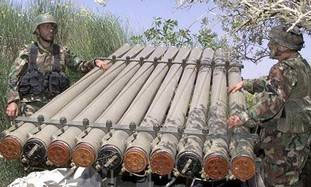
While some "Israeli" politicians and defense officials - particularly those who served in key positions during the conflict in 2006 - argue that the quiet along the border is the result of the war, according to Military Intelligence assessments things are more complicated.
The article said that the quite on the borders is due to restraining factors, one of which is the economy in Lebanon, which comes in third place in the Middle East after "Israel" and Saudi Arabia. The jpost.com article further claimed that if another war breaks out, Hizbullah will likely be blamed, all the more so due to its and its allies' current majority in the Lebanese cabinet.
In the five years since the war, Hizbullah has tripled in size, and according to "Israeli" intelligence today has bases and missile launchers in at least 100 villages scattered throughout southern Lebanon.
Furthermore, the jpost.com stated that "Israeli" military soldiers believe that the stronger Hizbullah grows, the more difficult it will be to defeat.
"For Israel, it was a wakeup call and helped it realize that the war of the future is usually nothing like the war of the past. That lesson needs to be remembered", the article reaffirmed.
__________________________________________________
Jonathan Lis, Haaretz- "Israeli" students fly to South Africa to improve their "so-called country's" image
As part of the "Israeli" cultural war launched against the world, an "Israeli" student delegation is flying to South Africa in order to improve their entity's image in the world, after it is described as apartheid.
The independent ambassadors will visit Johannesburg, Pretoria and Cape Town.
One of "Israel's" most serious image problems is how it is perceived on campuses around the world. Now, a group of 27 "Israeli" students are planning to tackle the issue head-on, funding their own trips to South African universities.
As part of the project, 150 students will be sent abroad in five delegations over the next six months.
The students receive no governmental aid, and are paying for the trip on their own and through contributions. As part of their fund-raising efforts, they will be holding a party in Tel Aviv next week.
On the first trip, scheduled to depart August 11, the participants will spend 10 days visiting universities in Johannesburg, Pretoria and Cape Town and try to convince students there that "Israel" is not an apartheid state.
Pro-Palestinian activities are held almost daily on these campuses. The University of Johannesburg, a major focus of the trip, launched an academic boycott of Ben-Gurion University of the Negev a few months ago.
The trips are a private initiative by the students, said Roy Wolff, one of the organizers of the group, called What Is REAL. "We all agreed that we were willing to spend $1,000 each, the cost of travel, and hoped we could raise money to cover expenses."
Why take part in such a delegation?
"I can stay home and cry about "Israel's" lack of [positive] publicity, or I can get out of my chair, take my money and do something. If within six months we manage to send 150 people on five delegations, we can influence 5,000 students. In two months we have trained 27 students for the educational missions. There is no doubt that this is just a drop in the ocean. However, we could manage to influence a student who goes on to become Britain's prime minister."
The participants do not share an ideology. Its members include Wolff, a parliamentary aide to MK Arieh Eldad (National Union ); and Lior Finkel, aide to MK Ilan Gilon (Meretz ).
"We all agree that "Israel" is a Jewish and democratic state, and we all agree that "Israel" is not an apartheid state. This is what we want to show the students on campus," Wolff said.
Finkel said, "To me, [the trip] will be a success if I can sit with people and explain "Israel's" side, and if they are willing to listen to me. The delegation will create the most basic kind of human interaction: I meet people my age, who are exactly like me, and who don't always feel like hearing about "Israel"."
How important are the group's activities?
"Most people on campus don't really care," Wolff says. "But the fact that they hear slogans about "Israel" being an apartheid state every day means that this is the only thing they know about "Israel". We have to create some doubt in their minds."
Talia Dekel, another group member, explains that the organizers prefer not to take government money so that they cannot be cast as official representatives.
__________________________________________________
Ben Hartman, Jerusalem Post- 81% of "Israelis" support EU membership, BGU poll finds
"Survey also finds 64% of "Israelis" would support NATO deployment of peacekeeping troops to West Bank, Gaza; Merkel most popular EU leader". This comes in another "Israeli" attempt to manipulate the world powers into achieving their oppressing goals.
Sixty-four percent of "Israelis" would support a NATO deployment of peacekeeping troops to the West Bank and Gaza, according to a survey published by the Ben-Gurion University of the Negev on Monday.
The survey, compiled by Sharon Pardo, Jean Monnet Chair in European Studies in the Department of Politics and Government at BGU, found that the level of support for such a move was the same for both Arab and Jewish citizens of "Israel".
Pardo's survey also found 81% of "Israelis" would support European Union membership for "Israel", and that in general, 43% of "Israelis" want stronger relations with the EU.
It also found that German Chancellor Angela Merkel is the most popular European leader, with a favorable rating of 55%. In addition, 8.5% of "Israelis" are already citizens of one of the 27 member states of the EU.
The survey, entitled ""Israeli" Positions on the EU," questioned 1,000 people from a representative sample of the "Israeli" public, and has a 3.3% margin of error.
Pardo said the survey shows ""Israelis" are really into strengthening and deepening the cooperation between "Israel" and the EU. "Israelis" understand the importance of the EU for the future of "Israel" and they want to strengthen the relations."
He added that "message is quite clear, "Israelis" are not for isolationism; they want cooperation."
When asked why "Israelis" are often seen as being at times anti-European, he said "we know that there is this misperception that "Israelis" are anti- European, and the survey shows that this is actually not the truth and that "Israelis" are de facto pro-European. They might not like policies of the EU and they may be critical of them, but they want to be as close as possible to the EU for a non-EU country."


