
Embedded Wrath or a Political Crisis?

Mariam Ali
"This Isn't Tahrir Square", "Understanding the Tent Protests", and "Could "Israel's" Middle-class Spearhead a National revolution?" are just a sample of Titles that the "Israeli" dailies have been raising in the past days. So what is really happening in the Zionist Entity?
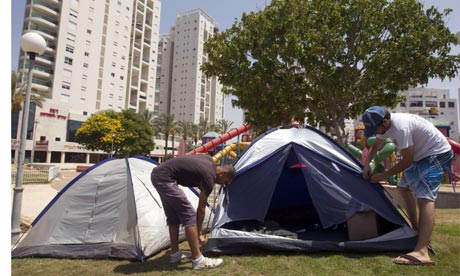
Tent protest villages have sprung up across "Israel" over the past week to demand action on house prices and rents, attracting large numbers of young workers and students, huge media attention and the panic of politicians beginning to feel the heat of people power.
The centre of the wide protest is "Rothschild Boulevard", a coveted and affluent avenue in "Tel Aviv", whose central pedestrian pathway is now littered with hundreds of small pop-up tents, posters, battered furniture and people debating into the night.
At the tent camp "Israeli" protesters carried sofas and chairs to one of the main streets for a traffic-blocking sit-in.
Daphni Leif, who initiated the protest on Face book, will "make the upper echelon shake", informed the "Guardian" British daily that "the protest movement has spread to cities and towns across the country, including Jerusalem and the desert city of Beer Sheva. The citizens of the tent villages, along with their many supporters, are expected to join a big rally on Saturday night that."
"Israeli" settlement minister Ariel Attias (Shas) argued that "the protesters were spoiled kids that refuse to leave the fashionable center of "Israel"."
"However, by Tuesday there were tents in Jerusalem, the southern city of Beer Sheva and as far north as Kiryat Shmona, near the Lebanese borders," Noam Sheizaf reported in "Haaretz" adding that "by Wednesday protesters tried to break into empty apartments in Tel Aviv and Jerusalem; the tents on Rothschild Boulevard stretched several blocks, all the way from Habimah Square to Shenkin Street, and marches and rallies were scheduled for the weekend."
Friday "Israeli" papers declared that PM Binyamin Netanyahu sees the "tent protest as the greatest potential political threat to his governing coalition."
Throughout the week Netanyahu conducted ongoing meetings in attempts to bring the protest to an end but all his efforts went in vain.
The "Israeli" government is alarmed at the spread of the protests and how the issue has united left and right, religious and secular, and the middle-class with their less-affluent fellow citizens.
The housing protest swiftly followed a widespread consumer boycott of cottage cheese in protest at the high cost of dairy products. Dairy companies were forced to cut prices, and the government initiated a review of the industry which made "Israeli's" move into another demand i.e. housing.
According to that same logic, "the housing protest should have been directed mostly against contractors and homeowners. Yet there is a small problem here: The contractors and homeowners are no longer a detached top echelon, as was the case in the cottage cheese affair - they are the whole nation of "Israel"," warned "Ynet".
A planned demonstration on Saturday evening will give some indication of the support for the protesters.
On Sunday, "Jerusalem municipality's deadline to evacuate the tents from the city center-sources in the municipality said that their presence would hurt tourism-will arrive. Other municipalities are bound to follow with attempts to evacuate the tents.
"Protesters couldn't care less about the occupation or Iran right now, but social crises have this funny effect on politicians - they make them more active. I don't think that Netanyahu or Barak will go so far as to attack Iran, for example, to divert attention from their problems at home; as some people have speculated (I hope they are not that crazy, and there is still considerable opposition in the security establishment for such a move).
Still if the protest continues for a prolonged period, we should expect some "bold" moves from what has been a very passive government so far, to say the least," Haaretz reporter concluded.
Source: Newspapers
"This Isn't Tahrir Square", "Understanding the Tent Protests", and "Could "Israel's" Middle-class Spearhead a National revolution?" are just a sample of Titles that the "Israeli" dailies have been raising in the past days. So what is really happening in the Zionist Entity?
Tent protest villages have sprung up across "Israel" over the past week to demand action on house prices and rents, attracting large numbers of young workers and students, huge media attention and the panic of politicians beginning to feel the heat of people power.
The centre of the wide protest is "Rothschild Boulevard", a coveted and affluent avenue in "Tel Aviv", whose central pedestrian pathway is now littered with hundreds of small pop-up tents, posters, battered furniture and people debating into the night.
At the tent camp "Israeli" protesters carried sofas and chairs to one of the main streets for a traffic-blocking sit-in.
Daphni Leif, who initiated the protest on Face book, will "make the upper echelon shake", informed the "Guardian" British daily that "the protest movement has spread to cities and towns across the country, including Jerusalem and the desert city of Beer Sheva. The citizens of the tent villages, along with their many supporters, are expected to join a big rally on Saturday night that."
"Israeli" settlement minister Ariel Attias (Shas) argued that "the protesters were spoiled kids that refuse to leave the fashionable center of "Israel"."
"However, by Tuesday there were tents in Jerusalem, the southern city of Beer Sheva and as far north as Kiryat Shmona, near the Lebanese borders," Noam Sheizaf reported in "Haaretz" adding that "by Wednesday protesters tried to break into empty apartments in Tel Aviv and Jerusalem; the tents on Rothschild Boulevard stretched several blocks, all the way from Habimah Square to Shenkin Street, and marches and rallies were scheduled for the weekend."
Friday "Israeli" papers declared that PM Binyamin Netanyahu sees the "tent protest as the greatest potential political threat to his governing coalition."
Throughout the week Netanyahu conducted ongoing meetings in attempts to bring the protest to an end but all his efforts went in vain.
The "Israeli" government is alarmed at the spread of the protests and how the issue has united left and right, religious and secular, and the middle-class with their less-affluent fellow citizens.
The housing protest swiftly followed a widespread consumer boycott of cottage cheese in protest at the high cost of dairy products. Dairy companies were forced to cut prices, and the government initiated a review of the industry which made "Israeli's" move into another demand i.e. housing.
According to that same logic, "the housing protest should have been directed mostly against contractors and homeowners. Yet there is a small problem here: The contractors and homeowners are no longer a detached top echelon, as was the case in the cottage cheese affair - they are the whole nation of "Israel"," warned "Ynet".
A planned demonstration on Saturday evening will give some indication of the support for the protesters.
On Sunday, "Jerusalem municipality's deadline to evacuate the tents from the city center-sources in the municipality said that their presence would hurt tourism-will arrive. Other municipalities are bound to follow with attempts to evacuate the tents.
"Protesters couldn't care less about the occupation or Iran right now, but social crises have this funny effect on politicians - they make them more active. I don't think that Netanyahu or Barak will go so far as to attack Iran, for example, to divert attention from their problems at home; as some people have speculated (I hope they are not that crazy, and there is still considerable opposition in the security establishment for such a move).
Still if the protest continues for a prolonged period, we should expect some "bold" moves from what has been a very passive government so far, to say the least," Haaretz reporter concluded.
Source: Newspapers


