Obama to Discuss Bombing Syrian Military Positions
Local Editor
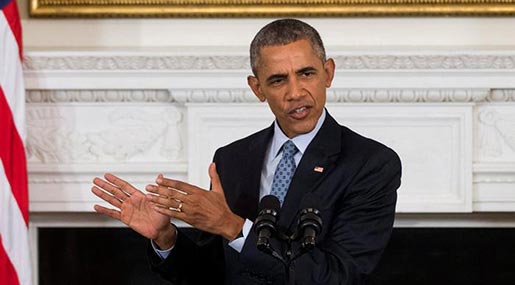
US President Barack Obama is set to discuss further US action in Syria with his senior foreign policy advisers at the National Security Council [NSC] on Friday.
US officials said military options are to be mulled over, among other possibilities. One scenario to be discussed involves direct US military action in Syria, including airstrikes on Syrian military, radar and anti-aircraft bases, as well as arms depots, Reuters reports citing high-ranking US officials who spoke on condition of anonymity.
Another scenario to be considered is allowing coalition forces to provide the US-backed "moderate opposition" with advanced ammunition and weaponry.
This would not include shoulder-fired anti-aircraft missiles, as Washington fears they could be used against Western airliners.
The officials, however, stated it was unlikely that Obama would actually give the green light to US airstrikes on Syrian Army targets, or that he would make any specific decisions at the upcoming meeting.
One official noted that, as Russian and Syrian troops cooperate extensively, striking Syrian army forces could result in a direct confrontation between the US and Russia - something Obama had been trying to avoid.
The White House declined to comment on the speculation surrounding any possible decisions, but confirmed the NSC meeting will take place on Friday, Reuters reported.
US authorities had already raised the bombing of Syrian Army forces as an option, with White House spokesman Josh Earnest telling reporters last week that although such action is unlikely to reduce violence, nothing can be taken off the table under the circumstances.
According to a recent report in the Washington Post, several top US officials had been considering striking positions of the Syrian military covertly and without a UN Security Council resolution.
The NSC meeting comes just ahead of the ministerial talks on Syria in Lausanne, Switzerland. On Wednesday, the Russian Foreign Ministry announced that Russia, the US and a number of regional powers will have a meeting "in a narrow format" on October 15 to discuss possible steps for a Syrian settlement.
Commenting on the upcoming Lausanne talks, Russian Foreign Minister Sergey Lavrov expressed hope that they "will launch a serious dialogue on the basis of the principles contained in the Russian-American deal, which was broadly welcomed but which unfortunately was not launched."
The US State Department noted that Lavrov and US Secretary of State John Kerry are likely to focus their discussion on the situation in the Syrian city of Aleppo and "getting cessation of hostility in place," which could enable conditions for political talks to resume.
Last week, Washington officially suspended bilateral cooperation with Moscow, ending a brief period of close cooperation aimed at sustaining the ceasefire in Syria, which had been agreed by the sides on September 9 after months of negotiations. The move followed mutual accusations of failing to fulfill the obligations agreed upon.
The US claimed Russia didn't deliver on a promise to ensure Damascus suspended its military campaign and provide humanitarian access to besieged areas of Syria, while Russia accused the US of failing to separate the moderate opposition under its control from the Takfiris, particularly from al-Nusra Front [now Jabhat Fateh al-Sham], as was agreed, and organize the withdrawal of militants from Castello Road to allow humanitarian aid supply to Aleppo.
In his interview to Russia's Komsomolskaya Pravda newspaper earlier this week, Syrian President Bashar Assad said there are no "moderates" fighting in Aleppo, as all armed groups there "work with al-Nusra in the area that's controlled by al-Nusra."
Assad denied criticism that Russian and Syrian air forces are bombing the positions of so-called "moderate" militants, stressing that anyone who holds a weapon is a terrorist.
Concerning the United States and its actions in Syria, the leader said Washington is using the battle against terrorists as an excuse to achieve its own objectives in the wider Middle East as well as those of its allies, while trying to keep the "hegemony of the Americans around the world."
Source: News Agencies, Edited by website team
Comments