- Home
- ISLAMIC RESISTANCE
- SECRETARY-GENERAL
-
Full Speeches
- Speeches-2000
- Speeches-2006
- Speeches-2007
- Speeches-2008
- Speeches-2009
- Speeches-2010
- Speeches-2011
- Speeches-2012
- Speeches-2013
- Speeches-2014
- Speeches-2015
- Speeches-2016
- Speeches-2017
- Speeches-2018
- Speeches-2019
- Speeches-2020
- Speeches-2021
- Speeches-2022
- Speeches-2023
- Speeches-2024
- Speeches-2025
- Speeches-2026
- Speech-Reports
- SG
-
Full Speeches
- Voices
- Ten Day Dawn
- The Biggest Crime
- Martyr Leaders

Top US Court Backs Trump Travel Ban on Muslim-Majority Countries
Local Editor
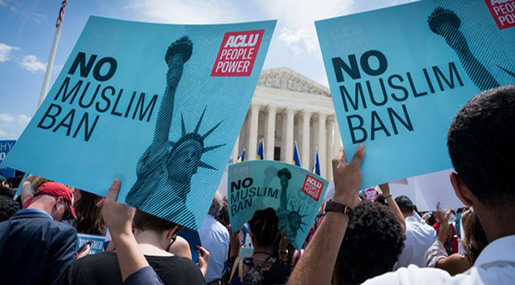
The United States Supreme Court has upheld President Donald Trump's controversial order blocking entry by people from several Muslim-majority countries, a decision described as "disappointing" and "worrying" by advocacy groups.
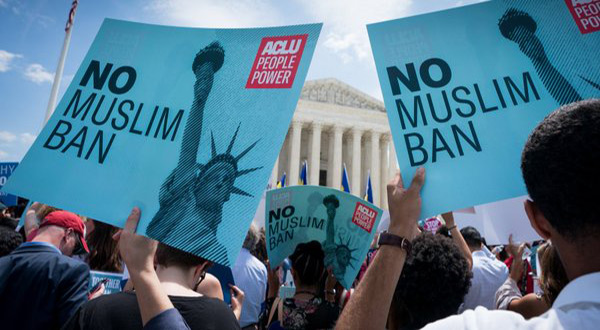
In a 5-4 decision on Tuesday, the high court found that Trump's action was "squarely within the scope of presidential authority" under US immigration law and rejected a challenge that it discriminated against Muslims or exceeded his authority.
The current ban, announced in September and widely criticized by human rights and refugee advocacy groups, prohibits entry into the US by most people from Iran , Libya, Somalia, Syria and Yemen.
It also affects two non-Muslim majority countries, blocking travelers from North Korea and some Venezuelan government officials and their families.
A sixth majority Muslim country, Chad, was removed from the list in April after improving "its identity-management and information sharing practices," Trump said in a proclamation.
Chief Justice John Roberts wrote the majority opinion, joined by his four conservative colleagues.
He rejected the challengers' claim of anti-Muslim bias, but was careful not to endorse either Trump's provocative statements about immigration in general and Muslims in particular.
"We express no view on the soundness of the policy," Roberts wrote.
Following the Supreme Court's announcement, Trump hailed the decision as "a moment of profound vindication" following "months of hysterical commentary from the media and Democratic politicians who refuse to do what it takes to secure our border and our country".
Lower courts had previously blocked the travel ban, the third version of a policy Trump first pursued a week after taking office in January 2017. But on December 4, the high court allowed it to go fully into effect while the legal challenge continued.
The Supreme Court on Tuesday held that the challengers had failed to show that the ban violates either US immigration law or the Constitution's First Amendment prohibition on the government favoring one religion over another.
The White House maintains the ban targets individuals from countries that have failed to provide enough information to allow for proper vetting of prospective travelers. Trump also says it is needed on matters of national security.
Source: News Agencies, Edited by website team
Comments
- Related News

US Military Faces Strain as Iran War Continues
one month ago