Fire on US Warship Hinders Navy’s Pacific Fleet for Years to Come
By Staff, Agencies
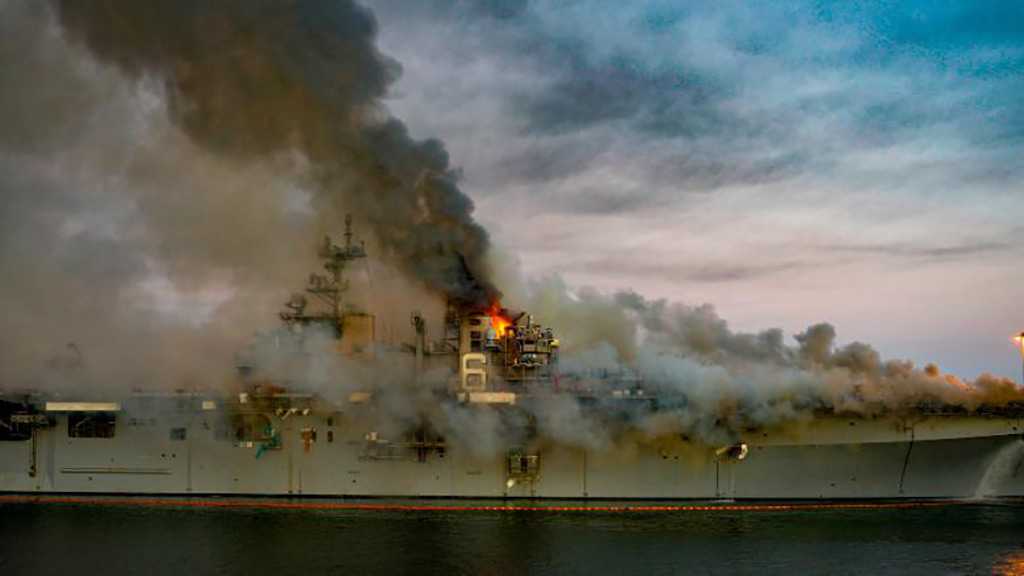
A massive blaze aboard a billion-dollar US Navy warship has been extinguished after raging for four days – but its effect might be felt across America's Pacific Fleet for years.
Navy officials said the fire aboard the USS Bonhomme Richard, an amphibious assault ship undergoing maintenance and upgrades at a port in San Diego, was put out last Thursday. Reaching temperatures up to 1,200 degrees Fahrenheit [about 650 degrees Celsius], it melted aluminum and incinerated wiring, plastics and combustibles like drywall, bedding and office supplies, while filling the 850-foot [260-meter] vessel with thick smoke.
The true extent of the damage, however, remains unknown. Engineers will need to get into the ship to assess the destruction once the spaces inside cool down, officials said.
The Navy's top officer, Adm. Mike Gilday, said Friday there would be a thorough investigation of the fire's cause.
"We will fully investigate what happened here so that we learn all that we can from this terrible tragedy," said Gilday, the chief of naval operations.
"It is too early to make any predictions or promises of what the future of the ship will be," said Rear Adm. Philip Sobeck, commander of the Navy's Expeditionary Strike Group Three. "Whether or not it will be repaired will be determined."
Either way, the long-term impacts are significant. The Bonhomme Richard, which resembles a baby aircraft carrier, was being upgraded to accommodate some of the newest and most sophisticated warplanes in the US arsenal, Marine Corps F-35Bs.
It was to be one of only four ships in the US fleet with the ability to handle the F-35Bs – meaning its absence will be felt.
"As tensions mount with China in the South China Sea, as well as with North Korea, the loss of this ship and her capabilities will make it more difficult for the Navy to meet all its war-fighting requirements," said John Kirby, a CNN military analyst and former US Navy admiral.
Timothy Heath, senior international military researcher at the Rand Corp., said deploying F-35s continuously in the Indo-Pacific region would have served as a visible reminder of the US military's technological edge over rivals such as China.
"The advanced capabilities of the F-35 outclass those of any Chinese fighter, providing an edge in air-to-air combat," he said. "The US Navy's effort to operate expeditionary task forces with F-35s on a continuous basis in the Indo-Pacific will be dealt a serious blow."
For now, the USS America – a newer version of the amphibious assault ship capable of deploying F-35s – is filling in for the Bonhomme Richard, operating out of the US Navy base in Sasebo, Japan.
And naval commanders pointed out that the USS Tripoli, the Navy's newest amphibious assault ship, was commissioned Wednesday, joining the fleet as the 22-year-old Bonhomme Richard burned.
But the absence of any ship can take a toll.
"There are always follow-on effects when a ship is unexpectedly removed from service," said Carl Schuster, a former director of operations at the US Pacific Command's Joint Intelligence Center.
"The Bonhomme Richard was supposed to return to the fleet this fall, freeing up another to receive needed maintenance and upgrade. Now, that is not going to happen. So, another ship's maintenance and upgrade needs will be delayed and a capability gap opened."
This is likely to cause a snowball effect, Heath said.
"The US military will have to cut back on the missions it takes on, or it will need to stress the remaining crews to meet its obligations. Both carry risks," he said.
"Cutting back on operations by US expeditionary task forces may leave gaps in the US Navy's operational presence, which could embolden countries like China to step up coercive measures.
"However, stressing crews by cutting back on maintenance, rest etc. raises the risk of further mishaps and disasters. Both could further injure US credibility in the region."
Although the Navy has not yet been able to determine the cause of the blaze on the Bonhomme Richard, losing a major war-fighting platform to a pier-side fire raises questions about whether procedures were properly followed.
Comments
US Military Faces Strain as Iran War Continues
one month ago