Secretive Dimona Nuke Facility Undergoes Major Project
By Staff, Agencies
A secretive nuclear facility at the center of the “Israeli” entity’s undeclared atomic weapons program is undergoing what appears to be its biggest construction project in decades, satellite photos analyzed by The Associated Press show.
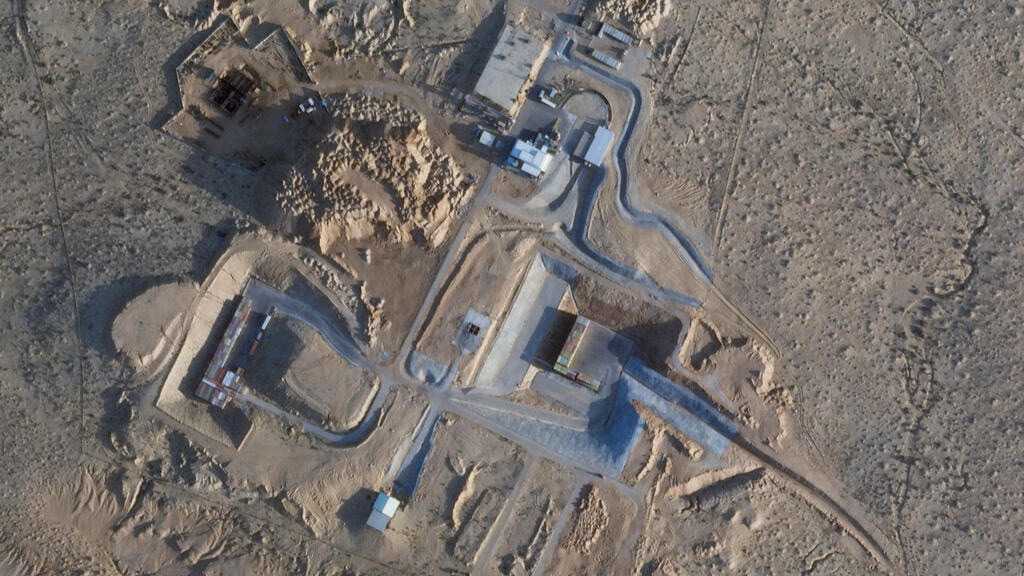
A dig about the size of a soccer field and likely several stories deep now sits just meters [yards] from the aging reactor at the Shimon Peres Negev Nuclear Research Center near the city of Dimona, satellite photos show.
The facility is already home to decades-old underground laboratories that reprocess the reactor's spent rods to obtain weapons-grade plutonium for the entity’s nuclear bomb program.
What the construction is for, however, remains unclear.
Under its policy of nuclear ambiguity, the entity neither confirms nor denies having atomic weapons. It is among just four countries that have never joined the Non-Proliferation Treaty, a landmark international accord meant to stop the spread of nuclear arms.
The construction comes as the entity — under “Israeli” Prime Minister Benjamin Netanyahu — maintains its scathing criticism of Iran's nuclear program, which remains under the watch of United Nations inspectors unlike its own. That has renewed calls among experts for the entity to publicly declare details of its program.
"What the ‘Israeli’ government is doing at this secret nuclear weapons plant is something for the 'Israeli' government to come clean about," said Daryl G. Kimball, executive director of the Washington-based Arms Control Association.
With French assistance, the “Israeli” entity began secretly building the nuclear site in the late 1950s in an empty desert near Dimona, a city some 90 kilometers [55 miles] south of al-Quds [Jerusalem]. It hid the military purpose of the site for years from America, now the entity’s chief ally, even referring to it as a textile factory.
Given the secrecy surrounding its program, it remains unclear how many weapons it possesses. Analysts estimate the entity has material for at least 80 bombs. Those weapons likely could be delivered by land-based ballistic missiles, fighter jets or submarines.
For decades, the Dimona facility's layout has remained the same. However, last week, the International Panel on Fissile Materials at Princeton University noted it had seen "significant new construction" at the site via commercially available satellite photos, though few details could be made out.
Satellite images captured Monday by Planet Labs Inc. after a request from the AP provide the clearest view yet of the activity. Just southwest of the reactor, workers have dug a hole some 150 meters [165 yards] long and 60 meters [65 yards] wide. Tailings from the dig can be seen next to the site. A trench some 330 meters [360 yards] runs near the dig.
Some 2 kilometers [1.25 miles] west of the reactor, boxes are stacked in two rectangular holes that appear to have concrete bases. Tailings from the dig can be seen nearby. Similar concrete pads are often used to entomb nuclear waste.
Other images from Planet Labs suggest the dig near the reactor began in early 2019 and has progressed slowly since then.
Analysts who spoke to the AP offered several suggestions about what could be happening there.
The center's heavy-water reactor has been operational since the 1960s, far longer than most reactors of the same era. That raises both effectiveness and safety questions. In 2004, soldiers even began handing out iodine pills in Dimona in case of a radioactive leak from the facility. Iodine helps block the body from absorbing radiation.
Those safety concerns could see authorities decommission or otherwise retrofit the reactor, analysts say.
"I believe that the ‘Israeli’ government is concerned to preserve and maintain the nation's current nuclear capabilities," said Avner Cohen, a professor of nonproliferation studies at the Middlebury Institute of International Studies at Monterey, who has written extensively on Dimona.
"If indeed the Dimona reactor is getting closer to decommissioned, as I believe it is, one would expect ‘Israel’ to make sure that certain functions of the reactor, which are still indispensable, will be fully replaced."
Kimball, of the Arms Control Association, suggested the “Israeli” entity may want to produce more tritium, a relatively faster-decaying radioactive byproduct used to boost the explosive yield of some nuclear warheads. It also could want fresh plutonium "to replace or extend the life of warheads already in the ‘Israeli’ nuclear arsenal," he added.
The entity built its nuclear weapons as it faced several wars with its Arab neighbors since its founding in 1948. An atomic weapons program, even undeclared, provided it an edge to deter enemies.
Comments