Divide Between Religious and Secular “Israelis” Heats Up Under Netanyahu’s Rule
By Staff, Agencies
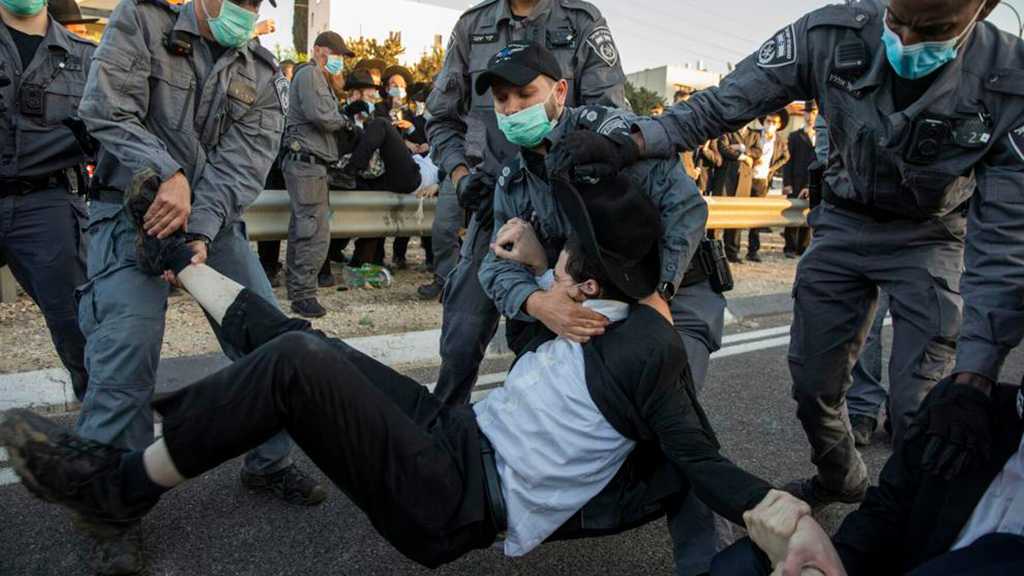
The “Israeli” entity is in a flashpoint amidst rising internal tensions between secular and religious “Israeli” settlers.
On May 20, at least a dozen religious “Israeli” settlers appeared and blocked the entrance of an indoor playground, accusing of desecrating the Jewish sabbath by opening for business. They were confronted by the children’s parents, scuffles broke out and, in an instant, the center had become a flashpoint symbol of a larger battle between secular and religious “Israelis” in the apartheid entity.
Thanks to its supercharged political clout, the haredi community has gained massive budgets that critics say will entrench its isolated way of life and weaken the entity’s economic prospects as the ultra-Orthodox population balloons.
“We have two kids. They have 10 kids. They’re going to be the majority here, eventually,” said Brayer Sharabi, a secular “Israeli” whose elbow was broken in the scuffle. “What’s going to happen to this place once they have the majority?”
The entity’s ultra-Orthodox, known as haredim, make up 13% of the entity’s 9.7 million population. The cloistered community has long been at odds with the secular majority, clashing over military conscription, their integration into the workforce and the basic tenets that guide their lives. Haredi Jews in the entity also are growing faster than any other group, at about 4% annually.
The many differences between religious and secular “Israelis” have chafed the entity. Under Prime Minister Benjamin Netanyahu’s government, the sense has sharpened among secular “Israelis” that their lifestyle may have an expiration date.
Netanyahu, meanwhile, brushes off such criticism, saying the ultra-Orthodox deserve funding and that he is working to integrate them into the workforce.
The ultra-Orthodox mostly live in separate towns and city neighborhoods, and unlike most secular “Israelis”, most are not conscripted in the military under a decades-old system of exemptions that allows them to study religious texts instead. Many continue religious study well into adulthood and do not work, living off government stipends and grating on the nerves of the entity’s tax-paying middle class.
Ultra-Orthodox schools widely do not teach a core curriculum of math or English. Experts say this gives them few skills to enter the work world, creating a recipe for poverty and increased dependence on government assistance as the population grows.
The ultra-Orthodox say their children nonetheless deserve robust funding for education, and that their otherwise insular communities protect a centuries-old way of life. Their leaders also say they contribute to the economy by paying significant sums of sales tax on consumer purchases for their large families.
Yinon Azulai, a lawmaker with the ultra-Orthodox Shas party, last month in a parliament speech denounced what he called “the wild incitement raging these days and running in the streets of baseless hatred for the ultra-Orthodox community” after a popular TV host called the community “blood suckers.”
Dan Ben-David, an economist who has long criticized what he says is preferential treatment for the ultra-Orthodox, said the generous subsidies and political power provide a glimpse of the entity’s future.
“Not a day goes by where we’re not inundated with a clear picture of what’s life going to be like” under an ultra-Orthodox majority, said Ben-David, president of Tel Aviv University’s Shoresh Institution for Socioeconomic Research. “The level of tension is much higher.”
The tens of millions of dollars in financial handouts passed in the recent budget last month have enraged secular “Israelis”.
Weekly protests against the legal overhaul have sometimes adopted anti-religious themes, especially ahead of a court-ordered July 31 deadline for Netanyahu to submit a new law to address the issue of ultra-Orthodox enlistment. It is not clear whether a proposed bill would pass legal muster. It does not seek to draft more ultra-Orthodox men into the military, but instead would cajole them into joining the workforce earlier.
Gilad Malach, director of the ultra-Orthodox in “Israel” Program at the “Israel” Democracy Institute, a think tank, said that the large budget was part of a broader trend showing the community is not integrating with the entity’s larger society.
“The last few years we have more and more signs that this process is not strong enough,” he said. “People ask themselves, what is the direction that [the] ‘Israeli’ ‘state’ goes?”
Comments