The Brave Martyr: The Last Statement of Mohammad Afif
Translated by Al-Ahed News, Al-Akhbar Newspaper
Exactly one year ago, on 11/11/2024, the sorrow felt by the Resistance fighters, the Resistance communities and their people across the region was striking—unlike any other day, especially since the beginning of the Zionist genocide. It was the first “Martyr’s Day” to pass without the appearance of the nation’s greatest martyr, Sayyed Hassan Nasrallah, who would usually address the nation and the world, console the families of the martyrs, and reinforce the spirits of the fighters on the battlefield. This year, the occasion arrived at the height of wars of aggression, extermination, and martyrdom.
Even though Martyr’s Day is a pivotal moment in the political and cultural memory of the Resistance communities—an event through which collective awareness is rebuilt amid ongoing events, and a symbolic, mobilizing occasion in which the collective narrative of resistance, martyrdom and the role of martyrs in the historical struggle is reproduced—this Martyr’s Day was unlike any other. It carried exceptional meanings and implications. Martyrdom was present in every moment and in every place.
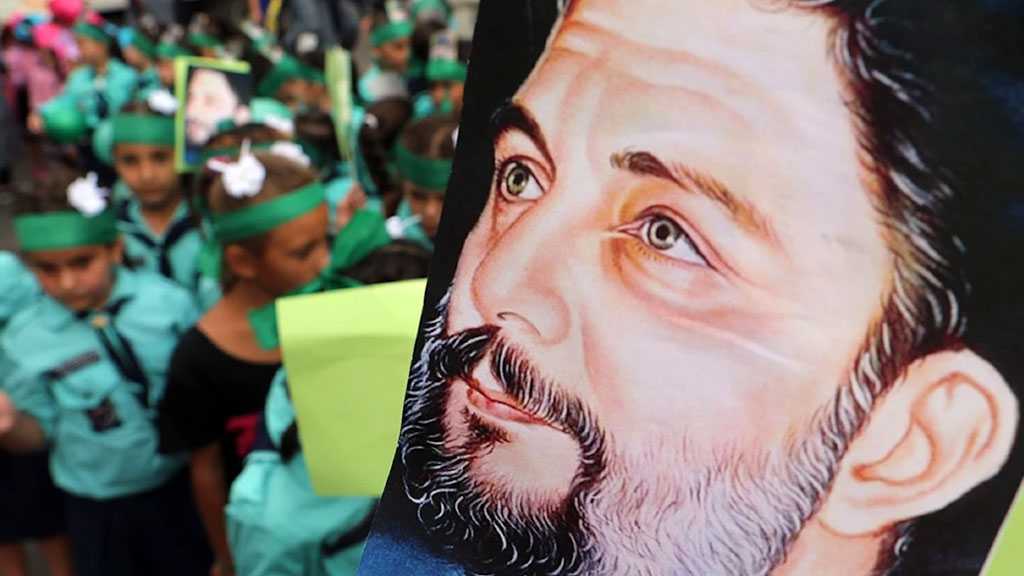
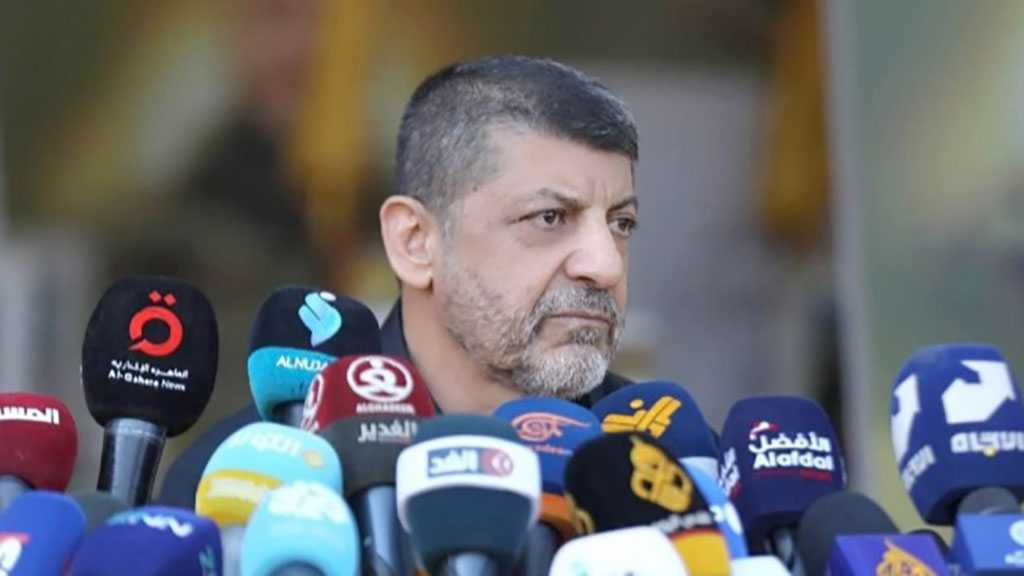
On this day, from the Sayyed Al-Shuhada Complex, martyr Mohammad Afif Al-Nabulsi appeared before us. We had grown accustomed to his constant appearances from the heart of the southern suburbs, from among its ruins, as the strong and courageous voice of the resistance. But the task he carried this time was heavier than any human could bear. He had to appear not only as a Resistance leader and media spokesperson, but as an exceptional leader upon whom, under extraordinarily sensitive circumstances, major responsibilities fell—responsibilities that went far beyond the traditional rhetorical role of a media commander.
He was required to deliver an exceptional performance—one that also served as a complex communicative and political act combining symbolic representation of the resistance, institutional expression of the party’s commitment to the continuity of the resistance project, and acting as the link between the popular base and the leadership at an extraordinary and difficult moment.
He had to transcend even the traditional role and political-cultural function of Martyr’s Day. He was not only required to affirm the Resistance’s commitment to the commemoration, and to pledge to the martyrs and their families that the path and principles for which they sacrificed would continue—but also, at that very moment, to be the voice of the resistance, the bond between it and its supporters, and even between it and the peoples of the region and the world.
The most important—and the most difficult—thing required of him that day was to remember the Master of the Martyrs of the nation, who had passed away just days earlier. His absence was itself an overwhelming presence that gave the occasion, this time once again, a different and additional meaning unlike any other year. He had to maintain his composure and firmness [his voice sometimes choked as he struggled to hold back his tears for the beloved, the father, the companion and the leader].
On that very day, it seemed as though the entire life of martyr Al-Nabulsi—full of resistance, heroism and sacrifice since his participation in the founding of the party in 1982, and his later work alongside the noblest fighters and leaders of the nation—had prepared him specifically for that day and that conference. Even if he had done nothing else in his life but what he did that day, and said nothing else but what he said that day, it would have been enough for his name to enter the history of the region and the resistance “as a great media commander and a magnificent martyr on the path liberating Al-Quds,” as the Islamic Resistance described him. And his performance that day alone would have been enough to place him in the hearts of every honorable and free person in the region and the world.
On that very day, it seemed as though the long path martyr al-Nabulsi had accumulated since joining the resistance at an early stage, and through his continuous work in the field of resistance media, revealed that his life story was not simply the product of professional experience. Rather, it expressed a deep, resistant and radical intellectual and political development that enabled him to fulfill the role assigned to him in that pivotal moment. In this way, he succeeded in elevating the function of media from mere description and reporting to the level of direct political and activist action, making the discourse itself a clear form of resistance.
The performance of martyr Hajj Mohammad was astonishing—to the point that it truly seemed that all the honorable years and days of his life had prepared him solely for that day. And not only because he alone became a vast and highly effective front in the war, standing against an enormous propaganda and media apparatus supported by the enemy and its allies inside and outside, but also because Martyr’s Day itself has a unique and personal connection to him. He was the one who coined the expression “the conqueror of the era of martyrdom-seekers” to describe the Prince of Martyrs, Ahmad Qassir, whose operation on November 11, 1982, is commemorated annually on this date.
For this reason, it was deeply symbolic—of immense significance, and something the enemy never considered when committing its crime—that the 2024 Martyr’s Day conference, and the statement recited by Hajj Mohammad that day, would be his final conference and his final statement as a martyr. Can any human being depart this world in a more fitting way?
The final conference [11/11/2024] was the martyr’s third appearance, and the fourth statement since the martyrdom of Sayyed Nasrallah. In his first appearance, on October 11, 2024, the martyr chose to appear from amidst the rubble in the southern suburbs, as if intentionally seeking to reconstruct the relationship between the devastated place and the discourse of steadfastness and resistance—turning the media appearance into an act of resistance in itself. It was a brilliant use of place as a semantic element reinforcing the narrative of steadfastness that has underpinned the resistance and its rhetoric from the beginning.
Beyond that, this appearance was also an exceptional lesson in media, as it was a lesson in resistance and courage. In it, the martyr revealed his precise and detailed monitoring of “Israeli”, international, and local media, and he demonstrated a spirit of challenge and astonishing bravery—qualities he knew were exactly what the resistance’s audience and supporters most needed at that moment.
But what set this appearance apart the most—and gave it a different meaning—was the public appearance itself, at a time when the enemy was fiercely targeting everything related to the resistance and its environment. The appearance, by itself, was a statement, a stance by the resistance and by the martyr, a declaration of defiance toward the entity—one that required immense courage and great readiness for sacrifice. While the details of the appearance offered a media lesson, its very form was a lesson in courage.
Across all three appearances, the martyr emerged as an exceptional media figure and resistance fighter—but he was also an outstanding revolutionary intellectual. Each time, he seemed as though he had truly been preparing and readying himself for this role for years, or as if fate had chosen him for it from the beginning. Hajj Mohammad did not settle for coining the concept of “the conqueror of the era of martyrdom-seekers” to describe a new phase and new historical actors with the rise of the resistance in 1982—though that alone would have been enough.
Rather, it seemed he wanted every appearance to be impactful and effective in its own right—to be an act equal in scale and spirit to the resistance he was entrusted to represent, and equal to the fighters on the battlefield whose voice he had become. Can any human live in a more meaningful way?
Thus, every press conference was filled with expressions, descriptions, quotations, and historical references indicating that the commander of the Resistance’s media front not only understood the power of the word—which, at the height of the war, was indeed stronger and more effective than bullets—but also knew better than anyone else when, how and where to use it.
Thus, he reminded all of us, from amid the destruction, that “the resistance is a nation, and a nation does not die.” This approach to the concept of “nation” and the concept of “resistance” revealed a profound awareness that goes beyond organizational boundaries. According to this vision, resistance becomes a civilizational, cultural, political and activist belonging and choice—an enduring identity—rather than merely a political or party-based structure.
In this way, the martyr, a son of Hezbollah, using this framework at the right moment, was able to reshape the relationship between the public and the supportive communities on one side, and the resistance project on the other, moving it beyond narrow affiliations. This reinforced the discourse of the “resistance nation” as an expression of a unifying identity. Thus, the concept of “the nation of Hezbollah” became deeply rooted in public discourse and consciousness—where Hezbollah appeared larger than a resistance party or a network of resistance formations, and instead came to resemble a complete nation, with its civilizational, historical, cultural, and activist weight—one that no war could defeat or erase.
Likewise, the martyr reminded us that “our culture is Karbala-based, and our spirit is the spirit of martyrdom.” But he also reminded everyone that “this battle is not Karbala; rather, it is the Battle of Khaybar”—it is “the battle of uprooting the door at Khaybar.” That the martyr could invoke our history and culture and employ them with such brilliance—as a reservoir of meaning that our people desperately needed at the height of combat—required far more than the role or function of a media figure, or even a spokesman for the resistance.
About Courage
“Without courage, man has no value,” says the brave martyr Patrice Lumumba in one of his texts addressed to his people. These words of Lumumba carry special meaning, great value, and profound truth, because the one who uttered them was truly courageous—to the point of death. He paid with his life for his stances, his resistance, and his courage, which he never abandoned until his final moments. Lumumba’s words have real weight because they were, in a sense, written with his blood.
What is striking is that everyone who mourned Africa’s greatest martyr, and grieved for him, focused—more than anything else—on the extraordinary courage of this exceptional revolutionary: from Frantz Fanon to Fidel Castro, from Aimé Césaire to Malcolm X, and from Gamal Abdel Nasser to Amílcar Cabral.
They all understood that what is exceptional in heroes and leaders is not presumed knowledge, nor the ability to assess and diagnose, nor even the understanding of what a leader, a fighter, or a revolutionary must do. Rather, it is the courage required for action—especially the courage demanded by the most difficult moments, when the fighter or the revolutionary knows that the price will be their life.
Thus, too, was martyr Mohammad Afif. And although everyone who followed him immediately recognized the clear exceptional qualities he possessed—knowledge, culture, performance, role, and professionalism—and although he appeared to all as if he had truly been prepared and shaped for this role and for these specific circumstances, it was his astonishing courage, his extraordinary boldness, and his great spirit of defiance that most captured the attention of the public as he spoke on behalf of the resistance.
Martyr Al-Nabulsi knew that anyone can repeat Imam Ali’s [AS] words: “By God, if I were to face them alone, even if they filled the earth, I would not waver nor feel fear.” But he also knew that true courage and true heroism lie in living these words, in acting upon them—not merely repeating them.
And he said them and lived them. For him, courage was not a rhetorical value—it was practice and action, just as true revolutionary knowledge is. This was shown in his words at the height of the aggression and threats to assassinate him: “The bombing did not frighten us, so how will the threats frighten us?” This statement in particular, in those very circumstances, captures an exceptional model of leadership that fuses awareness with decision, where courage in action appears more clearly than anything else.
At that moment, he was a leader whose mere public appearance approached, in courage, the act of martyrdom itself. For this reason, he was not “Karbala-like” only in words when he invoked Karbala; he was Karbala-like in spirit and in deed. In every appearance, his courage reminded us of what we truly need in these circumstances—not only courage as an individual value, but courage as an institutionally produced value as well.
Conclusion: Listen to him twice
Thirty-six years after the martyrdom of Víctor Jara, on December 3, 2009, and after the return of the party he had spoken for—resurrected through his martyrdom—to power once again, the party leader and heir of Salvador Allende, then-President Michelle Bachelet, led tens of thousands in his long-delayed funeral procession, after his remains were finally identified.
More than three decades after his martyrdom, Victor Jara’s poems were sung again by the people, the poor, the workers, and the students in Chile, Latin America, and across the world. But they all knew that Jara’s greatest poem went beyond the language and words they read and heard. His most beautiful and eternal poem was in his life—how he lived it—and in his martyrdom with such extraordinary courage. They knew he was profoundly right when he said that “a song sung with courage remains forever new.”
And in Lebanon, the experience of martyr Mohammad Afif Al-Nabulsi revealed not only a new model of resistance fighters and media leaders who do more than report and describe; it revealed a model of media leaders and resistance fighters who become producers of awareness, will, and resistance.
His remarkable experience showed a model that transcends individual capabilities and is organically tied to the institutional structure of serious resistance and its mission and historical role. The media official of the resistance could not simply be another exceptional media figure—and thus martyr Mohammad Afif was not merely another exceptional media figure. He had to lead a major and essential front in a major war, and compensate—with extraordinary courage up to the point of martyrdom—for the enormous imbalance in capabilities when facing an enemy with imperial-level infrastructure and resources.
On November 17, six days after Martyr’s Day, Hajj Mohammad Afif al-Nabulsi was martyred. But the war was still ongoing, and the resistance will continue until the liberation of Lebanon, Palestine, and the region. Until that day—and long after it—resistance fighters and their communities will always remember Mohammad Afif.
They will remember his courage, remember his statements and repeat his words. But everyone will understand that his greatest statement was the one beyond language—the statement found in his life, in how he lived it as a brave, heroic resistor, and in how he embraced martyrdom with extraordinary courage.
Therefore, listen to martyr Mohammad Afif Al-Nabulsi—listen to him twice: once to know what resistance and heroism are, and once again to know what courage is.