Thanksgiving: America’s Favorite Cover Story
By Mohamad Hammoud
A holiday built on amnesia, genocide and the exact blueprint that flattened Gaza
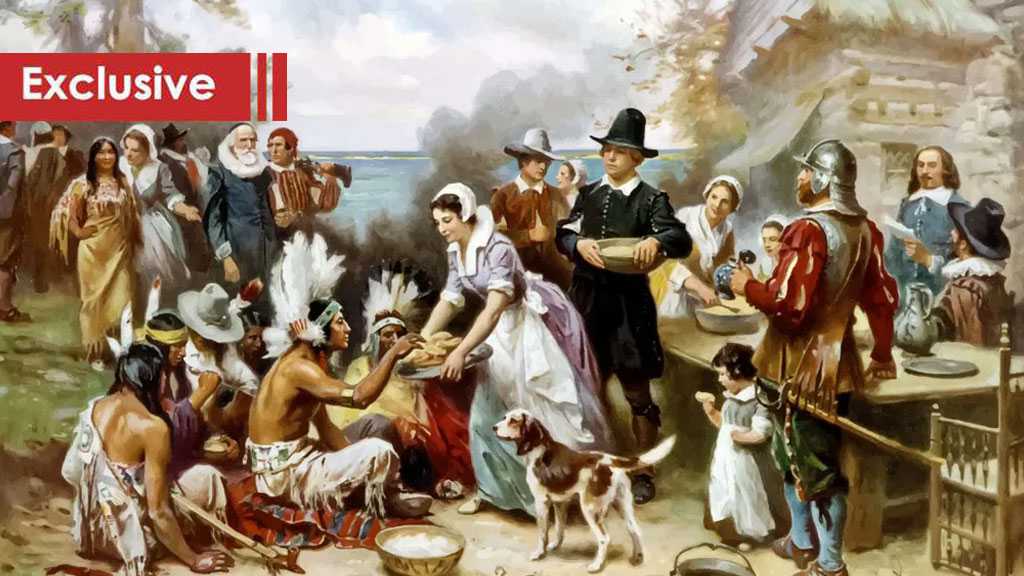
Every November, Americans fill their tables with turkey, stuffing, cranberry sauce and pumpkin pie, retelling the story of Pilgrims and Indigenous people sharing a peaceful feast. The narrative comforts, presenting a sanitized vision of national origin. But for many Native Americans — descendants of the Wampanoag and other tribes — Thanksgiving recalls a darker legacy: loss of land, lives and culture. The supposed harmony was fleeting: the same Pilgrims were already raiding Wampanoag granaries, and within fifty years they would sell Wampanoag children into Caribbean slavery. The feast was not a beginning — it was a bait-and-switch.
The Plague Before the Prayer
Before the Mayflower dropped anchor, European fishing crews had seeded the coast with smallpox. A viral tsunami between 1616 and 1619 wiped out as many as 96 percent of coastal New Englanders, according to 2023 genomic research led by the University of Oklahoma. When the Pilgrims stepped ashore, they found empty longhouses and planted fields already cleared—an all-you-can-steal buffet delivered by germ warfare. Bradford called the emptiness “a special providence of God,” a phrase that would echo centuries later when “Israel” described the depopulation of Palestinian villages in 1948 as a “miracle.” Same logic: someone else’s catastrophe rebranded as destiny.
Hospitality Repaid with Massacre
The Wampanoag did not merely tolerate the Pilgrims; they fed them. Edward Winslow’s 1621 letter, archived at Pilgrim Hall Museum, records Massasoit’s men delivering five deer when English stores were empty. Hospitality was repaid with land grabs: English courts soon convicted Wampanoag leaders of “trespassing” on ancestral land and auctioned it to settlers.
The pattern crossed the Atlantic. In 1909, Palestinian farmers in the Al-Jalil welcomed Zionist pioneers fleeing European pogroms, sharing wells and harvest festivals. British census data from 1922 shows Muslim, Christian, and Jewish neighbors pooling their money to build a joint flour mill. The thanks for that hospitality arrived on April 9, 1948, when Zionist militias stormed Deir Yassin, slaughtering at least 107 civilians and parading survivors through Jerusalem’s streets, according to a Red Cross field report. The massacre loud-speakered the flight of 750,000 Palestinians—the Nakba’s mirror image of King Philip’s War. In both cases, the welcome mat became a death shroud.
Same President, Same Season: Thanksgiving amid the Gallows
While Lincoln proclaimed the first national Thanksgiving in October 1863, he had already approved the largest mass execution in US history the previous December: the hanging of 38 Dakota men in Mankato, Minnesota, after a rushed military trial. The proclamation urged the nation to give thanks for “the advancing armies,” yet 1863 also saw Dakota women and children marched to a concentration camp at Fort Snelling, where hundreds froze or starved. Thanksgiving, then, was decreed while the smell of fresh rope still hung over the Plains—America’s habit of celebrating bounty over bodies written into the calendar itself.
The Day of Mourning No Camera Sees
Since 1970, Indigenous activists have gathered on Cole’s Hill overlooking Plymouth Rock for a National Day of Mourning. Ignored by major networks, the ceremony begins at noon with a funeral drum and the speech Wampanoag elder Wamsutta James was banned from delivering for mentioning “massacre” and “broken promises.” Last year, co-leader Mahtowin Munro linked the struggle to Gaza, telling the crowd, “From Turtle Island to Palestine, colonization is a crime.” The parallel is stark: 70 percent of Gaza’s population are Nakba refugees or their descendants, according to the UN Relief and Works Agency, confined in an open-air enclosure while the world carves turkey.
The Calories of Amnesia
The average American consumes 3,000 calories at Thanksgiving, a metabolic feat that requires forgetting. Forgetting that the poverty rate for American Indians and Alaska Natives is 21.2 percent, double the national average, the highest of any racial group. Forgetting that 28.5 percent of Native adults reported drug abuse last year, nearly twice the national rate, and that Native youth are five times more likely than white youth to die from alcohol-related causes. Forgetting that 70 to 95 percent of arrests on reservations are alcohol-related, yet barely half of those who need treatment receive it. Forgetting that while we nap on the couch, Palestinian children in Gaza measure the distance to the next drone strike.
Put down the fork and look at the land: native-land.ca shows whose soil you’re really celebrating. Until Americans confront that gilded lie, the feast is not over. It is just another course in a banquet that never ends, where the main dish is always someone else’s land, and the ritual entertainment is the pretense that Americans are guests rather than raiders at the gate.