Sheikh Qassem: Let It Be Clear — We Will Defend Our Country and Never Surrender
Translate by Al-Ahed News, Live Coverage
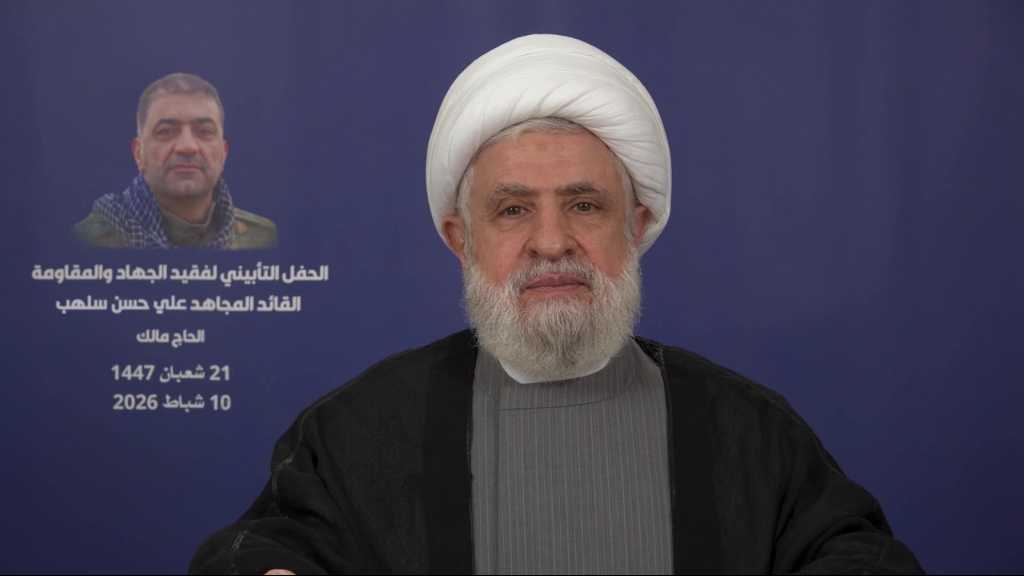
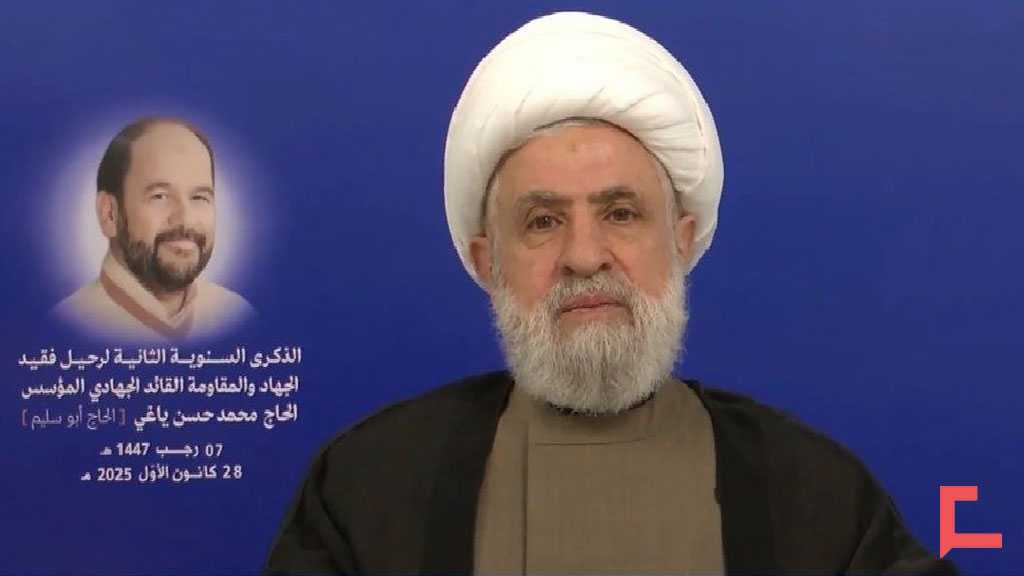
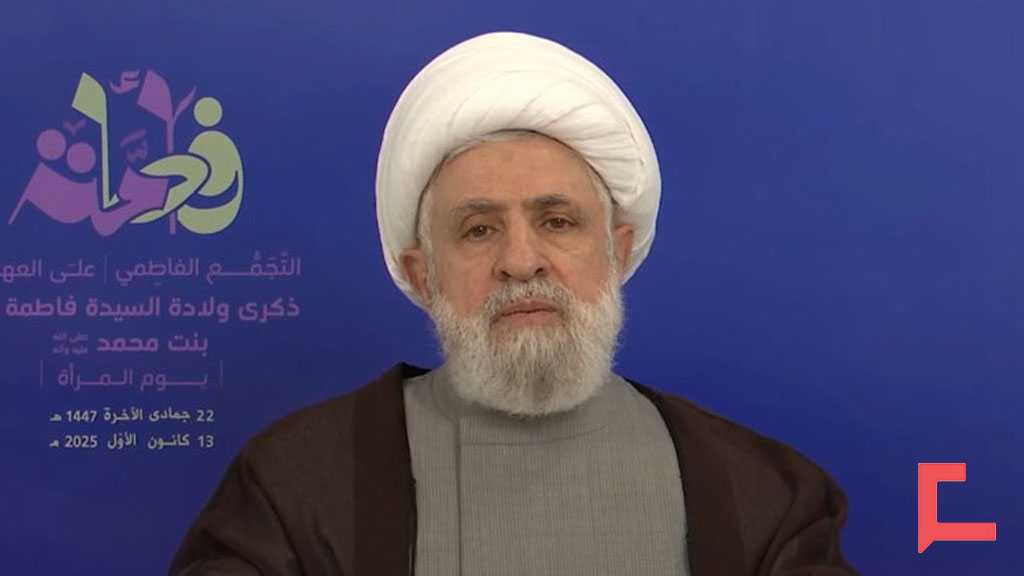
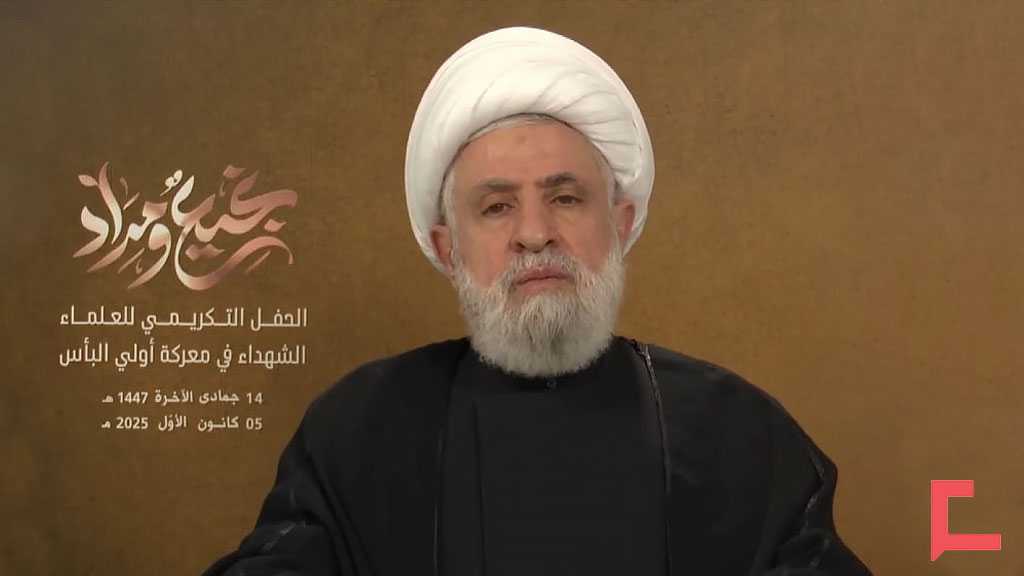
In a commemorative gathering honoring the martyred scholars on the path of liberating Al-Quds, Hezbollah Secretary General His Eminence Sheikh Naim Qassem opened his address with an expression of loyalty and reverence for those being honored.
His Eminence began by affirming the purpose of the event, stating, “We gather in loyalty to the martyred scholars.”
Transitioning to the symbolic significance of the ceremony, the Resistance leader noted that the occasion reflects a broader moral and historical current influencing community life.
As he explained, “This special ceremony is an effort to understand this profound current that has shaped our lives.” The Sheikh emphasized that the honorees exemplified total dedication, remarking that “They strove with their lives, their wealth and everything they possessed, giving all that they had.”
The Hezbollah Chief continued by employing vivid metaphoric language to describe the sacrifices of the fallen scholars, asserting that “Their blood blossomed at the moment of their harvest — they are the tillers of the earth and the rain of the sky.” This imagery served to frame their loss as both a personal tragedy and a generational legacy.
Reaffirming commitment to the broader cause and to the families of the deceased, the Secretary General offered what he described as a pledge of continuity. He stated, “From me to you, a pledge of continuation from the Resistance fighters, a pledge of steadfastness and victory and from the families and all who love them, a pledge of perseverance, loyalty and dignity.”
Furthermore, His Eminence presented the final tally of those honored during the ceremony, underscoring the human toll represented within the scholarly and familial circles. He reported that “The martyred religious scholars numbered 15, the martyred students of religious sciences numbered 41, and the martyrs from the families of the scholars numbered 39.”
Building on his reflections, the Secretary General turned to the historical foundations of the movement’s intellectual and spiritual lineage.
He highlighted the influential roles of two prominent figures, stating, “We must mention the two eminent religious scholars, the martyrs Sayyed Abbas Al-Mousawi and Sheikh Ragheb Harb, as pioneers on this path.” This acknowledgment served to situate the contemporary Resistance within a legacy shaped by earlier leaders whose sacrifices marked critical turning points.
Expanding on the ideological framework underpinning Hezbollah’s worldview, His Eminence underscored the centrality of struggle, declaring, “Jihad is a fundamental pillar of our Islamic framework, within which we are nurtured.” He elaborated on this dual concept by adding, “We are in a dual state of jihad — the jihad of the self and the military jihad.”
The SG emphasized that religious scholars were not merely theoreticians but active participants in this struggle. He explained, “Our religious scholars offered themselves as martyrs, their children as martyrs, standing at the frontlines.”
In his view, this level of personal sacrifice enabled these scholars to shape the ethical and cultural foundations of the community, which he reflected in the statement, “Our religious scholars succeeded in cultivating authenticity, dignity, and a righteous way of life.”
Turning to broader perceptions, the Resistance leader noted that both domestic and international observers had been struck by the organization’s trajectory. He stated, “Many inside and outside Lebanon were surprised by how Hezbollah was able to carve its path.”
He attributed this to a genuine grassroots experience, adding, “They were surprised by the people’s support and embrace of Hezbollah, because there is an honest, faithful, and sincere experience behind it.”
In outlining the core commitments that shaped Hezbollah’s development, the SG remarked, “As Hezbollah, we adhered to the principles of Islam; we committed ourselves to jihad, to noble ethics, and to the common word.”
He linked these principles to a broader vision of civic responsibility and national identity, explaining, “We were raised to love our homeland, and we believed in freedom — the freedom of choice, state-building, and expression.”
His Eminence then emphasized the pedagogical and institutional role of religious scholars, noting, “These are the teachings we have worked upon. They were affirmed by our scholars, who played a major role in promoting and laying the foundations of this path.”
This, Sheikh Qassem argued, positioned Hezbollah to advance a distinctive model within the Lebanese political scene. As he put it, “Hezbollah was able to present this refined and influential model, offering a distinguished national experience that drew attention — and consequently, the arrogant powers of the world now want to eliminate Hezbollah.”
The SG asserted that these external pressures stem from the movement’s commitment to values at odds with the agendas of major international actors. He remarked, “They want to confront the Resistance because it offers a project rooted in patriotism, independence, dignity, and morality — and these forces do not want us to live such a life.”
Highlighting one of the most significant developments in the movement’s political outreach, the Hezbollah Chief referenced the 2006 alignment with a major Christian political force. He explained, “Hezbollah succeeded in building a relationship in 2006 with the most significant Christian current — the Free Patriotic Movement — presenting a model of alliance between Hezbollah and a major influential force in the Christian arena.”
Elsewhere in his address, the SG emphasized that Hezbollah’s trajectory has always been intertwined with broader national dynamics rather than isolated initiatives. He explained, “Hezbollah’s experience has never been isolated; it has always been cooperative, extending its hand, offering a pioneering model — and this has angered the arrogant powers.”
His Eminence then highlighted the importance of education and moral formation in sustaining this model, noting, “The upbringing we provide in our scouts and schools is the model that emerges in terms of integrity, national commitment and cooperation with all.”
Shifting to a recent controversy, the Resistance leader addressed reactions to a statement issued by Hezbollah to the Vatican. He remarked, “Hezbollah issued a statement to the Pope, and suddenly some disturbed parties launched a campaign questioning: ‘Why did you do that?’”
Sheikh Qassem asserted that the backlash stemmed from the sincerity of the message, adding, “They opposed the statement because they saw that it touched the heart and had an impact — so they tried to distort the image, but they will not succeed.”
He then broadened the discussion to the question of political narratives and public perception, asking pointedly, “Who is trying to distort the image of a people rich in their strength, their morale, their patriotism, and their aspiration to stand in a position of dignity — a people whose Resistance has shed blood and sacrificed for the homeland?”
Despite these pressures, the Resistance Leader insisted that the community’s resilience would prevail, affirming, “All these arrows will break, and they will only increase us in determination, strength, and energy, for we are a community that believes in God and was nurtured by righteous scholars.”
Addressing the realities of internal politics, His Eminence acknowledged the inevitability of disagreements, stating, “Naturally, there will be political differences within the country.”
He then outlined the proper framework for managing disputes, explaining, “How do we regulate political disagreement? It should be regulated according to the constitution and the laws, within the framework that internal disagreement aims to improve the conditions of the state.”
To illustrate the movement’s approach, the Hezbollah Chief reiterated a commitment to national cooperation: “We cooperate with everyone to build the state and liberate the land; our record speaks for itself. We do not seek validation from anyone, nor do we grant it to anyone.”
His Eminence was firm in rejecting attempts to monopolize patriotism, asserting, “No one has the authority to hand out certificates of patriotism — especially those who themselves need absolution for their own dark histories, their crimes and the civil war.”
In his view, electoral processes provide the clearest measure of political legitimacy, as he stated, “Parliamentary elections reveal matters as they truly are, and they are decisive.”
Turning to issues of security and regional threats, the SG reiterated a long-standing assessment of the opposing side, saying, “This enemy is expansionist and has not adhered to agreements.”
He warned that recent aggressions were linked to broader geopolitical ambitions: “The enemy’s ongoing aggressions have nothing to do with Hezbollah’s weapons, but with laying the groundwork for the gradual occupation of Lebanon and drawing ‘Greater “Israel”’ through the Lebanese front.”
In defining Lebanon’s negotiating parameters, Sheikh Qassem stressed adherence to established frameworks, asserting, “The limit we must adhere to, in all our dealings as a Lebanese state with the ‘Israeli’ enemy, is the boundary of the agreement.”
He clarified political misconceptions regarding the southern region, stating, “There is no such thing as ‘beyond the Litani South.’ Everything else is an internal Lebanese matter.”
He also dismissed foreign intervention in Lebanon’s internal defense policies, stating, “The United States has nothing to do with the issue of weapons, the defense strategy or internal Lebanese disagreements.”
According to the Resistance Leader, external actors harbor broader aims, which he articulated clearly: “They want to strip us of our weapons, dry up financial resources, block services, shut down schools and hospitals, prevent reconstruction and donations and demolish homes.” He added succinctly, “They want to eliminate our existence.”
The SG questioned the logic behind these pressures, asking, “Do you really expect us to believe that the entire issue is just about disarming us, and that this alone will solve Lebanon’s problems?”
He reaffirmed an uncompromising stance on self-defense, stating, “We will defend ourselves, our people, and our country. We are ready to sacrifice to the utmost, and we will not surrender.” Emphasizing steadfastness, he continued, “Our resolve will only grow stronger and stronger, and we will not surrender.”
Highlighting the human dimension of the movement, he added, “We will stand by our people and our wounded — the very embodiment of sacrifice.” Sheikh Qassem concluded this section with a reaffirmation of loyalty to those who had fallen, declaring, “We will uphold the covenant and the trust of the martyrs, and we will not retreat.”
In addressing political engagement moving forward, His Eminence stated, “We will not give attention to the servants of ‘Israel.’ We will focus on those among our citizens and political forces who want to listen.”
He explained that productive dialogue must occur within a unified national framework, noting, “We will discuss and cooperate within the framework of one country, within a defense strategy we agree upon — this is the only open framework.”
Reinforcing a final principle, the SG emphasized that national defense capabilities are non-negotiable, stating, “No one in the world can prevent defensive capability; this is settled. Let them try other things with the defeated ones.”
Regarding ongoing procedural violations, he explained, “The participation of a civilian delegation in the Mechanism Committee is a violation, because the condition was that the enemy halt its hostile actions.”
In the final portion of his address, the Secretary General turned to recent political developments and the implications of unilateral decisions taken outside the agreed national framework.
His Eminence criticized actions he viewed as concessions without strategic benefit, stating, “You offered a free concession, and it will not change the enemy’s position nor its aggression.” According to him, such initiatives only embolden the opposing side. He elaborated, “The civilian delegation went, met and the pressure and aggression only increased.”
The SG argued that the intent behind these hostile escalations was clear, remarking, “‘Israel’ wants to send the message that it wants you under fire.” He described the decision to send the delegation as part of a pattern of miscalculations, asserting, “This step is an additional failure, added to the failure of August 5.”
Returning to Hezbollah’s position, he stressed that the movement had fulfilled its responsibilities within the limits of the state’s authority and existing agreements. He affirmed, “We in Hezbollah did what we were required to do, enabling the state to assert its sovereignty within the framework of the agreement.”
To counter any sense of political fragmentation, His Eminence emphasized the power of collective national unity. With deliberate clarity, he stated, “Be certain: they can do nothing when we are united.”
Sheikh Qassem issued a cautionary warning regarding internal alignment with external adversaries, concluding, “Aligning with ‘Israel’ is like puncturing the ship — and then everyone sinks.”
Comments