Sheikh Qassem: Soleimani’s Blood Fuels Our Resolve, A Stronger Resistance, A Sovereign Lebanon
By Al-Ahed News, Live Coverage
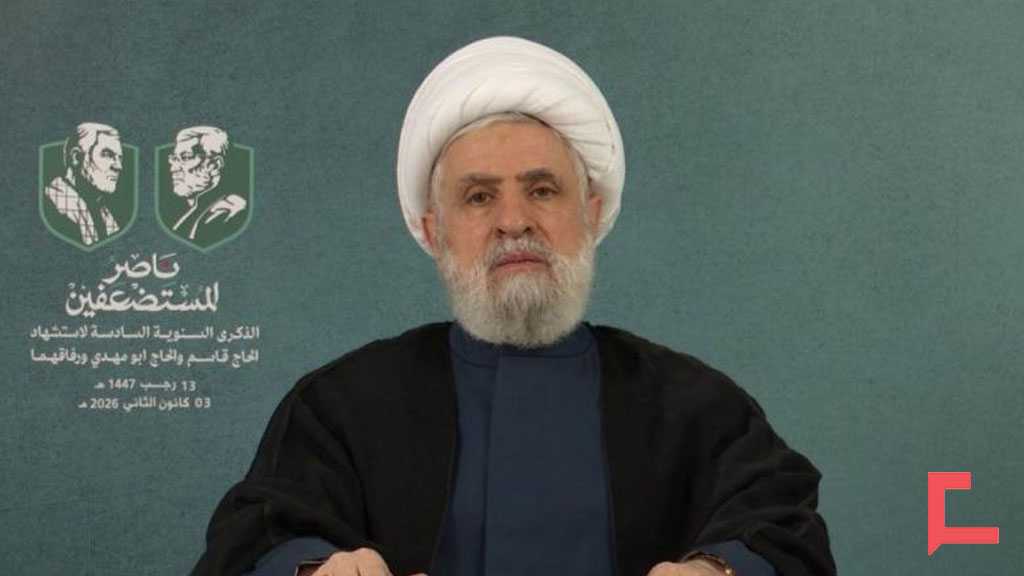
Marking the sixth anniversary of the martyrdom of commanders Hajj Qassem Soleimani and Abu Mahdi al-Muhandis, Hezbollah Secretary General His Eminence Sheikh Naim Qassem delivered a wide-ranging political and ideological address that linked faith, resistance, and sovereignty, while reaffirming steadfast commitment to the Axis of Resistance.
At the outset, His Eminence anchored his speech in Islamic principles, recalling that Imam Ali [PBUH] “embodied asceticism and justice” and firmly dismissed corrupt rulers. In this spirit, he praised God “who blessed us with Ali, the Commander of the Faithful,” presenting Imam Ali as a timeless model of leadership grounded in justice, integrity, and accountability.
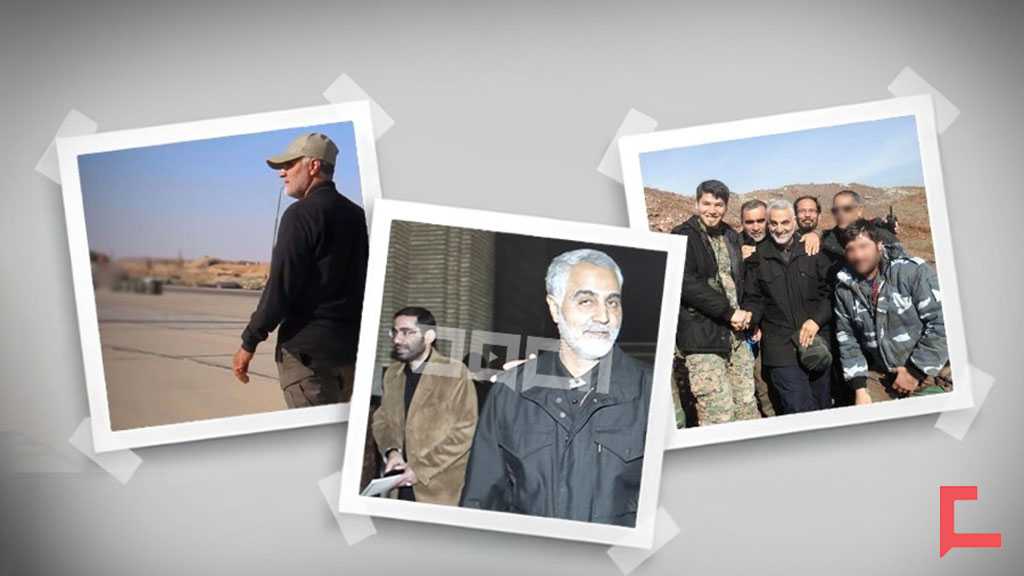
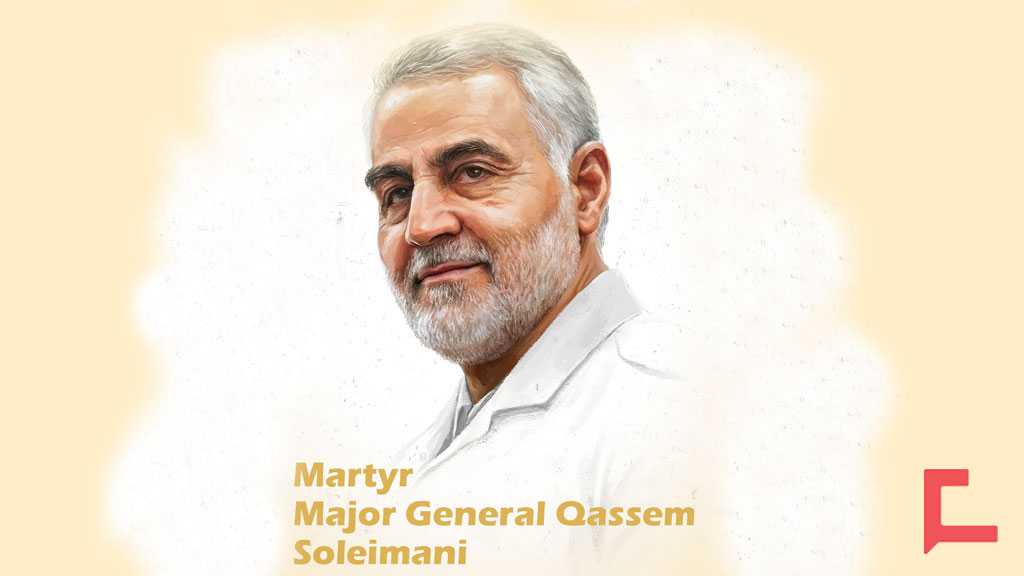
Turning to the life of the martyred commander Hajj Qassem Soleimani, Sheikh Qassem stated that he rose rapidly through various positions due to “his exceptional qualities.” He emphasized that the martyr possessed “remarkable military competence” and was constantly engaged in training and instruction. Recalling his early experience, he noted that Soleimani fought on the fronts of the Sacred Defense during the eight-year confrontation between Iran and Iraq.
According to the Secretary General, the martyred commander had deep military and political awareness, as he “analyzed and reflected on issues in all their dimensions,” making him truly “a man of the field.”
Sheikh Qassem also shared a personal recollection, stating that he had written the book “Khalifat Allah”, presented it to Soleimani, and later met with him to discuss it, highlighting the martyr’s intellectual depth alongside his operational role.
Sheikh Qassem stressed that Soleimani embodied “a model of obedience to God” and represented “an authentic Islamic project that serves the interests of humanity.”
He noted that the martyr was awarded the Order of Zulfiqar, describing it as “the highest military decoration,” in recognition of his exceptional service.
Elaborating on Soleimani’s leadership and character, the Hezbollah Chief stated that his view of the Leader of the Islamic Revolution His Eminence Imam Sayyed Ali Khamenei was one of “love, loyalty, engagement, and obedience,” emphasizing that this relationship with “the wise leadership” was among the key reasons for his success.
He further described the great martyred commander, leader of the Axis of Resistance, as a devoted admirer of Imam Khomeini [may his soul be sanctified].
Sheikh Qassem also highlighted the distinctive relationship between the martyr and the great martyr Sayyed Hassan Nasrallah, describing it as one marked by “a unique brotherhood and mutual longing.” He recalled that one day before his martyrdom, Soleimani came to Lebanon to pay his respects to His Eminence Sayyed Hassan, after which he was assassinated by the United States.
Addressing Soleimani’s official responsibilities, Sheikh Qassem noted that he served as commander of the Quds Force since 1998, with the primary objective of supporting “the Palestinian Resistance and Resistance movements across the region,” while working to thwart US schemes.
He stressed that the establishment of the Quds Force and the appointment of Hajj Qassem at its head demonstrated Iran’s “deep commitment to the Palestinian cause.”
According to His Eminence, Hajj Qassem “gave immensely” and possessed both “the capability and the faith” required for this cause. Alongside the martyr’s role, Sheikh Qassem underscored Iran’s leading and supportive position toward the Resistance, Palestine, justice, and humanity.
Reaffirming central priorities, he emphasized the importance of “the Palestinian Resistance, the Palestinian people, Gaza, the West Bank,” and all the sacrifices made by this people.
He described Lebanon as “a model of sacrifice, dignity, and liberation,” noting that it achieved major accomplishments through its resistance, its people, and its army. He also stressed the need to highlight “the sacrificial and pioneering model of Yemen.”
Reflecting on Soleimani’s martyrdom, Sheikh Qassem stated that while the Axis lost Hajj Qassem from among them, he gained “the Medal of Martyrdom in confronting American tyranny.”
Addressing the martyr directly, he affirmed, “We will continue,” adding that his blood “has given us an additional boost,” and that this momentum continues.
Turning to Iraq, the Secretary General highlighted the major role played by Abu Mahdi al-Muhandis, stating that Iraq succeeded in bringing down the Daesh “ISIS state” project, which he described as “the downfall of an American project.”
In remembrance and loyalty, he also mentioned the martyrs of the blessed Islamic Revolutionary Guard Corps among the commanders martyred in the region, as well as five senior Hamas commanders “who played a fundamental role,” and the martyr al-Tabatabaei, who “gave and sacrificed.”
Sheikh Qassem affirmed with confidence that “our path is strong and ongoing,” expressing certainty that it will, God willing, become “even stronger.”
Shifting to a broader geopolitical reading, he stated that global arrogance planted “Israel” for “expansionist goals,” explaining that this planting was linked to controlling future generations so it becomes “the stick and the hand when they need it.”
He noted that the geographical point chosen in the region is “sensitive,” which is precisely why it was selected.
Reflecting on historical transformation, Sheikh Qassem noted that when the Islamic Revolution triumphed in 1979, “the entire scene was overturned,” and Iran was no longer in America’s embrace.
He credited Imam Khomeini with charting Iran’s path away from Western control, adding that with the advent of the blessed Islamic Revolution, “the renaissance of peoples began through resistance yearning for freedom.”
Addressing Hezbollah’s ties with Tehran, Sheikh Qassem described the relationship with Iran as “a very natural one.” He contrasted this with arrogance, which “imposes its conditions and convictions on those who submit to it.” He posed a direct question regarding Iran’s support for Hezbollah—what has Iran taken in return? —and answered clearly that it “has taken nothing.”
According to him, Iran benefits when the region is stable and built on “sound foundations.”
He criticized foreign and Arab tutelage that interferes in the economy and politics, appoints officials, and intervenes to change convictions for its own gains, stressing that these states intervene “to change the direction,” whereas Iran has “never intervened to change the direction.”
Reaffirming Hezbollah’s core convictions, Sheikh Qassem stated that the movement believes America is “tyrannical and aggresses against us,” that Lebanon must be liberated, and that “Israel” is an aggressor.
He reiterated that Hezbollah has taken from Iran while Iran has taken nothing, stressing pride in a relationship that “has given us and taken nothing from us.”
Within this framework, he emphasized that Resistance, rejecting occupation, and confronting corruption are “a matter of faith and of interest.”
He strongly condemned those who justify “Israel,” declaring “shame—utter shame” on those who do not pressure it to stop its aggression and who fail even to apply media pressure in support of the Palestinian people.
Concluding with Lebanon’s internal priorities, Sheikh Qassem stated that Hezbollah seeks a Lebanon that is “sovereign, free, independent, and capable.”
He called for “a strong army and an independent country,” while stressing dialogue, consensus, and national unity in confronting enemies—“at the very least, confronting the one enemy.”
He identified the immediate priority as stopping the aggression, ensuring “Israeli” occupation withdrawal, returning the detainees, and beginning reconstruction, after which a national strategy can be discussed.
He also called for holding parliamentary elections on time, returning depositors’ funds so they receive their money in full, arming the national army so it can confront enemies, and ensuring justice for public sector employees.