- Home
- ISLAMIC RESISTANCE
- SECRETARY-GENERAL
-
Full Speeches
- Speeches-2000
- Speeches-2006
- Speeches-2007
- Speeches-2008
- Speeches-2009
- Speeches-2010
- Speeches-2011
- Speeches-2012
- Speeches-2013
- Speeches-2014
- Speeches-2015
- Speeches-2016
- Speeches-2017
- Speeches-2018
- Speeches-2019
- Speeches-2020
- Speeches-2021
- Speeches-2022
- Speeches-2023
- Speeches-2024
- Speeches-2025
- Speeches-2026
- Speech-Reports
- SG
-
Full Speeches
- Voices
- Ten Day Dawn
- The Biggest Crime
- Martyr Leaders

Europe Pushes Back on Trump’s Greenland Ambitions, Reaffirms Danish Sovereignty
By Staff, Agencies
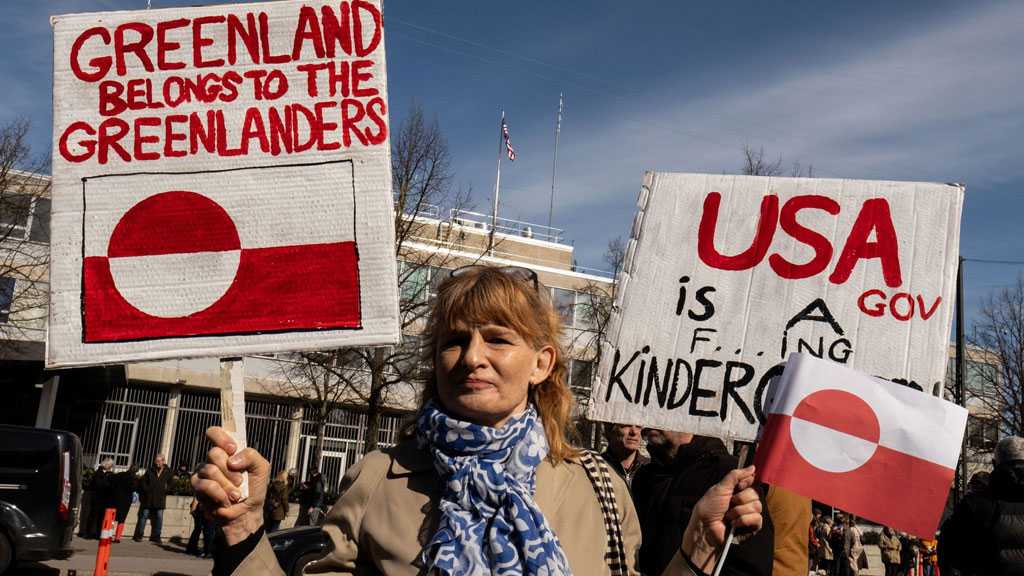
European leaders have issued a joint statement affirming that Greenland is an integral part of Denmark and warning that its future can only be decided by Denmark and the people of Greenland themselves, amid renewed claims by US President Donald Trump over the Arctic territory.
The statement was released Tuesday and signed by Danish Prime Minister Mette Frederiksen alongside French President Emmanuel Macron, German Chancellor Friedrich Merz, British Prime Minister Keir Starmer, and the leaders of Italy, Spain and Poland. It stresses that “Greenland belongs to its people” and that questions related to the territory are exclusively for Denmark and Greenland to determine.
Trump recently revived his long-standing interest in acquiring the autonomous Danish island, arguing that the US needs control of the resource-rich territory because of its strategic location in the Arctic. He has claimed that Denmark is unable to adequately protect Greenland, citing alleged Russian and Chinese naval activity, an assertion Moscow has rejected, insisting it poses no threat in the region.
Frederiksen said Trump should be taken “seriously” when he speaks about Greenland, especially in light of Washington’s recent military actions abroad. The renewed controversy comes shortly after the US attack on Venezuela and the abduction of President Nicolas Maduro, developments that have raised concerns among US allies.
While the European statement stops short of explicitly condemning Washington’s ambitions, it underscores that NATO’s European members consider the Arctic a strategic priority and are increasing their efforts to safeguard regional security and deter adversaries. At the same time, it describes the US as an “essential partner” in maintaining Arctic stability and calls on Washington to respect the principles of the UN Charter, including sovereignty, territorial integrity, and the inviolability of borders.
The carefully worded response mirrors the European Union’s muted reaction to the US operation against Venezuela over the weekend. In that case, the EU’s diplomatic service neither endorsed nor condemned Washington’s actions, instead urging calm, restraint, and adherence to international law.
Together, the statements reflect growing unease in Europe over US unilateralism, even as leaders seek to balance criticism with the need to preserve transatlantic unity.
Comments
- Related News