Loyal to the Pledge: Sheikh Naim Qassem on Martyrdom, Resistance and the Road Ahead
By Fatima Salameh
On the First Anniversary of the Grand Funeral, Sheikh Qassem tells Al-Ahed News: We Will Remain Steadfast, and Our Right to Defense and Resistance Is Legitimate
A year since Sayyed’s burial: Sheikh Qassem tells Al-Ahed News, “I lost a refuge, a leader, a towering mountain, and a brilliant mind.”
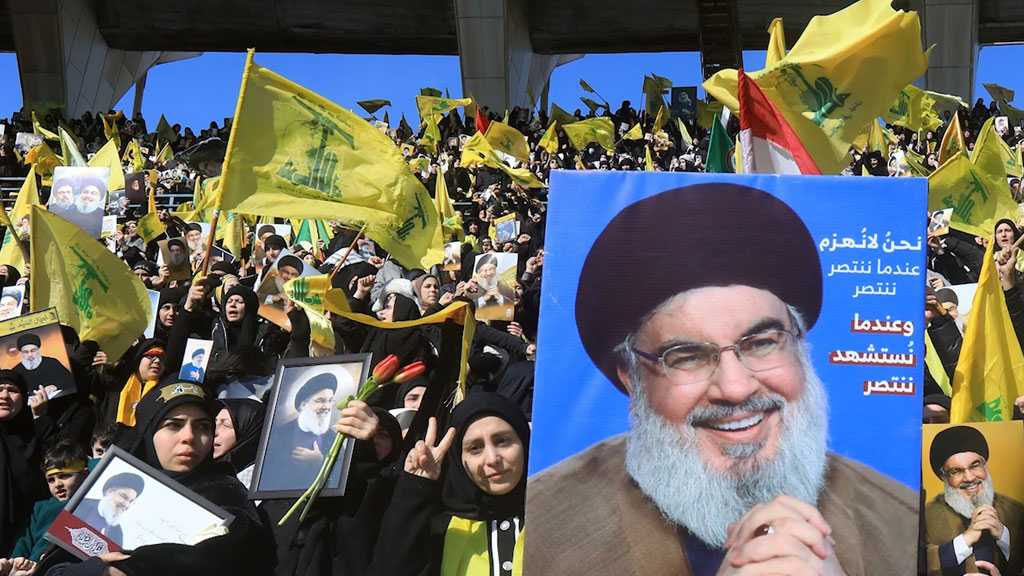
A year has passed since the burial of the two trusted martyrs. Many images from that solemn day remain etched in memory. On February 23, the people of the Sayyed mourned him with their very souls. They walked in the funeral procession undeterred by threats or warnings. Faces turned toward the blessed casket, and as soon as it appeared, voices choked with grief while hands rose along the path in pledge, as if hearts had stepped out of chests to follow him. The scene was not a farewell but a renewed promise.
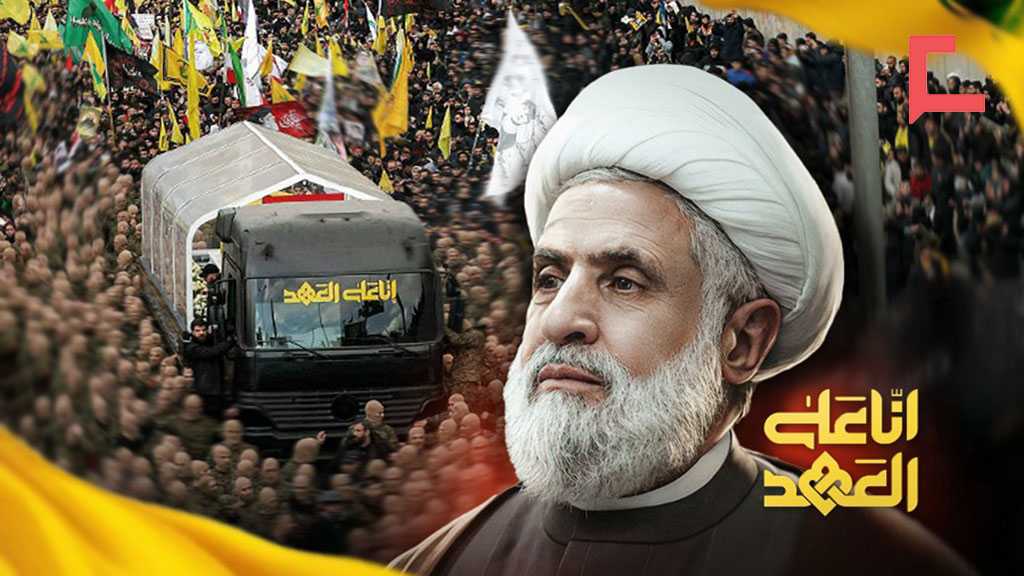
“We remain faithful to the pledge,” the Sayyed’s nation reaffirmed, making the funeral both a pledge and a renewal of commitment to the continuity of resistance, as emphasized by Hezbollah Secretary-General Sheikh Naim Qassem.
On the first anniversary of that grand funeral, Sheikh Qassem recalls in an interview with Al-Ahed News the Sayyed of the Nation’s Martyrs, the martyred Sayyed Hassan Nasrallah, whom he describes as a towering mountain, and his companion and trusted Hashemite Sayyed, Sayyed Hashem Safieddine, a steadfast support. In the atmosphere of remembering the martyred leaders that coincided with recent days, Sheikh Qassem revisits the beginnings, recalling the lives of these leaders as if it were yesterday. Decades have passed, yet he remembers them with longing and love. He speaks of them intimately, having lived alongside them, and their exemplary qualities remain vividly etched in memory, growing even more rooted and clear with the passage of time.
From the Sheikh of Martyrs, Sheikh Ragheb Harb, the son of the southern land as the Secretary General affectionately calls him, to the Sayyed of the Islamic Resistance, Sayyed Abbas Al-Moussawi, beloved by all, who revived the Beqaa region with his authentic missionary consciousness, and finally to the pillar of the resistance, the martyred leader Imad Mughniyeh, loved by everyone who worked with him, always innovating work methods and developing capabilities, according to Hezbollah’s Secretary General.
From the memory of the martyrs to the people of the resistance, Sheikh Qassem addresses words of love and loyalty through Al-Ahed News. He does not hide that since taking on his responsibilities, his feelings of love for the people have deepened—they are his own, the children of the path of resistance and of the martyrs.
Below is the interview text:
1- On the first anniversary of the grand funeral of the two martyred Sayyeds, that scene appeared as a unifying moment, combining the pain of loss with a renewed pledge. What remains etched in your memory from that day? And what political significance do you believe this massive turnout conveyed, both domestically and internationally?
When the Supreme Sayyed, Sayyed Hassan (may Allah bless his soul), was martyred on September 27, 2024, I discussed with Sayyed Hashem (may Allah bless his soul) the burial location and the funeral we wished to hold in the following days, following the recommended practice of hastening the burial. However, the intensity of the “Israeli” bombardment led us to agree to postpone the funeral until the situation calmed, possibly for about a week.
The surprise came when Sayyed Hashem was martyred by an airstrike on his location in Mraijeh on October 4, 2024. At that time, we did not know his fate due to the heavy “Israeli” raids on the site, which aimed to prevent the recovery of the body. Even when we finally retrieved the pure body, we could not consider holding a funeral because of the “Israeli” aggression. The delay thus coincided with that of the Supreme Sayyed; the security situation simply did not permit a funeral or a public gathering.
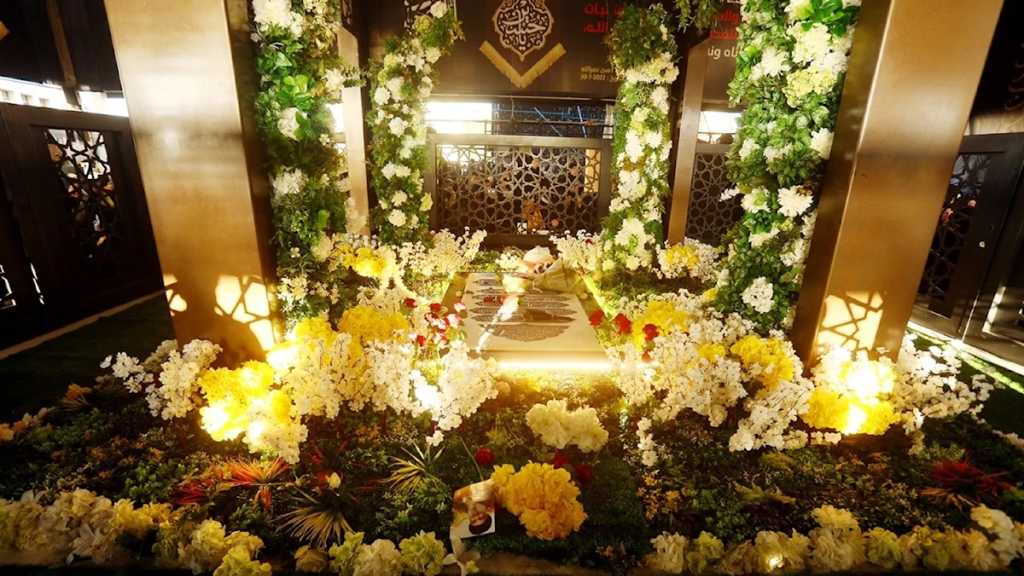
When we set the timing of the funeral, we felt that God had guided us to this moment and these circumstances. The delay allowed us to select the most suitable locations for the two revered shrines and to organize a funeral worthy of the two esteemed Sayyeds, both domestically and internationally.
The scene of the funeral was awe-inspiring, and the exceptional turnout of millions marked a historic moment for Lebanon and the region. The people’s love for the Sayyed of the Nation’s Martyrs, alongside the Hashemite Sayyed, was unparalleled. What the world witnessed reflected the deep-rooted presence of the resistance in the lives of the Lebanese people and gave a direct impression of determination to continue. The slogan “We Remain Loyal to the Pledge” truly expressed both the present reality and the commitment to the future.
The funeral was both a pledge and a renewal of the commitment to the continuity of the resistance, a reclaiming of the initiative to restore its capabilities, and a reaffirmation of popular solidarity around it. Its political significance is clear: the resistance continues—its leadership, its fighters, and its people. The Battle of the Mighty [Uli Al-Bas War] was only one stage, and what the movement has achieved, led by the two esteemed Sayyeds, was paid for with blood to revive the resistance and preserve its honor.
This principled, patriotic, and selfless resistance cannot be defeated, despite all attacks, sacrifices, and conspiracies against it. It was built on truth and for the sake of truth, and those who believe in the resistance are destined for victory, whether through martyrdom or triumph.
2- In light of the messages conveyed by the funeral, there were aggressive American positions, especially the leaks calling for airstrikes on the procession. How do you interpret the background and significance of this stance?
The “Israeli” entity is a colonial, arrogant project nurtured first by Britain and later by the United States, with international and Western backing. It is essentially run by the U.S. and serves its interests first and foremost. America intended it as a tool in the region to bend its countries and peoples to its will, while also seeking to eliminate the Palestinian cause by legitimizing “Israel’s” presence over all of Palestine.
America’s actions—recognizing Al-Quds as “Israel’s” capital, annexing the Golan Heights, abandoning the two-state solution, sponsoring genocidal wars in Gaza, and supporting the expansion of settlements in the West Bank while the Palestinian people are oppressed under its watch—are all indicators of a deliberate US strategy to dominate the region through force.
Similarly, the aggressive war on Lebanon is an American war carried out through “Israeli” crimes to achieve US control. This was evident in “Israel’s” refusal to comply with the ceasefire agreement on November 27, 2024, and the continuation of “Israeli” aggression alongside political pressure on the Lebanese state in its policymaking, including efforts to disarm the resistance in preparation for its elimination.
Trump’s slogan, “Peace through Strength,” essentially means colonization and domination of countries by force—used either violently and brutally or as a threat to compel submission. Here, the project of a “Greater 'Israel'” intersects directly with American hegemony, which relies on “Israel” as a tool as long as it serves that purpose and intervenes directly when “Israel” alone cannot achieve it, as in the case of Iran.
The daily flights of weapon-laden aircraft to “Israel”, the fleets that transport them, the direct coordination of military operations by US forces, and political moves framed as protecting “Israel’s” security—all of these are clear manifestations of direct American management, which rejects any form of resistance, liberation movement, or challenge to the new American colonialism.
3- Beyond the political implications, the moment of farewell carried deeply human dimensions, especially for those who were close to the two trusted martyrs. A year after Sayyed Nasrallah was laid to rest and after witnessing the public outpouring of loyalty to him, how would you describe your personal relationship with him and your long experience alongside him?
I worked directly with the Sayyed of the Nation’s Martyrs, Sayyed Hassan (may Allah bless his soul), beginning in 1987, as Deputy Head of the Executive Council when he was its head, and as a member of the council alongside him. When Sayyed Abbas (may Allah bless his soul) took over for less than a year, we served together on the council, and then I became Deputy Secretary-General under Sayyed Hassan (may Allah bless his soul) after Sayyed Abbas, from February 1992 until the day of his martyrdom—a span of 31 years.
We were brothers in God, companions on the path, working under the banner of the Wali Imam Khomeini (may Allah sanctify his soul) and later Imam Khamenei (may his shadow be extended). Together, we faced all the stages of the resistance, its difficulties, dangers, complexities, victories, and sacrifices. I told him many times that I loved him for the sake of God, and he told me the same on many occasions. This reflects the daily nature of our relationship, marked by constant consultation and collaboration.
The Supreme Sayyed earned the highest honor, but I lost greatly on a personal level. I lost a refuge, a leader, a towering mountain, and a brilliant mind—the loss of closeness and shared interaction. Yet I am firm in faith in God’s decree, and we must continue to draw from these qualities even in his absence.
4- Regarding the martyred Sayyed Hashem Safieddine, who played a central role in the organizational and executive structure, what was your relationship with him? And what did you lose personally after his martyrdom?
I was in constant interaction with Sayyed Hashem (may Allah bless his soul). He was the head of the Executive Council, and coordination with me—as head of the Parliamentary Work Council—was continuous. We worked together on all organizational committees, which determined the structures as representatives mandated by the Shura, and sometimes as rapporteurs, often under the chairmanship of Secretary General Sayyed Hassan (may Allah bless his soul).
We shared the journey of Wilayah and resistance, taking responsibility and leadership positions that required awareness, wisdom, and dedication. This gave me a sense of closeness and comfort in working with a conscious, mission-driven, meticulous, and dedicated personality committed to serving the resistance and its people. I miss him as a steadfast support and pillar, and God willing, we will continue to benefit from what he built and established.
5- While your relationship with the martyred Sayyed Nasrallah was marked by a long companionship and shared responsibilities, this journey was never separate from the connection to the line of Wilayah, a connection that is evident in the relationship with the Leader of the Islamic Revolution His Eminence Imam Sayyed Ali Khamenei, especially as we mark the anniversary of the Islamic Revolution. How would you describe the Supreme Sayyed’s relationship with Imam Khamenei?
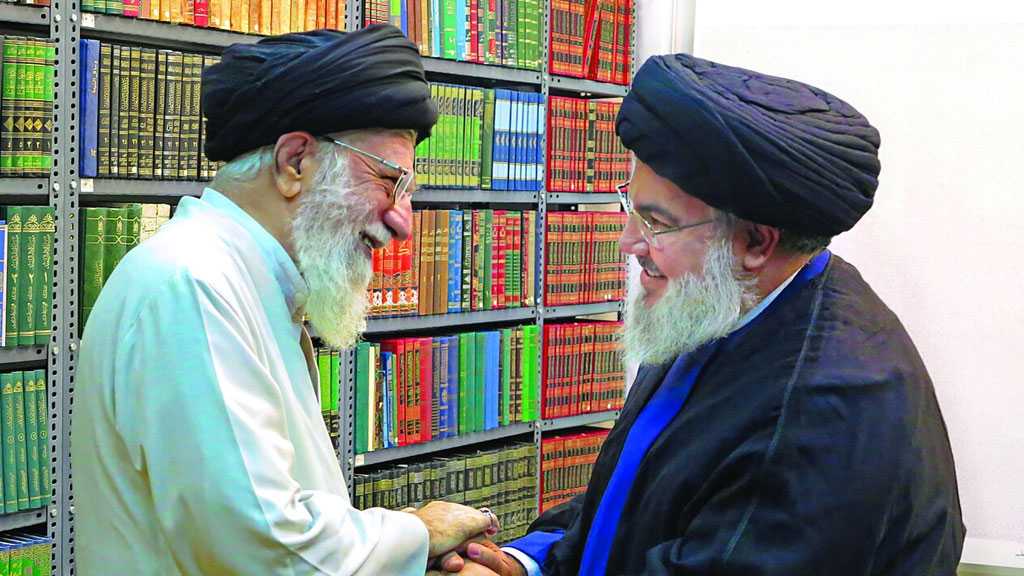
The Supreme Sayyed (may Allah bless his soul) was completely devoted to the love of Imam Khamenei (may his shadow be extended). He awaited every word from the Leader, following, analyzing, and learning from them, sometimes repeating them to the brothers and the public. The Leader, in turn, reciprocated this love, showing trust in Sayyed Hassan’s (may Allah bless his soul) role, competence, and distinguished position.
The Leader’s confidence in the Sayyed was absolute, grounded in his sound judgment, experience, and the correctness of his stances. The martyred Sayyed always spoke of the Leader and urged the leadership and brothers to obey and show loyalty to him, for he is the deputy of Imam Mahdi (may Allah hasten his reappearance) and our legitimate authority. Their relationship represented the highest level of faith, struggle, and practical collaboration.
6- With the memory of the grand funeral, which represented a unifying moment of loyalty, reaffirmed the pledge, and revived the journey of the leaders in people’s hearts, the recent anniversary of the martyred leaders prompts us to return to the beginnings of this path. Among those early figures is the martyred Sheikh Ragheb Harb. How would you present his character to the generation that did not live alongside him? And what distinguished his presence during the founding stage?
With the victory of the Iranian Islamic Revolution led by Imam Khomeini (may Allah sanctify his soul) in 1979, Sheikh Ragheb Harb (may Allah bless his soul) was among the first to openly pledge loyalty and allegiance to Imam Khomeini and promote the connection to this blessed revolution. He saw in it true faith, sincerity, and a commitment to the causes of the oppressed. Sheikh Harb participated in all activities supporting the Iranian Islamic Revolution in Lebanon and attended several conferences in Iran.
In Lebanon, he was among the earliest to carry the banner of resistance against the “Israeli” enemy in all its forms, including steadfastness on the land and direct confrontation with the occupier. His statement, “Position is a weapon, and a handshake is recognition,” reflected this spirit.
It can be said that Sheikh Harb was a son of southern Lebanon, descended from the scholars of Jabal Amel. He lived among the people in their daily lives—their poverty, farming, nightly gatherings, social closeness, and assistance to the poor. Above all, he supported and assisted the resistors, both in action and in material and moral support.
7- Amid the spirit of initiative embodied by the martyred Sheikh Ragheb Harb in the south, the early years also saw the foundational presence of the Sayyed of the Islamic Resistance’s Martyrs, Sayyed Abbas Al-Moussawi, who helped lay the first organizational foundations while fulfilling his mission-driven and jihadi role. How do you assess his position during that founding stage, and what unique contribution did he make?
The Secretary General, the Sayyed of the Resistance’s Martyrs, Sayyed Abbas Al-Moussawi (may Allah bless his soul), revitalized the Beqaa region with his authentic, mission-driven consciousness, strongly influenced by the late scholar Sayyed Mohammad Baqir Al-Sadr (may Allah bless his soul), and then by Imam Khomeini (may Allah sanctify his soul), whom he loved and devoted himself to from the very first moment with passion, love, and unwavering dedication.
Sayyed Abbas was one of the nine pillars who, in 1982, pledged allegiance to Imam Khomeini as their leader and representative, and spoke on behalf of the group. He served as a member of Hezbollah’s first Shura Council until his martyrdom in 1992, for a continuous ten years.
His car was his mobile home, traveling between Beqaa, Beirut, the South, Damascus and Zabadani—wherever the work required. He was tireless in his movement, loved by everyone, and treated everyone equally. He had no personal agendas. He once tried to pass the Secretary General position to Sayyed Hassan (may Allah bless his soul), but the Sayyed of the Nation’s Martyrs refused to surpass his teacher, and thus Sayyed Abbas (may Allah bless his soul) became Secretary General in mid-1991.
When the Shura Council was formed and he became Secretary-General, a new position of Deputy Secretary-General was created. In one of the sessions for assigning roles, he surprised me by proposing me for this post. I initially objected, saying he hadn’t consulted me. He replied, “I want you by my side. This is a responsibility I hope you accept.” I could not refuse such a pure, God-fearing man.
8- The martyrdom of Sayyed Abbas marked a pivotal moment in the history of the resistance. How did his martyrdom affect its course, and what of his ideas and approach remained alive after his passing?
Two statements summarize Sayyed Abbas’s contribution to the early structure of Hezbollah: his own words, “The fundamental will is the preservation of the resistance,” and his promise to the people, “We will serve you with our full devotion”.
For him, the party’s structure prioritized the resistance and serving the people. This was reflected in his fieldwork: he made a point of meeting the resistors before operations against the “Israeli” enemy and, even before assuming the Secretary General position, chose to serve as the Shura Council’s representative in the south to stay close to the resistance efforts.
In serving the people, he was generous and attentive to their needs, working to ease their burdens, provide assistance, and organize social activities and institutions to serve them. His distinctive contribution was embodying Hezbollah’s engagement in addressing the people’s concerns. The party is an organizational framework, not the ultimate goal—the goal is to liberate the land through resistance and to serve the people closely and with full devotion. The party exists for the people and with the people, and this principle was deeply rooted in his ideas.
His martyrdom became a landmark of the price those who follow the path of resistance must pay and a stimulus for continuity, especially when it happens to a man devoted to Islam like Sayyed Abbas (may Allah bless his soul). As God says:
“Among the believers are men who have proven true to what they pledged to Allah.1 Some of them have fulfilled their pledge [with their lives], others are waiting [their turn]. They have never changed [their commitment] in the least.” (Al-Ahzab, 23)
9- In terms of security and military matters, the name of the martyred leader Imad Mughniyeh stands out as one of the foremost minds who contributed to the development of field operations. What distinguished his experience, and why is he considered one of the most influential leaders in the history of the resistance?
Jihadi work is the essence of the Islamic resistance, and our religious duty—above all else and foundational to everything associated with it—is the resistance against the “Israeli” enemy to liberate the occupied land and support Palestine.
Hajj Imad Mughniyeh (may Allah bless his soul) stood out for his exceptional security and military expertise, practical experience from a young age, and deep Islamic commitment aligned with the path of Imam Khomeini (may Allah sanctify his soul) and the leadership of Imam Khamenei (may his shadow be extended). This positioned him at the forefront of Hezbollah’s jihadist leadership, assisting the Sayyed of the Nation’s Martyrs, Sayyed Hassan (may Allah bless his soul), in all matters related to security and military operations.
He left a lasting mark on the cadres he trained and led. He was constantly developing work methods, preparing capabilities, identifying talent, training it, and entrusting it with responsibilities through his effective management. Everyone who worked with him loved him. Many resistance leaders—both those later martyred and those still alive—have stated that they were his students and were nurtured under his guidance.
Hajj Imad played a foundational role in establishing this approach to resistance and assumed leadership during the critical stage that led to liberation. He built operational capabilities and diversified cadres. Perhaps the most precise description of him came from the Supreme Sayyed (may Allah bless his soul) after his martyrdom in 2008, when he called him “the commander of the two victories”—the liberation of 2000 and the 2006 July War (the “Divine Promise” war).
10- With the anniversary of the grand funeral and in remembrance of the martyred leaders and their tireless contributions to this path, people’s attachment to the pledge with the resistance and their loyalty to the leadership has grown. They promise to stand by you no matter what. What do you promise them in return, and what do you say to those who rely on your wisdom in leading the ship of resistance?
Leading the journey of Hezbollah and the Islamic Resistance is a very great responsibility, and the role of the people in this path is both central and essential. The movement belongs to them, and they are its lifeblood. I will not hide that since assuming this responsibility, my love for the people has grown even deeper—they are my family and the children of the path of resistance and of the martyrs. From the very first moment, I vowed to God to fulfill my duty toward them as best I can, according to the abilities and capacities God has granted me. My place in life is only for God, for Wilayah, for the resistance, and for the people, so that together, God willing, we may be among the soldiers of Imam Mahdi (may Allah hasten his reappearance).
I know that this stage is difficult, but together we have passed through the Uli Al-Ba’s Battle with continuity. We patiently endure what the past fifteen months have required, and when the time comes for any stance, we will not hesitate. Our path is clear: the land is ours, and our right to defend it and to resist is legitimate. We will remain steadfast, preparing ourselves for the two best outcomes—victory or martyrdom—and readying ourselves while awaiting the Master of the Age (may Allah hasten his reappearance). There is no place for defeat, no matter the sacrifices. “And victory comes only from Allah—the Almighty, All-Wise.” (Ali Imran, 126)
Comments