The Auditory Slaughterhouse: How ’Israel’ Weaponizes the Cries of Dying Children to Murder Civilian Empathy
Mohamad Hammoud
In the shadowed villages of southern Lebanon, a new layer of warfare has crept in. Beyond the destruction of homes and the displacement of families, “Israel” has expanded its battlefield into the realm of sound itself. Now, when darkness falls, the air is not only split by distant explosions but haunted by the cries of children and the desperate pleas of women.
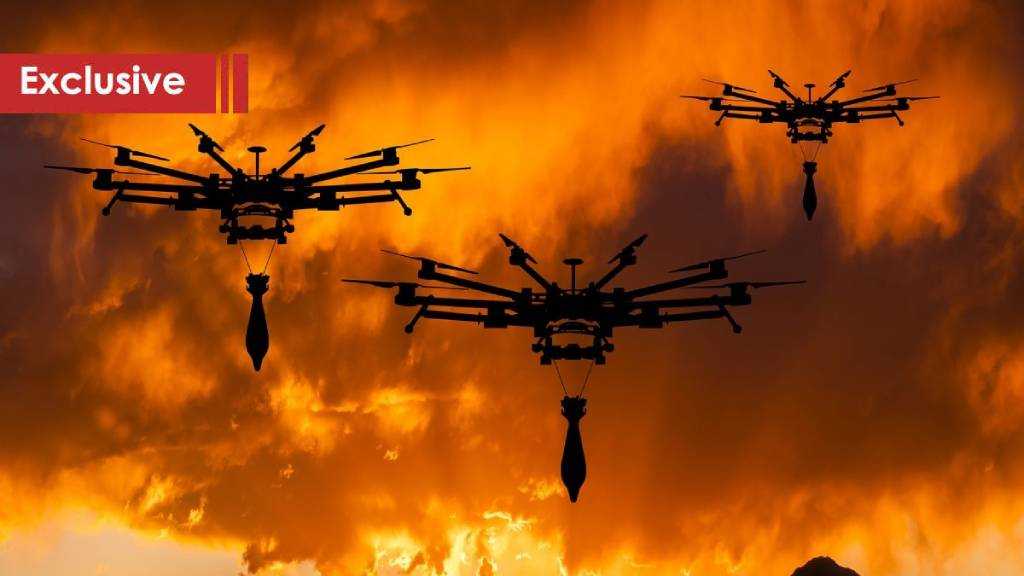
According to eyewitness accounts reported by Middle East Eye, the sounds are sometimes broadcast from hovering quadcopters, machines that move like ghosts above the rooftops, weaponizing the most intimate frequencies of fear.
Psychological Warfare: When Fear Becomes a Weapon
It’s a tactic chilling in its calculation. These sounds are not incidental background noise; they are deliberate psychological triggers, transforming the familiar into the uncanny. Residents describe a new kind of uncertainty, where every cry might signal a real emergency- or might be manufactured. The result is not just fear, but a grinding exhaustion: the slow erosion of trust in one’s own senses, the relentless pressure that pushes families to abandon their homes. Middle East Eye reports that this same tactic was honed in Gaza and is now being replicated in Lebanon, blurring the line between authentic suffering and engineered panic.
The Machinery of Weaponized Empathy
This is a war that targets the very core of what makes us human. The instinct to help a child in distress is nearly universal. But as Hashem, a local paramedic, told Middle East Eye, the reflex to run toward a scream or a plea for help becomes almost automatic in the tense silence of a besieged village. Now, that same reflex is laced with danger. What seems like a call for rescue could be a trap- bait set to expose movement, identify targets, or bleed a community of its last psychological reserves. In this framework, empathy is not collateral damage. It is the target.
From the Gaza Laboratory to Lebanon
This weaponization of sound did not appear overnight. The blueprint for this psychological warfare was drafted in the Palestinian territories, years before it echoed off the walls of Lebanese homes. Human rights groups, journalists, and residents have all documented how quadcopter drones in Gaza would broadcast the fabricated cries of children and distress signals, drawing civilians into the open- where they could be watched, targeted, or killed.
According to Middle East Eye, these drones are not just eyes in the sky; they’re multi-role weapons. Sometimes they serve as surveillance tools, sometimes as loudspeakers for psychological terror, and sometimes, tragically, as armed units ready to open fire on crowds once they have gathered. The fact that this pattern is now repeating itself in southern Lebanon hints at something systematic- a chilling doctrine rather than mere improvisation.
What’s being tested- and exported- is a model of control that treats the human mind as its terrain. The goal is not just to occupy land, but to destabilize the very reliability of perception itself, so that fear is never-ending and uncertainty becomes the new normal.
Targeting Social Structure and Civil Organization
But this psychological campaign doesn’t stop at frightening individuals. It’s designed to fracture whole communities, to isolate leaders, and to make collective resistance feel impossible.
For Tarek Mazaani, founder of the Gathering of the People of the Southern Border Towns, this strategy hit home. He recounted to Middle East Eye how “Israel” drones broadcast warnings across several villages, accusing him of ties to Hezbollah and urging residents to shun his reconstruction efforts completely.
Mazaani eventually abandoned his shelter, fearing that staying could endanger everyone around him. The message, he said, was never just about scaring one man—it was a warning to the entire community: anyone who dared to organize, to help rebuild, could become a target.
The effect is corrosive. Civil society itself becomes a target. Community coordination is reframed as exposure. Leadership becomes liability. In such conditions, social trust weakens under pressure from both surveillance and signaling.
Sound as an Instrument of Control
The use of drones to project fabricated human suffering represents a form of warfare that operates beneath conventional frameworks of visibility and accountability. It does not rely solely on destruction but on perception management- on reshaping how reality is interpreted at the moment it is experienced.
Stories like those of Hashem and Mazaani reveal that the conflict in southern Lebanon is not just about territory, or even survival. It is a battle for the spirit of entire communities—their ability to trust their senses, their neighbors, and themselves.
Comments