
Suleiman Stresses Proportionality, Bakers’ Strike Suspended

Source: Lebanese newspaers, Translated and Edited by moqawama.org
Nothing new under the roof of the Lebanese Parliament.
The second day of discussions brought no surprises to the scene: Some lawmakers delivered long statements ,some screamed, others debated, while the remaining preferred to take a nap or enjoy chatting via smartphones or ipads.
This came as the announced strikes retreated, paving the way for last minute compromises.
However, as usual the US presence in the Lebanese arena marks the news.
US Commander Tours the Blue Line
US Army Central Command (ARCENT) Commander Lieutenant General Vincent K. Brooks made a visit to South Lebanon, and particularly the "Blue Line" on the borders between Lebanon and Occupied Palestine.
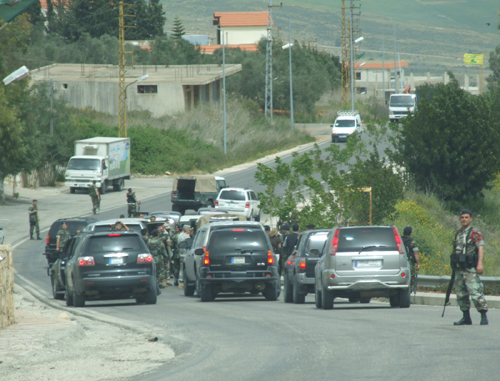
He was joined by commander of the Lebanese Army in south Litany Brig. Gen. Sadeq Tleis and UNIFIL commander Maj. Gen. Paolo Serra.
According to "as-Safir" Lebanese daily, "the US official's visit raised questions about the actual aims."
Well informed sources suggested to the daily that the tour aimed at collecting information concerning the role of the Lebanese army, its nature, and its relationship with Hizbullah.
"The American General's field tour would have its effects on the level of US aids to the Lebanese army," sources told "as-Safir".
For its part, Lebanese military sources informed the paper that "the Lebanese delegation accompanying the US visitor explained the daily "Israeli" land and sea violations of the Lebanese sovereignty as well as the continuous breaches tothe Blue Line."
"The delegation also emphasized Lebanon's commitment to its rights," the sources added.
Parliament to End Show
On the political level, the second day of parliamentary sessions aimed at assessing the government's performance remained under the level of expectations.
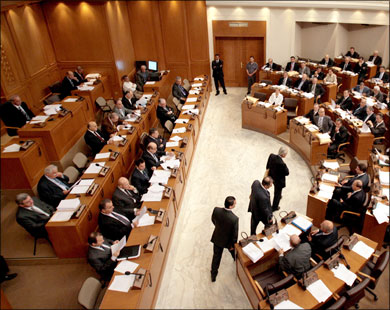
The Lebanese Prime Minister Najib Mikati's circles commented on Wednesday's session by saying: "the debates between the majority and the opposition MPs took the nature of settling accounts."
"The ministers will prepare technical answers," Mikati's sources told "an-Nahar", adding that "Mikati is to respond to the political titles."
The sources highlighted that "the opposition raised nothing new, but poured harsh criticism that is not related to the government's performance."
The daily also mentioned that "Mikati's response will be quiet and will clarify points in an attempt to set the government's attitudes and aspirations to the next stage, most notably the protection of stability."
For his part, the Minister of Interior and Municipalities Marwan Charbel expressed his satisfaction at the course of the parliamentary sessions.
"Despite some skirmishes and controversies that have remained under the roof of political discourse, the session's atmosphere was democratic," Charbel told "al-Joumhoria" daily.
The minister added that "the government came to the parliament with a belief in the parliamentary right to discuss all the ministerial performances."
Meanwhile, a dozen MPs opted to heed House Speaker Nabih Berri's request to limit appearances by colleagues from the same bloc.
This means that 61 MPs instead of 73 will likely speak during the three-day session on Thursday.
Electoral Law Back to Debate
On the electoral law, Lebanese President Michel Suleiman stressed Thursday that "those standing against proportionality today will be with it in the future."
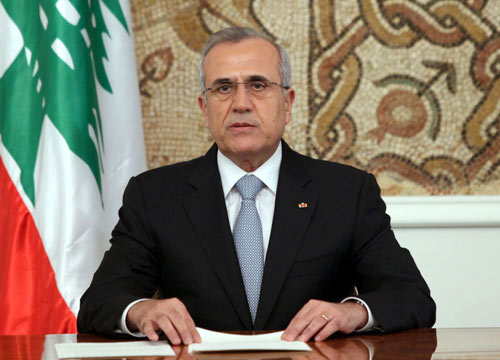
In an interview with "as-Safir", Suleiman viewed that "the formation of a new political class through a modern and democratic electoral law forms a guarantee to overcome the political inability to bring a president from the political ranks."
During his visit to Australia, the President unveiled that he "had discussed with Speaker Berri various ideas on proportionality that would lead to the formation of a non-sectarian parliament."
"This would lead to the establishment of a senate as stated by the Taif Accord," Suleiman told "as-Safir".
On the appointment of the head of the Higher Judicial Council, the president neglected fears that the procrastination would lead to a crisis especially if we choose or elect other members."
Suleiman also hailed the army's role stating that "as a former head of the Lebanese Army and the head of the state, I concluded that that the army acts democratically while politicians behave in a dictatorial way."
For his part, "National Struggle Front" Leader MP Walid Jumblatt commented on Berri's initiative that calls for adopting proportionality after having Lebanon as a single electoral district to be later followed by the establishment of a Lebanese Senate.
In remarks to "as-Safir", Jumblatt said: "Honestly, I am not excited for establishing a senate now because if we want to implement the Taif Accord then the senate's existence is linked to the elimination of political sectarianism."
"The time isn't appropriate for such step," Jumblatt stressed.
"I appreciate Berri's keenness on finding a solution for the electoral law and I thank him on his effort," Jumblatt said, adding that "the proposal is not practical because it doesn't move in harmony with the Taif accord." Jumblatt reiterated his call for adopting "the 1960 law that I still hold on to as the only realistic option."
Tripoli's Municipality Crisis to Solution?
On another level, "an-Nahar" daily reported that the PM agreed with several Northern ministers on rifting the political lift over the Head of Tripoli's municipality Nader Ghazal.
According to "an-Nahar", "Mikati headed a meeting that gathered Tripoli MPs and ministers to tackle the crisis gripping the municipal council after its members threatened to resign in protest at the performance of Ghazal."
"The conferees agreed on calling the man to submit his resignation within the coming 24 hours, as the elections to select a new chief for the municipality would take place on April 24 or 25," the daily reported.
On the strikes level, the Bakeries Union decided to suspend its strike after reaching an agreement with Economy Minister Nicolas Nahhas, one day from the scheduled Thursday strike.
In a press conference, the minister announced that "an agreement was reached to subsidize flour with LL70,000, which means that the bakeries will receive a ton of flour at the cost of LL440,000 instead of LL510,000."
He further declared his support "for liberalizing the price of bread because subsidizing flour will not necessarily yield the desired results."


