Washington Opts for Diplomacy in Syria

Ali Rizk
After over two years since the beginning of the crisis in Syria two things have become clear:
President Bashar Assad will not fall (his situation now has significantly improved after the advances made by the Syrian military near Homs and the outskirts of Damascus).
 The continuation of the crisis in the current fashion will only lead to a growing footprint for extremist, Al-Qaeda affiliated groups.(As the pattern has shown the more the crisis continues the more extremism footprint which is even spreading beyond Syria to neighboring countries like Turkey ,Jordan, Lebanon etc).
So after this period, is this the scenario Washington wants to see?(Assad still in power and growing momentum for extremists).Obviously it is not the ideal scenario for the US, which means it must take steps to change the situation. Basically Washington has two choices:
Realizing that Assad will not fall by force under the current situation the US could opt to take on a more enhanced military role in support of the armed opposition to topple Assad.(Turkey also realizes that Assad won't fall under the current status which is why Turkish officials spoke in a somewhat desperate way about Assad crossing the Obama "red line " of chemical weapons). A more enhanced role would range from the Nato intervention scenario in Libya under the guise of a no fly and/or buffer zone on border areas near Turkey or Jordan to increasing and/or enhancing weapons sent to the opposition.("Boots on the ground" is something clearly not on the table).
With regards to the option of a no fly and/or buffer zone, US officials have cited Syrian air defense capabilities as valid reason not to go ahead with this option.. What's more is that contrary to the case of Libya, the security council this time around is sharply divided and president Obama has made it clear that his policy revolves around working, and not confronting world players like Russia or China. And just to make sure that this scenario is completely taken off the table, Russia has sent advanced "Yakhont" missiles equipped with a radar system.
When it comes to equipping the opposition with better arms ; in order to give this opposition the upper military hand, it would require the US to send weapons which outweigh the advanced weaponry Russia and other players are providing the Syrian government. But can Washington provide such weapons to an opposition which appears to be led by Al-Qaeda?(Public opinion would obviously object to such a policy particularly after the recent video was released showing the gruesome heart eating opposition fighter.)
So while Russia can afford to provide advanced arms to the Syrian government which is a rational player, the US cannot afford to provide such arms to the Al-Qaeda led opposition, which is not only an irrational player, but also a terrorist network that launched the deadliest attacks ever on the US homeland!
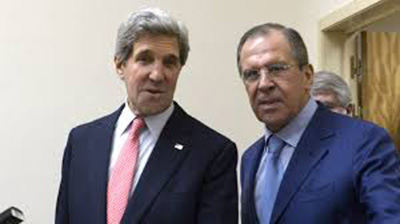
This brings us to Washington second option, which is to move closer to the Russian position and find a diplomatic way out, without setting pre-conditions like president Bashar Assad leaving or ceding power. The US appears to have made its decision in support of this option. The remarks made by US secretary of state John Kerry in Moscow signaled the turn-around. After agreeing with his Russian counterpart Sergey Larvov to hold an international conference bringing together the government and the opposition, Kerry responded to a question about Assad's future role in Syria saying:
"It's impossible for me as an individual to understand how Syria could possibly be governed in the future by the man who has committed the things that we know have taken place. But that's not - I'm not going to decide that tonight. And I'm not going to decide that in the end".
Although Kerry in the following days went on to say that Assad must not be part of the future of Syria or of the transitional government, this appeared only to be lip service to the Syrian armed opposition and its regional allies like Qatar and Turkey. These statements were more like a push for the opposition to go to the negotiating table, as this opposition has always insisted that Assad step down.
Consider another statement by Kerry when he said that if Assad does not go to the negotiating table THEN the opposition would receive more lethal arms.
The bottom line then is: The US now wants a diplomatic solution in Syria. From the beginning it has lacked a clear strategy and has turned a blind eye as Turkey, Qatar and Saudi Arabia provided arms and financing to a fractured and increasingly extremist opposition. Obama's latest statement during a joint presser with Turkish prime minister Rejab TayyeB Erdogan at the white house:
"no magical solution" to the Syrian crisis and "keep increasing the pressure on the Assad regime and working with the Syrian opposition."
These statements serve as a perfect example of lip service which is vague precisely because Washington has no means by which to "increase the pressure on Assad and work with the Syrian opposition". During the same press conference Obama made it clear that he fully supports the agreement which was reached when John Kerry was in Moscow.
And in an effort to make sure that nobody would sabotage this new diplomatic approach, CIA chief John Brennan's made a sudden unannounced visit to "Israel", on the heels of fresh just after "Israeli" threats to launch more airstrikes on Syria.
The message: Washington has opted for diplomacy and there is no room for anyone to sabotage this diplomatic track, not even "Israel".
Source: moqawama.org