Obama Calls Putin over Ukraine as Tension Escalates
Local Editor
US President Barack Obama urged his Russian counterpart Vladimir Putin in a phone call Monday to press pro-Moscow groups to lay down their arms in Ukraine, as the Kiev government sought UN help to tackle the growing insurgency.
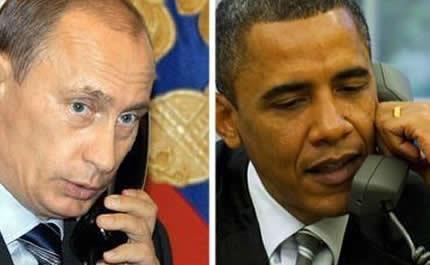
A White House statement said the telephone call came at Russia's request and that Obama accused Moscow of supporting "armed pro-Russian separatists who threaten to undermine and destabilize the government of Ukraine".
Obama told President Putin that all "irregular forces in the country need to lay down their arms".
Putin denied involvement with the pro-Russian insurgents, but an unconvinced European Union expanded its sanctions against officials accused of seeking to break up the ex-Soviet country.
Putin told Obama that Russia was not sponsoring the Kalashnikov-toting separatists who have seized a string of key state buildings in eastern Ukraine, according to the Kremlin's account of the phone call between the two leaders.
He urged Obama to "do everything possible to avoid the use of force and a bloodbath", the Kremlin added.
Underlining the danger of an escalation into military conflict, the US said a Russian fighter jet had made several low-altitude passes near an American destroyer in the Black Sea at the weekend, branding the flyby "provocative and unprofessional".
The White House meanwhile fended off Russian criticism of its own moves in the crisis, acknowledging that Central Intelligence Agency director Brennan had visited Kiev at the weekend but insisting it was part of a routine trip and that claims to the contrary were "absurd".
The pro-Kremlin protestsers who have seized state buildings in coordinated raids across eastern Ukraine only appeared to be gaining confidence while paying little heed to the "full-scale anti-terrorist operation" announced with much fanfare in Kiev.
Protesters armed with rocks and clubs smashed their way inside a police station in Gorlivka - a coal-mining town straddling a highway between the regional capital Donetsk and the city of Slavyansk to the north that is now effectively under militants' control.
The unrestrained crowd whistled and cheered as they ripped away metal shields from the visibly frightened local force before raising the tricolour flag of the self-declared "People's Republic of Donetsk".
Armed militants in Slavyansk - already in control of the local police station and security service office - took command of its administration building before asking Putin to send in his troops.
"We ask President Putin to help us," rebel leader Vyacheslav Ponomaryov told a group of reporters.
The spreading unrest is rooted in the deep mistrust in the big industrial cities along Ukraine's Russian border of the new, nationalist government that enlisted Western support in toppling Kremlin-backed president Viktor Yanukovych in February.
Pro-Kremlin protesters in rundown regions such as Donetsk and Kharkiv are now seeking local referendums on either broader rights or an option to join the Russia.
Turchynov made a dramatic about-face aimed at defusing the tensions by backing a national poll on turning the centralised nation into a loose federation in which regions enjoy broader rights.
Washington has previously advised Kiev to devolve powers in order to avoid eastern Ukraine going the same way as Crimea, which Russia annexed last month.
"We are not against holding a national referendum," Turchynov told lawmakers. "I am certain that a majority of Ukrainians will support an indivisible, independent, democratic and united Ukraine."
The announcement stopped well short of meeting protesters' calls for each Russian-speaking region to stage its own referendum.
Polls show most in Kiev and the Ukrainian-speaking west supporting a strongly unified state.
Source: News Agencies, Edited by website team