Nuclear Talks Extended, Iran and US Exchange Warnings, Amano to Tehran
Local Editor
Iran and the world powers gave themselves an extra week to reach a nuclear accord, extending a deadline due to expire on Tuesday, while US President Barack Obama said there would be no deal if all pathways to an Iranian nuclear weapon were not cut off.
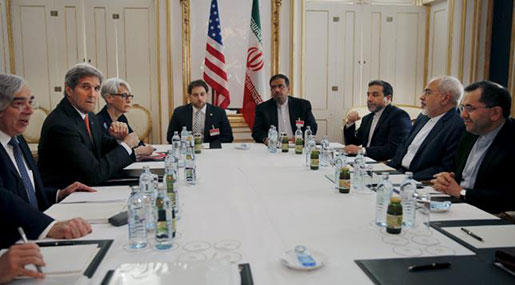
With talks in the final stretch, Iran's president Hassan Rouhani also spoke out, saying his country would resume suspended atomic work if the West breaks its promises.
Iran and six world powers are working towards an accord that would see Tehran halt sensitive nuclear work for at least a decade in exchange for the lifting of economic sanctions, potentially the biggest breakthrough in decades of hostility between Washington and Tehran.
"Ultimately this is going to be up to the Iranians" to meet the requirements set out by the international community, Obama said during a news conference in Washington.
"I have said from the start I will walk away from the negotiations if in fact it's a bad deal," the US president added.
But he added that "my hope is they can achieve an agreement."
President Rouhani said on Tuesday Tehran would resume halted nuclear work immediately if the powers failed to keep their promises under any accord.
"If we reach a deal, both sides should be committed to it," Rouhani said in Tehran, the state news agency IRNA reported. "If the other side breaches the deal, we will go back to the old path, stronger than what they can imagine."
For his part, senior Iranian nuclear negotiator Abbas Araqchi revealed that "sticking points still remain between Iran and the P5+1 group of countries in drafting the text of a final deal over Tehran's nuclear program."
"There remain issues of difference on which no agreement has been reached yet, and there are certain texts which have not been written down yet. In fact, we are working on them round the clock," Araqchi said on Wednesday.
Araqchi, who is also the deputy foreign minister for legal and international affairs, said that all delegations present in the talks are "seriously" working on the text.
He said that there has been a "positive climate" in the negotiations as all sides are keen to move the talks forward.
Stressing that Iran will not accept an agreement at any price, the senior negotiator said that a good deal should respect Iran's principles and red lines.
"An agreement should be a good one and a good agreement is the one that complies with the principles, frameworks and red lines set especially by the Leader [of the Islamic Revolution His Eminence Imam Sayyed Ali Khamenei] and in that case we will agree to a deal," he said.
Araqchi said that Iran prefers a good agreement to time, adding that Tehran will not be bound by time in striking a final deal with six world powers.
In a positive sign for the talks, Western diplomats said the International Atomic Energy Agency (IAEA) was expected to report next month that Iran had complied with a preliminary deal to reduce its low-enriched uranium stockpile.
Meanwhile, Director General of the International Atomic Energy Agency [IAEA] Yukiya Amano is due in Iran on Thursday for talks on Tehran's nuclear program.
An informed source close to the Iranian negotiating delegation said Wednesday that Amano will visit Iran to receive the country's proposals on removing certain misunderstandings over the country's nuclear program, IRNA reported.
During his stay in Iran, the IAEA chief is expected to hold talks with Iranian President Hassan Rouhani and Secretary of the Supreme National Security Council Ali Shamkhani.
An IAEA report in May said the stockpile had increased above the required level, but Tehran met a June 30 deadline to reduce it, the diplomats said on condition of anonymity.
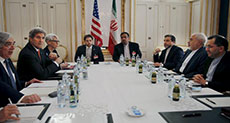
US Secretary of State John Kerry, on crutches with a broken leg, resumed negotiations on Tuesday with Iranian Foreign Minister Mohammad Javad Zarif, who returned in the morning from consultations in Tehran.
Zarif flew in with Iran's nuclear chief Ali Akbar Salehi, who is still recovering from major surgery in May. The two immediately went into almost two hours of private talks with Kerry.
"I am here to get a final deal, and I think we can," Zarif told reporters."
German Foreign Minister Frank-Walter Steinmeier, in an interview with Iranian state news agency IRNA, said there were difficult issues to work out but outlined the benefits Iran could enjoy if a long-term agreement is reached in Vienna.
"We have offered to suspend all economic and financial sanctions in the first phase," he was quoted as saying. "Experts estimate that lifting the sanctions will lead to economic growth of 5 to 7 percent."
Iranian media said it was the first interview Iranian state media had with a German government minister since the 1979 Islamic Revolution.
For more than a week, the sides have been working into the night trying to break an impasse in talks they feel have never been closer to success.
Source: News Agencies, Edited by website team
Comments
Iran Downs 52nd US MQ-9 Drone over Qeshm Island
one month ago