General Aoun: The oppressive powers will fall, bringing down with them their policy of monopolizing the political

Source: Nowlebanon, 15-3-2008
Supporters and prominent figures of the anti-government Free Patriotic Movement (FPM) gathered today at Qasr al-Moutamarat in Dbayeh to celebrate the commemoration of March 14, 1989.
The ceremony comes 24 hours after the FPM's major opponent, the March 14 coalition, revealed the beginnings of their own formalized plan for Lebanon at a conference in Biel.
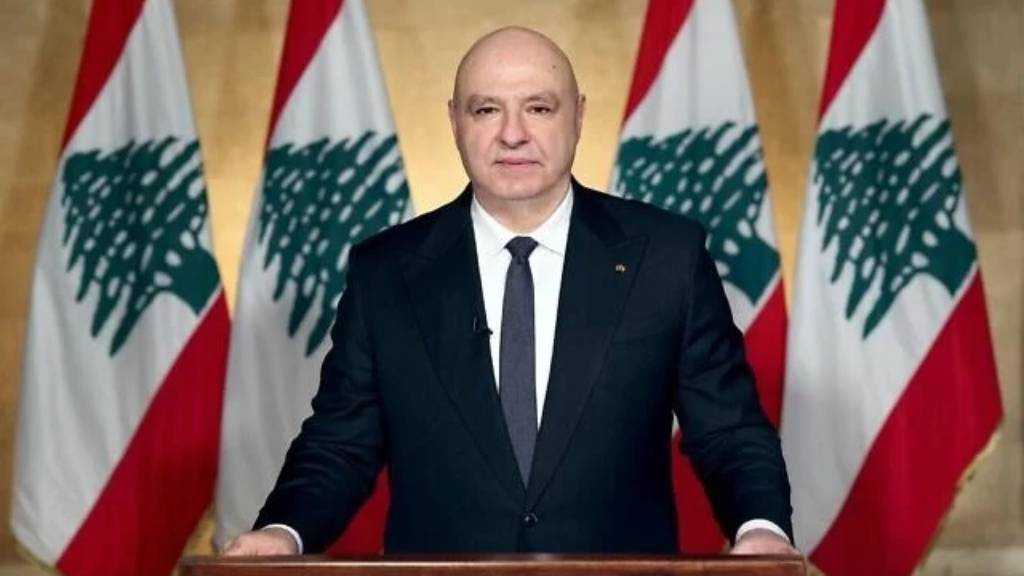
After the screening of a short documentary highlighting General Aoun's military and political career and the Free Patriotic Movement's history since 1989, General Aoun gave a live transmitted by television to his supporters in Dbayeh, in which he attacked the ruling majority and promised his followers a new dawn after the darkness of the current era.
Aoun began by asking the Lebanese what had changed over the pasts 20 years, since he came to power in 1989. "Did we really achieve independence and reach free decision making at a time when those who detain the rule in the country still live on the remains of their master, pleading for directives and soliciting green and red lights, just as they were, in the past crawling in humiliation to Anjar? And what is the difference between one master and the other, while they both occupy the will and the decision-making of the Lebanese people?" he said.
"What's the difference between a rule that oppresses its citizens who demand freedom, sovereignty and independence and a rule hiding behind closed windows of the Grand Serail only a few meters away from its citizens asking for freedom, sovereignty, independence, in addition to participation and reform...and for the right to a basic living?"
Aoun questioned the "difference between a de facto rule imposed on the people by the occupier that used it to cover up its actions against the people, and after the end of occupation, the same rule that stole the principles and slogans of the active population that it oppressed in the most hideous ways."
"Have those ruling the country, those cloned by the occupier, succeeded in making a strong Lebanon rise from the rubble of confessionalism or have they redrawn the map of the country according to religious and confessional patterns that might have triggered a civil war tearing it apart in fiefdoms for militias, had it not been for a national, deep and wise understanding done by two national groups conscious of the seriousness of the situation and sharing the same strategic vision?"
"Have yesterday's slaves become free now but they still don't dare - in speech and in deeds- shake the hand that is reaching out for them for dialogue because their new-old master has not yet given them the permission to do so?"
"Should real national reconciliation be built on the convergence of regional and international interests and of transient tactical relations that fluctuate according to offer and demand? Or is it based on the nation's supreme interests and common living among the various components of the Lebanese social fabric in the framework of regional and international relations based on equality among nations? A national reconciliation born out of regional and international wills and interests is abnormal and not viable."
"All that the current de facto ruling power has done is to replace the oppression of the people through guns with their oppression through their basic living... thus it refused participation and marginalized the opposition in general and the Christians in particular."
"Aren't these political powers and leaderships who covered the invasion of October 13, 1990 covering today the current ruling power that relinquished Lebanon's freedom and decision making and drowned in the quagmire of political, administrative, and moral corruption?"
"Do these political powers and leaderships want another Taif accord, only internationally-brokered this time, to be imposed on the Lebanese people under the threat of sectarian strife and regional wars, instead of a national accord resulting from a sovereign Lebanese will free from all regional and international pressures."
"Aren't these powers the ones that refuse to reinforce the position of the president of the republic through the formation of a national unity government that unifies the national decision, and through a new electoral law to yield a truly democratic parliament that represents the people and takes the necessary measures to curb corruption and to stop the squandering and embezzlement of public funds; a parliament that will stop the falsification of the national will, ensure that justice is done and prevent the slipping of the country into the hands of foreign powers and suspect projects that lead Lebanon into the path of submission."
The FPM leader concluded by saying, "Despite this gloomy atmosphere that prevails and the presence of this oppressive ruling power, I want to tell you that a bright future is dawning and the days of darkness will be gone as Lebanon's new face will appear. The oppressive powers will fall, bringing down with them their policy of monopolizing the political power and selling the national decision making. And on the remains of this power, a national, free, and transparent power will be built and Lebanon's tomorrow will look like it should be, bound only by your ambitions and the future of your children who always long for freedom, sovereignty, and independence."
General Michel Aoun and his supporters were a major pillar in the mass rally on March 14, 2005, which led to the withdrawal of the Syrian troops which had occupied Lebanon for 29 years. Over the next two years, the FPM leader realigned with the anti-government March 8 forces, which culminated in the signing of a Memorandum of Understanding with Hizbullah.