Fillon Favored over Juppe in French Rightwing Debate
Local Editor
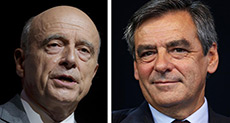
France's former prime minister François Fillon topped the second presidential hopeful from The Republicans party, also former prime minister, Alain Juppe, in popularity in the Thursday primary debate, even though the two expressed similar views on some issues.
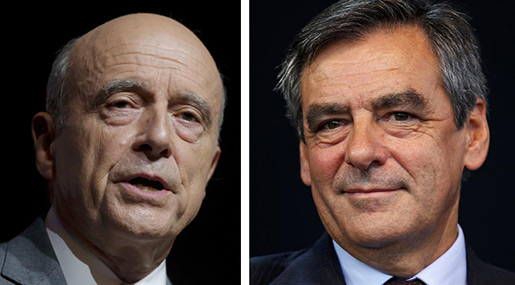
On November 24, François Fillon and Alain Juppe emerged as the winners of the first round of The Republicans primaries with the former securing 44 percent of center-right voters while the latter, long thought to be the front runner, ended with just 28 percent.
Former French leader Nicolas Sarkozy finished with the third result and thus was eliminated from the race.
Sarkozy had already endorsed Fillon, who served in his government in 2007-2012.
Over half of French viewers thought Fillon was more convincing during the Thursday night debate with Juppe, according to an Elabe survey conducted at the request of BFMTV. Out of right-wing supporters, over 70 percent preferred Fillon while 28 percent favored Juppe.
Both of the presidential hopefuls stressed on Thursday that France must better defend its own interests in foreign policy, but disagreed on certain internal reform issues.
Fillon attacked the policy of French President François Hollande with regard to Russia, calling for more independence on the part of France.
What counts in the foreign policy that I want to pursue is that France defend its interests. The policy of Hollande with regard to Russia is absurd, it pushes Russia to harden, to isolate itself ... The real danger for Europe, economic [danger], is the Asian continent," Fillon said during the Thursday debates.
He also criticized France's current policy with regard to Syria and called for dialogue with Iran and Russia in that respect.
"To stop this [Syrian] war, we must bring the Russians back into a discussion with the Europeans, talk with Iran, and accept the idea of a temporary agreement that will allow for a form of status quo," Fillon said.
The second republican frontrunner Alain Juppe agreed that France needs to go along a different path in foreign policy than the current one and defend its interests.
"France must be itself and reconquer its freedom of choice. France must become what it once was, a power of world influence. We are a nuclear power, what is not ok is that our economy is weakened and our voice has become inaudible. I want to strengthen that voice. From that point on, we are free from our choices, I do not want France to be dependent either on Washington or Moscow," Juppe said.
Fillon said on Thursday that he does not consider France to be multicultural and expects foreigners to integrate into local communities.
"No, France is not a multicultural nation. France has a history, a language and a culture, which have been enriched by external contributions," Fillon said on Thursday.
He stressed that he wants foreigners who come to France to integrate and assimilate.
"When one comes to the home of another, out of courtesy, one does not take the power," Fillon said.
In his turn Juppe said that different religions and political ideas enrich France, as long as they lead to the strengthening of the country's unity.
"The identity of France is its diversity, we are not all alike," Juppe said.
Both Fillon and Juppe acknowledged that security must be heightened in France and that law enforcement needs to be strengthened.
Fillon warned that if radical reforms are not implemented in France soon, there is a danger that the French "will turn away from politics and be tempted by extremism." He accused Juppe of being a supporter of only mild change, which is not enough for France, according to Fillon.
Source: News Agencies, Edited by website team
Comments