«Israel» Fears Death of «16,000» If Hizbullah Exploits Security Weakness
Local Editor
The apartheid "Israeli" regime is alarmed of an attack on key security weak spots by Hizbullah in the Haifa bay which could "fall apart even tomorrow morning," killing 16,000 settlers.
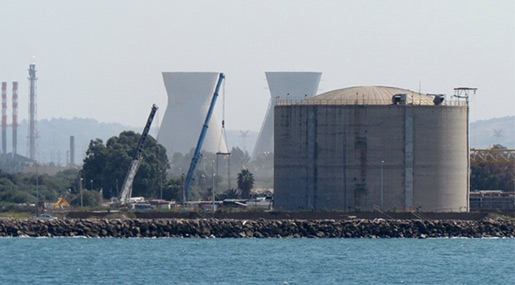
"Israeli" experts had warned that in case Hizbullah exploited those weaknesses - if the group attacked the ship that brings ammonia to the "Israeli" entity on a monthly basis, tens of thousands of "Israeli" settlers could be killed as a result of a chemical reaction between liquid ammonia and seawater.
Fears in the entity coincide with findings of Prof. Ehud Keinan, a senior "Israeli" research chemist at the Technion - the "Israeli" entity's Institute of Technology, regarding the legal proceeding between Haifa Chemicals and the city of Haifa concerning the ammonia storage tanks in Haifa Bay.
According to the paper prepared by Keinan, a ship brings ammonia to the entity about once a month. It docks at Haifa's Kishon Port, and it takes most of a day to unload the cargo to the storage facility. The ship carries 16,700 tons of liquid ammonia, 10,000 tons of which are off-loaded in Haifa.
The ammonia on the ship is carried in five storage tanks. According to Keinan, damage to a single tank could cause a disaster whose effects could exceed that of the atom bombs dropped on Hiroshima and Nagasaki in World War II.
If all five storage tanks were to be compromised, the resultant deadly cloud of ammonia could cover the Haifa area for at least eight hours: Every person in the danger zone would choke to death within one hour, Keinan's paper noted.
The paper had been sent to the "Israeli" entity's so-called Supreme Court which in its turn sent a summary in a classified letter of the document to the "Israeli" prime minister and other "Israeli" officials.
In a statement, the Prime Minister's Office confirmed that it had received the letter and forwarded it to its so-called Security Council, adding that its contents were "discussed with the professionals who deal with ammonia and a response was sent to the letter's sender and to the mayor of Haifa."
The proposal to move the location of the ammonia storage facility to the Eilat-Ashkelon Pipeline Company facility near Ashdod had been rejected, a person involved in the search for an alternative location said.
The docking of the ammonia delivery ship at Ashdod Port not far from the Gaza Strip poses a risk.
"They said that the fact that the boat stands there for a full day is very dangerous because Qassam rockets could be fired at it," said the source, who was speaking on condition of anonymity, adding that during those hours, "it is more dangerous than any storage tank."
What frightens the "Israeli" entity most is Hizbullah's ability to develop and acquire rockets and highly accurate missiles, as they consider the group as "the most significant threat."
According the entity's information, Hizbullah operates a system of rockets and advanced surface-to-surface missiles, and now has 10 times as many rockets as it had on the eve of the Second Lebanon War in 2006.
The group possesses about 130,000 rockets of various types: Grad, with a range of up to 40 kilometers; Fajr [75 kilometers], Zelzal missiles [200 kilometers], Fateh and M-110 [250 kilometers] and the Scud-D missile [up to 700 kilometers].
The entity also fears Hizbullah's diverse launching options: underground launchers in addition to mobile launchers on trucks and commercial vehicles.
The "Israel" Occupation Forces [IOF] estimates that in the next war Hizbullah will be able to fire up to 1,500 rockets a day, compared to about 200 during the 2006 war.
In the UN General Assembly in October 2015, the entity's PM Benjamin Netanyahu shed light on Hizbullah's advanced weapons systems including precise ground-to-ground missiles, SA-22 anti-aircraft missiles and Yakhont surface-to-sea missiles.
The "Israeli" primer further affirmed that throughout the years, Hizbullah had accumulated its experience and gained new capabilities in essential areas such as commando fighting and the operation of drones, some of them capable of combat.
Source: Haaretz, Edited by website team
Comments