Global Arms Sales at Highest Level since Cold War
Local Editor
Global arms sales skyrocketed in the last five years, reaching their highest level since the Cold War in sales to the Middle East, according to a report by the Stockholm International Peace Research Institute [SIPRI].
It said the volume of international weapons transfers had "grown continuously since 2004 and increased by 8.4% between 2007-11 and 2012-2016," with the flow of arms to the Middle East, Asia and Oceania spiking in part due to conflicts raging in the Middle East [ME] and tensions in the South China Sea.
The five biggest exporters - the US, Russia, China, France and Germany - accounted for 74 percent of the total volume of arms exports.
France and Germany accounted for 6% and 5.6% respectively. But the report stated the low rate of French arms exports would likely end due to a series of major defense contracts signed in the past five years.
Russia is reported to have accounted for 23% of global exports between 2012-2016 with 70% of its arms exports going to four countries: India, Vietnam, China and Algeria.
Of all the arms exported by the US, almost half ended up in the ME, with the main buyers being Saudi Arabia, the UAE and Turkey.
"The USA supplies major arms to at least 100 countries around the world - significantly more than any other supplier state", said Dr. Aude Fleurant, director of the SIPRI Arms and Military Expenditure Program.
"Both advanced strike aircraft with cruise missiles and other precision-guided munitions and the latest generation air and missile defense systems account for a significant share of US arms exports," he said.
According to the report, arms imports jumped by 86% between 2012 and 2016 in the ME, accounting for 29% of global arms purchases, almost double the previous five-year period studied.
Saudi Arabia was the world's second largest arms importer after India, with an increase of 212% compared to the previous five-year period, while imports by Qatar rose by 245%.
According to senior SIPRI researcher Pieter Wezeman, "over the past five years, most states in the Middle East have turned primarily to the USA and Europe in their accelerated pursuit of advanced military capabilities. Despite low oil prices, countries in the region continued to order more weapons in 2016, perceiving them as crucial tools for dealing with conflicts and regional tensions."
Several countries in the ME are involved in armed conflicts, such as the Saudi-led campaign in Yemen and in Syria.
According to Wezeman, while the "Israeli" entity is "out of the league of major importers, it is one of the larger arms exporters," ranking 10th of all countries.
The "Israeli" entity belongs to a group of smaller countries that plays a large role in arms trade, such as Germany or France, Wezeman told the Jerusalem Post, adding that, while "Israel" has not been a major arms importer in the past five years, by next year "we will see a change, especially due to the F-35 program."
The "Israeli" entity is set to receive a total of 50 of the stealth fighters, two full squadrons, by 2022.
Of the MOU signed between Washington and Tel Aviv in September that provides the entity with $38 billion in military assistance over the next decade, at least $7 billion of the MOU had been earmarked for purchasing the F-35s.
The statistics compiled by SIPRI, which had monitored international arms transfers from 1969, are based on the transfer of major arms, not small arms, ammunition or electronic arms components, which are harder to track, and would have likely seen "Israel" ranking higher had the statistics focused on that, Wezeman said.
India was reported by SIPRI to be the world's largest importer of major arms in 2012-16, accounting for 13 percent of the global total - far greater than regional rivals China and Pakistan.
"With no regional arms control instruments in place, states in Asia continue to expand their arsenals," said Wezeman, adding that "while China is increasingly able to substitute arms imports with indigenous products, India remains dependent on weapons technology from many willing suppliers, including Russia, the US, European states, ‘Israel' and South Korea."
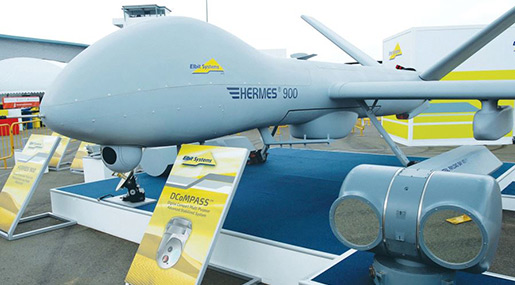
The "Israeli" entity has been supplying India with various weapons systems, missiles and unmanned aerial vehicles over the last few years, making India one of the entity's largest buyers of military hardware.
Over the last five years military trade between the two countries averaged annual sales worth more than $1 billion.
In addition to India, "‘Israel' is exporting arms to a large variety of countries, including those where there are significant tensions, like Colombia and Azerbaijan," Wezeman said.
In terms of "Israel's" neighbors, Lebanon had very modest arms imports and is very much dependent on foreign military aid from the US and Jordan, but "...they have lost the support of Saudi Arabia, which stopped supporting them in 2016," Wezeman said.
Syria had several ongoing arms import deals between 2011-2013, primarily air-defense systems from Russia, but since then SIPRI had "very little information showing major arms imports," Wezeman said.
According to SIPRI, Syria is very difficult to monitor due to the ongoing conflict.
Imports by other southeast Asian countries increased 6.2% from 2007-11 to 2012- 16, with Vietnam significantly increasing its arms imports by 202%, making them the 10th largest arms importer in 2012-2016 compared to 29th place in 2007-2011.
Meanwhile, there was a decrease of 36% in the flow of weapons to Europe, the Americas [18%] and Africa. In the conflict zones of Africa, Algeria was the largest arms importer, accounting for 46 percent of all weapons sales on the continent and Nigeria, Sudan and Ethiopia were the largest buyers of heavy weapons in sub-Saharan Africa.
In the Americas, while Colombia's arms imports decreased by 19%, Mexico's arms imports grew by 184% in 2012-2016 compared to 2007- 2011.
|stockholm international peace research institute
Source: News Agencies, Edited by website team
Comments