State Dep’t: US Open to Dialogue with N Korea
Local Editor
The United States is open to a dialogue with North Korea on denuclearizing the Korean peninsula, but the onus is on Pyongyang to take "meaningful actions" toward that end and to refrain from provocative acts, the State Department said Wednesday.
China earlier Wednesday called for North Korea to suspend its nuclear and missile activities in exchange for a halt in joint military exercises conducted by the US and South Korea.
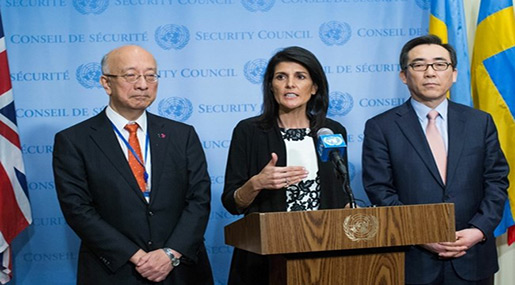
But US Ambassador Nikki Haley made clear after emergency closed consultations of the Security Council that North Korea has to respond first, saying the exercises are defensive and have been held for 40 years with advance notice to Pyongyang.
The military drills are especially needed now after Pyongyang conducted two nuclear tests and 24 ballistic missile launches last year and two sets of missile launches and the assassination of Kim Jong-Un's estranged brother using a chemical weapon this year, she said.
In Washington, State Department acting spokesman Mark Toner said, "At this point we don't see it as a viable deal."
Pentagon spokesman Cmdr. Gary Ross said US activities to defend South Korea "cannot be equated to North Korea's repeated violations of its obligations and agreements."
Haley also defended the upcoming deployment of a US missile defense system in South Korea - strongly opposed by China - saying America would not leave its ally facing the threat of North Korea without help.
"We have not seen any goodwill at all coming from North Korea," Haley said. "I appreciate all my counterparts wanting to talk about talks and negotiations [but] we are not dealing with a rational person."
"With any other country, the US would be seeking negotiations," she said.
Haley went on to say that the US is re-evaluating how it is going to deal with North Korea going forward "and we are making those decisions now and will act accordingly."
"We're not ruling anything out and we're considering every option that's on the table," she said.
South Korean Ambassador Cho Tae-yul rejected the idea of a North Korean nuclear freeze in exchange for halting US-South Korea military exercises, which he stressed are defensive in nature.
"All kinds of options have been exhausted so far," Cho said, "So the only available means to change the North Korean behavior fundamentally is to continue to keep up the pressure and sanctions on North Korea."
But China's UN Ambassador Liu Jieyi warned that "if you look at ... the development of events now on the Korean Peninsula there's a real danger, there's a real risk." The alternative to China's proposal "would be escalation of tension, and the situation may get out of control," he told the Associated Press [AP] and two other reporters.
"We should avoid any worsening of the situation, or still any conflict, any sparks triggering a larger-scale conflict or even war on the Korean Peninsula," Liu said. "That's not something that's in the interest of anyone."
He said implementing China's proposal "shouldn't be hard" if there is political will, but "it would take the agreement of all the sides to get this result."
When asked whether China had a commitment from North Korea to freeze testing, he told AP that "we have been talking to various parties concerned about this."
Haley indicated China's proposal is one option on the table for US consideration along with many others. She said other council members would also all be discussing with their capitals what to do next on North Korea.
Source: News Agencies, Edited by website team
Comments