«Israeli» Minister: «Israel» to Hit Civilians in Future War with Lebanon
Local Editor
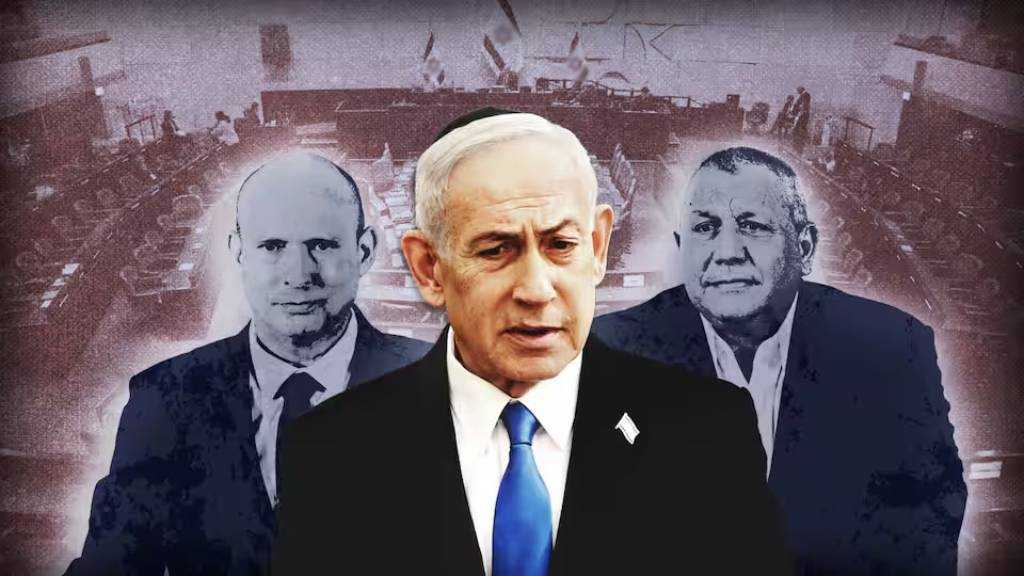
Naftali Bennett and Lebanese president agree: There's no line between Hezbollah and Lebanese state. Lebanese must realize another war with the "Israeli" entity means Lebanon will be sent back to Middle Ages, Bennett said.
Lebanese President Michel Aoun paid an official visit to Cairo a month ago, ahead of which he gave a number of interviews to the Egyptian media. Aoun was only elected president after a while of presidential vacancy.
Hezbollah is a significant part of the Lebanese people, Aoun explained. "As long as ‘Israel' occupies land and covets the natural resources of Lebanon, and as long as the Lebanese military lacks the power to stand up to ‘Israel', [Hezbollah's] arms are essential, in that they complement the actions of the army and do not contradict them," he said, adding, "They are a major part of Lebanon's defense."
Brig. Gen. Assaf Orion from the Institute for National Security Studies wrote recently that Aoun's comments were a "lifting of the official veil and tearing off of the mask of the well-known Lebanese reality - which widely accepted Western diplomacy tends to blur. The Lebanese president abolishes the forced distinction between the ostensibly sovereign state and Hezbollah. Thus, the Lebanese president takes official responsibility for any actions by Hezbollah, including against ‘Israel'."
Aoun's declaration also tallies with the facts on the ground. At a meeting of the Knesset Foreign Affairs and War Committee this past week, War Minister Avigdor Lieberman said that the Lebanese army is now "a subsidiary unit of Hezbollah."
What does that mean with regard to an "Israeli" response against Hezbollah in case another war breaks out on the northern front? This column recently discussed the basic difficulty that faces the "Israel" Occupation Forces [IOF] in Lebanon: limited ability to deal with the threat of high-trajectory rockets directed against both the "Israeli" settlers and the strategic infrastructure on the rear front. On the southern front, even though the air force lacks a proper offensive response to rockets, the missile intercept systems - chiefly the Iron Dome batteries - are enough to thwart most of the launches.
In the north, with Hezbollah able to launch more than 1,000 rockets into the entity on a single day of fighting, the offensive solution seems partial and the defensive solution limited.
The "Israeli" entity's so-called "State Comptroller's" report on the 2014 war in Gaza disappeared from the headlines within a few days, but the difficulties facing the entity in future conflicts in Gaza - and even more so in Lebanon - remain.
At this point, it's interesting to listen to security cabinet member Naftali Bennett, who served as a reserve officer during the Second Lebanon War in 2006 said that hunting rocket launchers during a war is almost impossible adding that he says this "as someone who specialized in hunting rocket launchers."
During the 2006 war, Bennett commanded an elite unit sent deep into southern Lebanon to find Hezbollah's rocket-launching squads.
"When we worked in a particular area, we did reduce the teams of rocket launchers there - but they simply moved a little farther north," Bennett related. Since then, he said, 11 years have passed and Hezbollah has learned to deploy in a more sophisticated manner. "They moved their launchers from the nature reserves, outposts in open areas, to dense urban areas. You can't fight rockets with tweezers. If you can't reach the house where the launcher is, you're not effective, and the number of houses you have to get through is enormous," he explained.
"After I was released from reserve duty, I read all of the books you wrote about the war," Bennett told me. "I understood in retrospect that the fundamental event of the war took place on its first day, in a phone call between [former Prime Minister] Ehud Olmert and Condoleezza Rice." President George W. Bush's secretary of state had asked the prime minister not to hit Lebanon's infrastructure, and was given a positive response. As a result, "there was no way that Israel could win the war," Bennett said.
"Lebanon presented itself as a country that wants quiet, that has no influence over Hezbollah," he continued. "Today, Hezbollah is embedded in sovereign Lebanon. It is part of the government and, according to the president, also part of its security forces."
Bennett believes this should be the "Israeli" entity's official stance. "The Lebanese institutions, its infrastructure, airport, power stations, traffic junctions, Lebanese Army bases - they should all be legitimate targets if a war breaks out. That's what we should already be saying to them and the world now. If Hezbollah fires missiles at the Israeli home front, this will mean sending Lebanon back to the Middle Ages," he said.
At the same time, he notes that this is not necessarily the plan for a future war, but instead an attempt to avoid one: "If we declare and market this message aggressively enough now, we might be able to prevent the next war. After all, we have no intention of attacking Lebanon."
According to Bennett, if war breaks out anyway, a massive attack on the infrastructure - along with additional air and ground action by the IOF - will speed up international intervention and shorten the campaign. "That will lead them to stop it quickly - and we have an interest in the war being as short as possible," he said. "I haven't said these things publicly up until now. But it's important that we convey the message and prepare to deal with the legal and diplomatic aspects. That is the best way to avoid a war."
Source: Haaretz, Edited by website team
Comments