- Home
- ISLAMIC RESISTANCE
- SECRETARY-GENERAL
-
Full Speeches
- Speeches-2000
- Speeches-2006
- Speeches-2007
- Speeches-2008
- Speeches-2009
- Speeches-2010
- Speeches-2011
- Speeches-2012
- Speeches-2013
- Speeches-2014
- Speeches-2015
- Speeches-2016
- Speeches-2017
- Speeches-2018
- Speeches-2019
- Speeches-2020
- Speeches-2021
- Speeches-2022
- Speeches-2023
- Speeches-2024
- Speeches-2025
- Speeches-2026
- Speech-Reports
- SG
-
Full Speeches
- Voices
- Ten Day Dawn
- The Biggest Crime
- Martyr Leaders

Iran’s Zafar Satellite on Ready-to-launch List - Space Agency
By Staff, Agencies
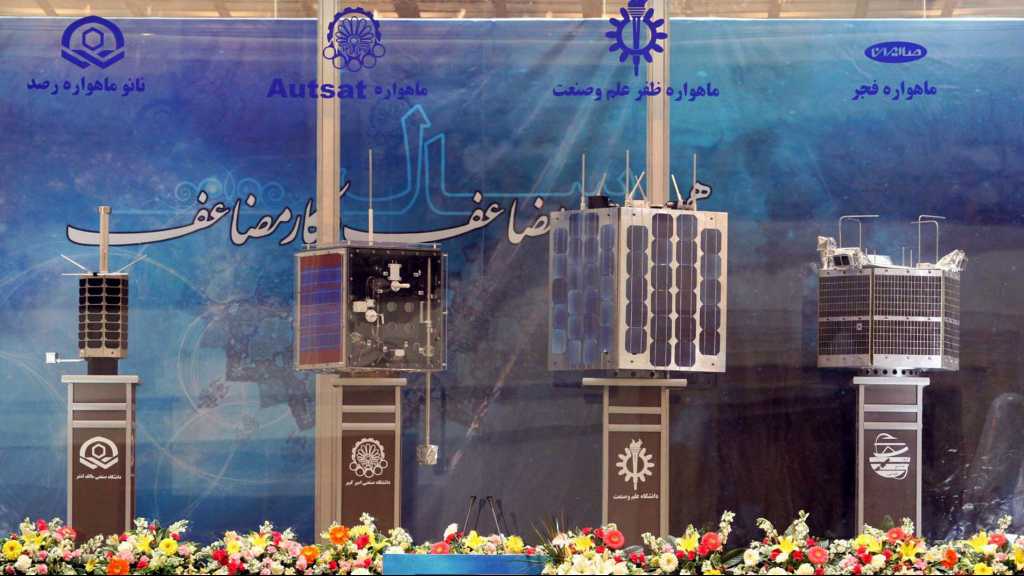
Iran is due to send a highly advanced version of its satellites on discovery missions, the latest breakthrough in the field of aerospace by the Islamic Republic’s competent experts and specialists.
Zafar, a fully sophisticated satellite built at the Iran’s University of Science and Technology, was announced by the Iranian Space Agency [ISA] on Saturday to have been placed atop the ready-to-launch list.
The new satellite, designed for an 18-month activity plan, weighs about 90 kilograms and is equipped with four color cameras to capture the Earth's surface with a resolution of 80 meters.
Zafar is similar in size and weight to its previous version —Payam— but distinct in one way as it can move in circular orbit and send a message alongside its exploratory missions.
In January 2019, the domestically-built Payam [Message] satellite was launched into space with an aim to collect environmental information; however, technical problems that occurred during the final stage of the launch prevented the spacecraft from reaching orbit.
Iran's indigenous satellite launch capabilities first made headlines when the first locally-built satellite, Omid [Hope], was launched in 2009.
The country also sent its first bio-capsule containing living creatures into space in February 2010, using a Kavoshgar-3 [Explorer-3] carrier.
In February 2015, the Islamic Republic placed its domestically-made Fajr [Dawn] satellite into orbit, which is capable of taking and transmitting high-quality photos to stations on Earth.
The Islamic Republic considers its space program a matter of national pride, and has said its space vehicle launches are for scientific purposes.
Comments
- Related News
Iran Downs 52nd US MQ-9 Drone over Qeshm Island
one month ago