Sheikh Qassem’s Full Speech on the 6th Martyrdom Anniv. Gen. Qassem Soleimani and Abu Mahdi Al-Muhandis
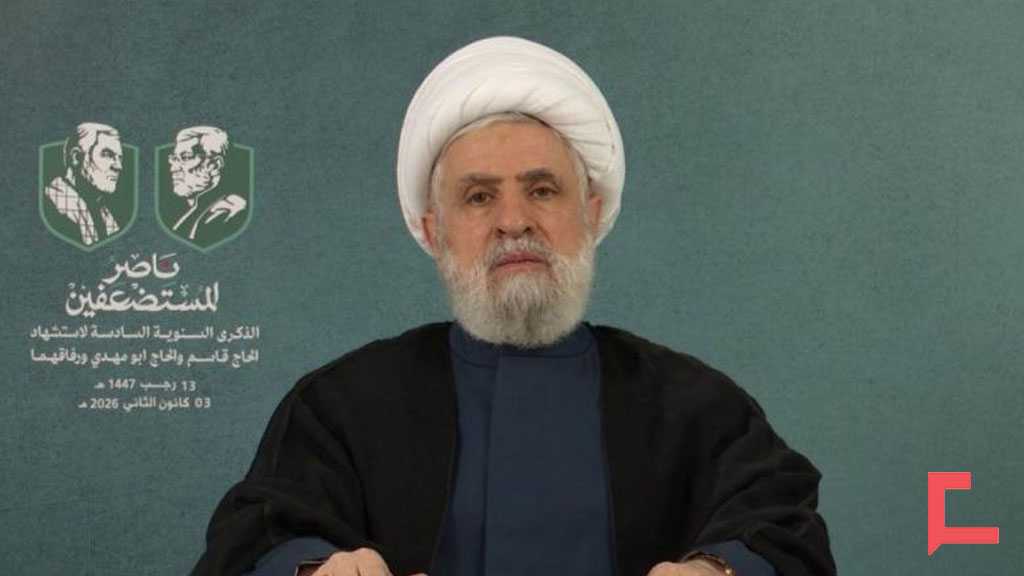
Translated by Al-Ahed News, Hezbollah Media Relations
The full speech of Hezbollah Secretary His Eminence Sheikh Naim Qassem on the sixth martyrdom anniversary of the two leaders Hajj Qassem Soleimani and Hajj Abu Mahdi Al-Muhandis on January 4, 2026.
In the Name of God, the Most Merciful, the Most Compassionate. Praise be to God, Lord of the worlds. Peace and blessings be upon the noblest of creation, our master, our beloved, and our leader, Abu al-Qassem Muhammad, upon his pure and immaculate family, his righteous and chosen companions, and upon all the prophets and the righteous until the Day of Judgment. Peace, God’s mercy, and His blessings be upon you.
Today marks the sixth anniversary of the martyrdom of the great commander, Hajj Qassem Soleimani. We commemorate this occasion together and will speak about the martyr and his brothers in general, as well as about the political situation. But we begin with this great occasion we are observing today: the 13th of Rajab, the birth anniversary of the Commander of the Faithful, peace be upon him, Ali ibn Abi Talib. This birth granted humanity immense blessings. When Imam Ali, peace be upon him, is mentioned, two things immediately come to mind: first, his asceticism, and second, the justice for which he became renowned.
Sheikh Qassem: Imam Ali [AS] walked the path of truth
He was the ascetic who said: “Indeed, your Imam has contented himself from this world with two worn garments, and from his food with two loaves. Truly, you cannot live like this, but help me through piety, effort, chastity, and uprightness.”
He was the just ruler who distributed the wealth of the Muslims’ treasury equally, who dismissed corrupt governors, and who endured many hardships during the five years of his rule because of his justice and his bond with his Creator, walking always on the path of truth.
The Prophet Muhammad, peace and blessings be upon him and his family, said about him at Ghadir Khumm:
“Whoever I am his master, Ali is his master. O God, befriend whoever befriends him, oppose whoever opposes him, support whoever supports him, forsake whoever forsakes him, and let the truth turn with him wherever he turns.”
The Messenger of God, peace and blessings be upon him and his family, also spoke of his rank, his role, and what he did for Islam on the day when the confederate forces gathered from every direction in the Battle of the Trench. When the Commander of the Faithful, peace be upon him, confronted Amr ibn Abd Wudd al-Amiri, the Prophet said:
“Ali’s single strike on the Day of the Trench is equal to the worship of all humans and jinn.”
Praise be to God who blessed us with the Commander of the Faithful, Ali, peace be upon him.
Sheikh Qassem: Martyr Soleimani Was a Man of the Battlefield
We reflect on and speak about Hajj Qassem Soleimani, the great commanding general, may God be pleased with him. He was born in Kerman Province and joined the Islamic Revolutionary Guard Corps in 1980, the beginning of the formation of the Corps after the victory of the blessed Islamic Revolution in 1979. He rose quickly through various positions because of his exceptional qualities.
Hajj Qassem possessed remarkable military competence and outstanding administrative ability. He was constantly learning, reading, training, and teaching. He fought on the front lines of the Sacred Defense during the eight-year confrontation between Iran and Iraq. He had a strategic political awareness, thinking in broad dimensions and analyzing military developments through a strategic lens.
He was truly a man of the battlefield. He was always present wherever he was needed, not a commander who led from behind a desk or from a distance, but a leader at the very heart of the field, advancing before others and planning based on geography and direct observation. He was brave and bold, and widely read. I recall a personal story: I had written a book titled “Khalifat Allah” (God’s Vicegerent) and gifted it to him. Two weeks later, when I met him, he began discussing the content of the book with me. I asked, “You read it?” He replied, “I always read in my spare time,” and went on. He cared deeply about the fighters and was attentive to their social conditions. He sustained multiple injuries to his body as a result of the many battles he fought.
One of Hajj Qassem Soleimani’s distinguishing traits, alongside his great stature, was his extreme precision in matters of religious law. His Eminence the Leader, Imam Khamenei (may his shadow endure), said of him: “He was extremely meticulous in observing the religious limits.” He also said of him: “He was a man of sound judgment and planning.” He would think carefully and manage wisely, and above all this was his exceptional sincerity.
He was a living embodiment of the noble verse:
“O believers! Be mindful of Allah, and say what is right. He will bless your deeds for you, and forgive your sins. And whoever obeys Allah and His Messenger, has truly achieved a great triumph.” (Al-Ahzab, 70–71).
He was a model of obedience to God and a model of the authentic, humane Islamic project that works for the good of humanity.
Imam Khamenei (may his shadow endure) awarded him the highest medal of honor in the Islamic Republic, one that had never before been granted to anyone: the Order of Zulfiqar.
Soleimani’s view of the Leader, Imam Khamenei (may his shadow endure), was a view filled with love, loyalty, engagement, and obedience. This is one of the fundamental reasons behind success in a relationship with wise leadership.
Soleimani said about His Eminence the Leader: “Through my twenty years of experience in serving the Leader, I witnessed the fruits of piety, whose outcome is wisdom that flows on the tongue, and into the heart and mind. I saw it fully embodied in the Leader.”
We can say that Hajj Qassem, the great martyred commander and leader of the Axis of Resistance, was deeply devoted to Imam Khomeini (may his soul be sanctified), completely immersed in his personality. This is something we clearly sense from the will he wrote. Early on, he understood the depth of this bond and this relationship.
The martyr also had a unique relationship with His Eminence the Sayyed of the Nation’s Martyrs, Sayyed Hassan Nasrallah (may God be pleased with him). In truth, the brotherhood between them was exceptional. They genuinely longed for one another.
I remember that at times His Eminence the Sayyed would tell us, “I met yesterday with the martyred commander Soleimani.” We would ask, “Was there something specific? Special matters?” He would reply, “No. He missed me, so he came.” Of course, we would talk about the general situation: political developments, resistance affairs, the state of the region, confronting “Israel,” confronting America. That is natural. But there was no specific agenda that brought him. He simply felt that time had passed and that we should meet, and so he came for that reason.
I even recall that one day before his martyrdom, when he came from Syria to Lebanon, he came only to greet His Eminence the Sayyed. Then he returned to Syria, and afterward America (under Trump) assassinated him in Iraq at the airport. The reason he came to see His Eminence was this love, this Islamic, brotherly, humane relationship that was translated into action on the ground, an intimate, influential, and effective relationship across the entire Axis, by God’s grace.
What was the objective that Martyr Soleimani worked for? He had been commander of the Quds Force since 1998, and the primary goal was to support the resistance in Palestine and across the region, in Lebanon, Syria, Iraq, and Yemen, and to thwart American plans.
Here we can see, through the very establishment of the Quds Force and through Hajj Qassem’s leadership of it, how great the blessed Islamic Republic of Iran’s commitment is to the Palestinian cause. This began with Imam Khomeini (may his noble soul be sanctified) and was continued by Imam Khamenei (may his shadow endure), because of how central and foundational this cause is in our region and in the world.
He was the commander of the Axis. I remember clearly that when he was appointed in 1998 and began communicating with Lebanon, since the Quds Force operates outside Iran and Palestine and Lebanon are central arenas, we felt that a real shift had taken place. Capabilities became very great, training expanded significantly, and so did planning and operations that strengthened the resistance, enhanced its dignity, increased its power, and enabled it to achieve its objectives. In truth, Hajj Qassem gave enormously. He had ability, and he also had deep faith in this cause.
Here, we must also acknowledge, alongside Hajj Qassem, the pioneering role of the Islamic Republic of Iran in supporting the resistance and Palestine and in standing with the causes of justice and humanity.
We also affirm the importance of the Palestinian resistance, the Palestinian people, Gaza, the West Bank, and all the sacrifices this people have offered. According to the latest figures, nearly a quarter of a million martyrs and wounded were presented by Gaza during the war and confrontation of the Al-Aqsa Flood against the “Israeli”-American enemy. These people offered tremendous sacrifices for the resistance, yet they did not submit. This is a very important point.
Lebanon too is a model of sacrifice, dignity, and liberation, and it has achieved major accomplishments—Lebanon, through its resistance, its people, and its army, and at the head of them all, the Sayyed of the Nation’s Martyrs.
Sheikh Qassem: Sayyed Nasrallah Gave His Soul, His Life, His Son, and All He Possessed in Devotion to God for the Sake of the Palestinian Cause
Sayyed Hassan Nasrallah, may God be pleased with him, gave his soul, his life, his son, and all that he possessed in devotion to God for this great cause, the cause of Palestine, alongside the righteous martyrs, alongside the people, alongside all the sacrifices we see shaping our lives and shaping our region.
We must salute Yemen—this model of courageous and sacrificial support for what is right. And we must salute Iraq, which has stood in solidarity with love and generosity.
All of these arenas were, in truth, the fields of movement for Martyr Qassem Soleimani. He is a model for leaders and for the path itself. We lost him, but he gained the medal of martyrdom in confrontation with American tyranny and Zionist criminality.
And I say to Hajj Qassem: We are carrying on. Your loved ones are continuing. Your sons are continuing. The peoples of this region are continuing. Your blood has given us renewed strength. If the enemy thinks that by killing you it can stop this momentum, it is gravely mistaken. This momentum continues, by God’s grace.
Here, we must also mention the great martyr Abu Mahdi al-Muhandis, who was always at the side of the martyr Qassem Soleimani.
Abu Mahdi al-Muhandis was a distinctive Iraqi figure of faith and mission. He had an exceptional record. He was a key figure in expelling ISIS from Iraq and in founding the Popular Mobilization Forces, helping build the strength inside Iraq that ultimately brought down ISIS’s attempt to establish a state.
Naturally, because the defeat of ISIS meant the defeat of an American project, America targeted Martyr Qassem Soleimani and Martyr Abu Mahdi al-Muhandis to protect what it had created. As Hillary Clinton herself stated, they had contributed to the establishment of ISIS. Thus, this was a defense of ISIS and of the collapse of the opposing project. But God willing, through the blood offered by Martyr Abu Mahdi al-Muhandis and Martyr Qassem Soleimani, this path will continue.
Here, out of remembrance and loyalty, we must mention the martyrs of the blessed Islamic Revolutionary Guard Corps among the commanders who were martyred in Lebanon, Syria, and Palestine in this region: Martyr Sayyed Abu Ali Hijazi, Martyr Sayyed Rida Mousawi, Martyr Hajj Abu Mahdi Zahedi, Martyr Abbas Nilfroushan, and Martyr Mohammad Saeed Izadi (Hajj Ramadan). These martyrs gave their lives.
And on this occasion, as Hamas has announced the names of five of its senior martyred leaders, they too stand in this same rank, in this same giving, and on the path to Al-Quds. I mention the blessed and dear martyrs of Hamas: Martyr Mohammad Sinwar, Chief of Staff; Martyr Abu Ubaida Hudhayfa al-Kahlout; Martyr Mohammad Shabana; Martyr Hikmat Issa; and Martyr Raed Saad.
We are also now in the days marking the forty days since the martyrdom of Sayyed Abu Ali al-Tabatabaei, may God be pleased with him.
They are a group of martyrs who gave, offered, and sacrificed on this path. But the central question is: did they give and then the matter ended? Did their killing throw our path into disarray? Not at all. Our path continues strong, drawing strength from their momentum, and God willing, it continues stronger and stronger.
To the souls of Martyr Qassem Soleimani, Abu Mahdi al-Muhandis, and all the martyrs we have mentioned, and in all the arenas, and those we did not mention who offered their lives on this path, together with them and at their head the Sayyed of the Nation’s Martyrs, Sayyed Hassan Nasrallah, may God be pleased with him, we dedicate Surat al-Fatiha, along with prayers upon Muhammad and the family of Muhammad.
I will speak about three matters related to the political situation.
First: Global arrogance, represented first by Britain and France, and later by the United States and other Western countries, implanted “Israel” for expansionist, cultural, economic, social, and political objectives. In other words, the “Israeli” entity was not planted merely as a geographic presence. It was implanted as a cultural and civilizational project aimed at changing ways of thinking and controlling the economy and future generations. All of this is part of the project of planting “Israel” to serve as a stick when force is needed, and as a transmitter of ideas and convictions when the stick is not needed.
Since the end of the First World War, this entity began to be established through Britain. The geographic point chosen in our region was a sensitive, influential, and strategic one, and that is why it was selected.
In that period, after the establishment of the “Israeli” entity in 1947, the Shah’s Iran was playing the role of the policeman of the Gulf and intimidating the entire Gulf region. There had to be a relationship between the Shah and “Israel” in order to strengthen “Israel”, since their objectives were aligned with those of America and the Shah. This situation remained imposed on the heart of the Gulf region for a long time, until the blessed Islamic Revolution triumphed under the leadership of Imam Khomeini, may his soul be sanctified.
Sheikh Qassem: The resistance took on a new dimension in our region, especially in Palestine and Lebanon
When the Islamic Revolution triumphed in 1979, the entire picture was transformed. Iran was no longer in America’s embrace, nor was it allied with “Israel”. Instead, a leadership emerged that raised the practical slogan: “Neither East nor West.” No allegiance to America and no allegiance to the Soviet Union. Imam Khomeini, may his soul be sanctified, was thus able to carve out a path for Iran toward independence, distinction, and prominence, standing outside the equations of Eastern or Western domination.
With the emergence of Islamic Iran, the door of resistance was opened. The door was opened to supporting peoples in claiming their rights, and to restoring the Palestinian cause to its vitality and central role. You know that in 1978, a year or less before the victory of the blessed Islamic Revolution, the Camp David accords had been concluded. It was expected that the entire region would move toward full surrender and grant “Israel” whatever it wanted.
With the arrival of the blessed Islamic Revolution, a line was drawn. “Israel” could no longer continue as before, nor could America. A popular awakening began through resistance, and the support of the Islamic Republic began to have a profound impact on the region.
Of course, the peoples of the region have always yearned for independence, for freedom, and for the liberation of Palestine. That is why the resistance took on a new dimension in our region, especially in Palestine and Lebanon. This was the most prominent development.
When we observe the positions taken, it is often said that there is a similarity between the stances of Hezbollah and those of the Islamic Republic, between the Palestinian resistance and the Islamic Republic, and between any faction or any state and the Islamic Republic. Is this a problem? No. There is a cross-fertilization of positions. Does this harm patriotism? Also no. It does not harm patriotism, because nothing national is isolated from the regional or the global. Any group, any country, any faction, any association, any institution anywhere in the world will naturally find others who resemble it, who share similar ideas, and who are willing to support that direction. From this, national, regional, and international relationships emerge. That is why our relationship with Iran is entirely natural, because this convergence exists.
Today, with whom does global arrogance align itself? It aligns itself with its own followers, extending its hand globally to states, movements, and national actors. Instead of peoples turning to it for help in their national causes, it goes to them to impose its conditions, impose its convictions, and impose its objectives. That is the first point.
Second: A defining feature of the Axis of Resistance is that the convergence in vision has enabled every party within the axis to meet its needs and requirements. Today, Hezbollah engages with Iran, cooperates with Iran, and receives Iran’s support. Fine. What has Iran taken in return for this support? It has taken nothing from us. Iran does not support in exchange for economic, political, or cultural gains. We have a project, and that project intersects with the Iranian project ethically and humanely, in terms of independence and the liberation of Palestine. The core principles, the cultural vision, and the political outlook converge. But there are no Iranian objectives imposed to be taken from us.
It is said: “Fine, if there are no objectives, then what does Iran gain?”
It gains the fact that when the entire surrounding environment in the region shares the same convictions, we have a positive climate for coexistence and cooperation among these countries, and people feel at ease because the region is grounded on sound principles.
Whereas when we look at arrogance, meaning American tutelage or other forms of tutelage, what do we see? We see interference in the economy, interference in politics, the appointment of officials, pressure to change convictions, and interference in cultural matters. Colonialism, and the states that interfere in our country, in reality intervene for their own gains, not for ours.
If we compare Iran with the other countries that are intervening now in Lebanon, or that intervened in Lebanon in the past, we see that those countries intervene because they have economic, political, social, and cultural interests. They intervene in order to change the direction. Whereas the Islamic Republic has never intervened to change the direction in any field.
We are the ones who believe in resisting the “Israeli” entity. We believe that America is tyrannical and wants to attack us. We believe that we must live with dignity and that our country must be liberated. And they say to us: “We agree with you. We are with you, and we are ready to support you.”
We took from Iran, and Iran took nothing from us. But look at the tutelage practiced by others.
Hezbollah acts on the basis of its faith and the interests it sees. When someone says, “On what basis do you act this way? Why do you pursue resistance? Why do you hold certain convictions and carry out certain actions?”—in the end, everyone acts according to their beliefs and the interests they judge to be appropriate.
Hezbollah proceeds from its faith and from the interest it sees in adopting the option of resistance and working on that basis. Building a capable and just state and serving the people are, from Hezbollah’s perspective, both matters of faith and of interest.
Resistance is faith and interest. Confronting corruption is faith and interest. Rejecting occupation is faith and interest.
On this basis, we take pride in our relationship with Iran, which has given to us and taken nothing from us. Shame, all shame, on those who submit to American tutelage and become its followers.
Shame, all shame, on those who promote “Israel’s” right to occupation, justify its pretexts, and do not demand its withdrawal or pressure it to stop its aggression. Shame, all shame, on those who do not contribute—even through media pressure—to supporting our brothers in Palestine, while they rush to denounce and rally around any minor incident involving an arrogant power or one of those who claim guardianship over Lebanon.
Sheikh Qassem: Hezbollah Wants a Sovereign, Free, Independent, and Capable Lebanon
Third: Hezbollah wants Lebanon to be sovereign, free, independent, and strong. We want it sovereign, exercising its authority over all Lebanese territory, especially the south.
We want it free in the cultural, political, and social choices of its people, without interference from anyone. We want it independent, not subject to any foreign or regional tutelage.
We want it strong, with a solid administrative structure, a sound system of governance, cohesive institutions, and a strong army.
How do we achieve these objectives, in our view? They can be achieved through the following:
First: We call for dialog and consensus, and we stress national unity in the face of enemies. This unity is not undermined by internal differences, as long as they remain under the framework of the constitution and the law. When we speak of unity, we do not mean that we all think alike, but at the very least we confront the same enemy and agree that there is one enemy. As for internal matters, we may differ on some issues, and let the constitution and the law be the arbiter.
Second: The priority must be to stop the aggression, secure an “Israeli” withdrawal, free the captives, and carry out reconstruction. Then, we can discuss a national strategy so that we know how to protect our country and how to build it for the future.
Third: We call for holding parliamentary elections at their scheduled time.
Fourth: We call for the return of depositors’ funds, and for proposed laws to ensure that depositors receive their full rights, without any reduction.
Fifth: We call for arming the Lebanese army so that it can truly be a national army that defends the country against enemies, in addition to its other duties in cracking down on drug gangs, theft, agents, and all those who tamper with the nation’s security.
Sixth: We call for fairness for public-sector employees so that the administration can function properly.
Finally, the level of sacrifice offered by Hajj Qassem, Hajj Abu Mahdi al-Muhandis, the Sayyed of the Nation’s Martyrs Sayyed Hassan, and all these righteous men, rises to the level of the greatest divine distinction, martyrdom. It also rises to the highest level of honor in patriotism and sovereignty, each according to his position, and to the highest level of appreciation for sincerity in the path of God Almighty.
We offer both condolences and congratulations for Martyr Qassem, for the Sayyed of the Nation’s Martyrs, for Abu Mahdi al-Muhandis, and for all the martyrs from Iran, Palestine, Lebanon, Yemen, Iraq, and all the arenas of confrontation and sacrifice.
To all their souls, we dedicate the reward of the blessed Surat al-Fatiha, along with prayers upon Muhammad and the family of Muhammad.
Peace and God’s mercy and blessings be upon you.
Comments