The Million-Man Defiance: The Funeral That Revealed Iran’s Enduring Strength
By Mohamad Hammoud
How Imam Ali Khamenei’s Farewell Became a Global Demonstration of Unity, Faith and Regional Influence
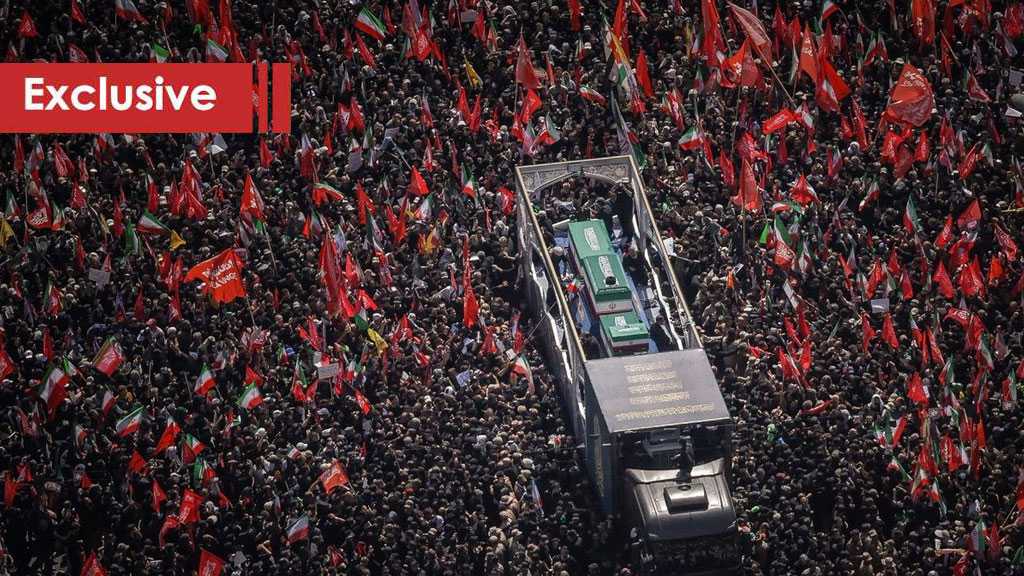
For years, much of the Western political imagination treated Iran as a state that could crack at any moment under pressure, producing the political collapse Washington and “Israel” had long hoped to engineer. But that collapse never came. Even the belief that assassinating Imam Sayyed Ali Khamenei would be the tipping point ultimately proved unfounded. Instead, that illusion was shattered during an extensive, week-long state funeral that transformed national mourning into one of the most significant political and religious gatherings in modern Iranian history. The ceremonies became a testament to unity, resilience, regional influence, and international anti-imperialist solidarity, all under a single banner of resistance. The scale was so extraordinary that even hostile media outlets could not ignore the sheer magnitude of the event.
A Catalyst for Transnational Unity
Reuters described the procession as a message to the United States and “Israel” that the attempt to break the Islamic Republic had failed. According to TIME, the elaborate, multi-day ceremonies across five major cities proved that the institutional foundations of the Islamic Republic could absorb catastrophic leadership losses without losing political, bureaucratic, or military momentum.
The mourning for a leader, martyred in war, became more than just collective grief - it was a public declaration that the state itself remained intact, its networks of loyalty undiminished, and the symbolic authority of the Islamic Republic radiating beyond Iran’s borders. The BBC called the funeral an “intensely political moment,” underscoring a deeper reality: these ceremonies were not simply about death, but about continuity under fire.
A Message in Mourning
Western media repeatedly returned to one idea: Iran was not merely burying a leader; it was speaking to its adversaries. CNN described the funeral as a defiant message to the Trump administration, while Reuters and the BBC emphasized that the ceremonies carried political meaning far beyond ritual grief. The funeral route-winding through Tehran, Najaf, Karbala, Qom, and Mashhad-was not simply a path of mourning; it was a living map of allegiance, shared history, religious authority, and geopolitical influence.
The scale of the symbolism exposed the shallowness of the regime-change fantasy. While Western strategists often measure legitimacy through battlefield victories or narratives crafted in distant newsrooms, the funeral projected a different kind of authority- one rooted in sacrifice, memory, religious identity, and collective endurance.
The Transnational Geometry of the Axis
Routing the funeral procession through the Iraqi holy cities of Najaf and Karbala added an unprecedented transnational dimension, highlighting just how far Iran’s regional alliances extend. The sight of mourners reaching out to touch the coffin, joining the river of grief and remembrance, reinforced a reality that Western coverage too often reduces to simplistic analysis: Iran is not just a government-it is a node in a far broader religious, political, and emotional community.
Al Jazeera English reported that the cross-border ceremonies demonstrated the operational depth of the Axis of Resistance. The formal reception of the casket by senior Iraqi officials and regional paramilitary commanders projected a message of geopolitical defiance toward Washington and “Israel.”
Bloomberg described the funeral as a mass event, while the Financial Times framed it as part of Iran’s effort to project regional power. Even when neutral in tone, those descriptions acknowledged that Iran continues to command loyalty in ways its adversaries struggle to understand.
The Mandate for Future Mobilization
The funeral’s symbolism was unmistakable: revolutionary slogans, red flags symbolizing blood revenge, and anti-Western banners transformed a moment of loss into a display of political determination. Reuters noted that the ceremonies projected the leader’s death not as weakness, but as a catalyst for renewed mobilization. Across much of the Western press, the funeral presented the image of a state that had absorbed a major blow without losing its political foundations.
The funeral’s greatest political power lay in transforming grief into discipline. It told the West that eliminating leaders does not weaken a movement built on memory, sacrifice, and endurance. Reuters summarized the message: the attempt to break the Islamic Republic had failed.
That is why the funeral should be understood not as vulnerability, but as an answer to it. The West anticipated fragmentation and found choreography. It expected retreat and found procession. It looked for silence and found a political sermon carried by millions.
In the end, Imam Khamenei’s funeral became a reminder that power is not always expressed through military force, and defiance is not always spoken in the language of war. Sometimes it is carried by a coffin through streets filled with people who refuse to bow.