J.D. Vance, “Israel” and the Shadows of Diplomacy
By Mohamad Hammoud
From sabotage in Iran talks to the Epstein file, the Vice President’s interview exposes the rot behind American foreign policy
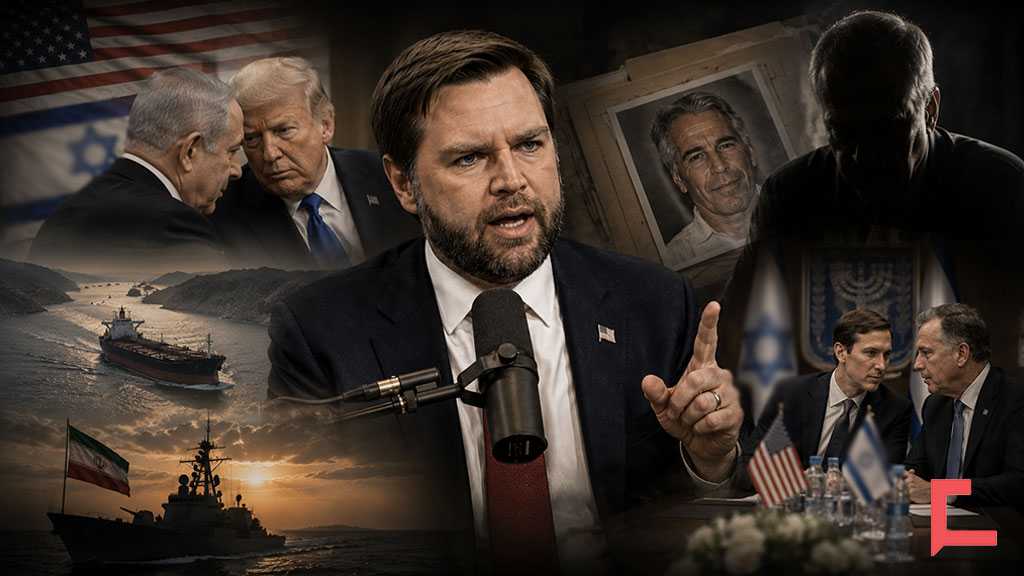
For decades, American officials have disagreed behind closed doors over Middle East policy while presenting a united front in public. That illusion was shattered when Vice President J.D. Vance sat down for a candid, unscripted conversation on The Joe Rogan Experience. Vance did not mince words: he leveled one of the most pointed accusations in memory from a sitting vice president against “Israel.” Vance asserted that certain elements within the government of “Israel” were not just disagreeing, but actively working to sabotage the administration’s efforts to secure peace with Iran because they preferred a prolonged military confrontation over a negotiated settlement.
According to Reuters, Vance told Rogan he knew “beyond a shadow of a doubt” that people inside the “Israeli” government were working to manipulate American public opinion to push Washington away from negotiations and keep the conflict alive. Vance described how these networks were deliberately sabotaging negotiations through leaks and pressure campaigns. His words cut against Washington’s usual script of neutrality, exposing a messy reality: American diplomacy is often compromised by external loyalties. This wasn’t just a personal belief. It echoed a shift inside the Trump administration, where some now argue that America’s Middle East playbook should be written in Washington, not dictated by regional partners.
The Epstein Files Enter the Conversation
Vance also turned to another controversy that has fueled public skepticism toward American institutions: the Jeffrey Epstein files. He admitted the administration had “absolutely screwed up” its communications surrounding the declassification of the Epstein files, pointing to errors by former Attorney General Pam Bondi. While Vance denied an active cover-up, the mishandling of these records underscores a persistent pattern of elite impunity that shields powerful figures from genuine scrutiny.
The interview became even more controversial when Vance agreed with Rogan that Epstein maintained deep connections to the highest levels of both American and “Israel” intelligence networks. By acknowledging that Epstein operated within these intelligence spheres, the vice president validated long-held public suspicions regarding the “deep state” and institutional permissiveness.
Drop Site’s Allegations Raise New Questions
The interview gained additional significance because it coincided with reporting from Drop Site News describing alleged Iranian concerns about the administration’s negotiating team. According to an investigative report published by Drop Site News, senior Iranian negotiators warned Vance that Jared Kushner and Steve Witkoff should not be treated as conventional diplomats because they viewed both men as actively manipulating the negotiations to serve their own financial interests rather than American security.
According to the report, an Iranian official alleged that these men—neither of whom has diplomatic experience—were using classified information to manipulate financial markets. Iran also alleged that individuals close to President Trump profited by as much as $9 billion.
The Drop Site News article further alleges that Kushner and Witkoff systematically funneled sensitive negotiation details directly to Prime Minister Benjamin Netanyahu and the Mossad. This allegation is supported by reporting from Axios, which revealed that both Kushner and Witkoff maintained near-daily contact with "Israeli" leadership after the talks began. For Iran, this confirmed its suspicion that American negotiators were conduits for “Israel’s” interests.
A Deeply Compromised Foreign Policy
Predictably, the administration moved quickly to contain the political fallout. White House spokesperson Anna Kelly called the allegations of market manipulation and private dealmaking flat-out false, dismissing the investigative reports as little more than hostile propaganda. Kelly dismissed the investigative reporting as hostile propaganda but did not address the reported near-daily communications between Kushner, Witkoff, and Israeli leadership.
That defensive stance hasn’t eased the tension between Vance’s public calls for American independence and the behind-the-scenes maneuvering by his colleagues. The gap between Vance’s on-the-record defiance and the team’s private backchannels makes one thing clear: American foreign policy is still riddled with internal contradictions.
Conclusion
Vance’s interview was not just a media moment; it was a rare glimpse into the shadows behind American foreign policy.
By naming “Israel” as a saboteur and connecting the culture of diplomatic impunity to the Epstein saga, Vance exposed the rot that prevents genuine peace. Add in Iran’s warnings about Kushner and Witkoff, and what emerges is a portrait of negotiations warped by profit, secrecy, and betrayal.
Whether the allegations are ever substantiated, they reveal why peace remains elusive: too many players, too many agendas, and too little faith that anyone at the table is truly there for diplomacy. Until that changes, the US-Iran talks will remain what they have long been—a mirage of peace, shimmering in the distance but never within reach.
Comments