IRG Navy: Tanker Catches Fire After Striking Mine on Unauthorized Hormuz Route
By Staff, Agencies
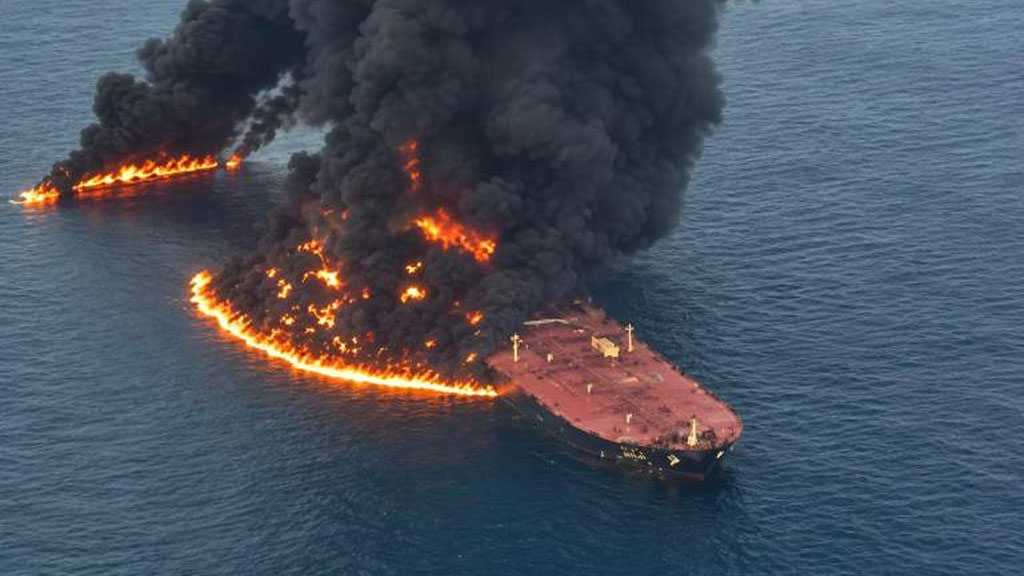
Iran’s Islamic Revolution Guards Navy [IRG-N] has warned tankers against violating its navigation restrictions in the Strait of Hormuz after reporting that a crude oil supertanker struck a naval mine while attempting to exit through an unauthorized passage.
In a statement carried by IRNA on Sunday, the IRG Navy said the vessel suffered a powerful explosion after entering the restricted route with its navigation and positioning systems switched off.
The tanker was subsequently engulfed in a massive fire, with flames visible to residents along the coastline, the statement added.
“A massive fire is the fate of any violating tanker that seeks to ignore the security and rules of the Strait of Hormuz,” the IRG Navy warned.
The force’s public relations office separately stated that the crude oil tanker had attempted to transit an unauthorized route earlier in the day. According to the statement, the vessel ignored warnings issued by Iranian naval forces before striking a sea mine, triggering an explosion and setting the tanker ablaze.
IRNA reported that the incident marked the third tanker since Saturday to strike naval mines and catch fire while attempting to use the unauthorized passage.
IRG Navy Commander Major General Ali Azmaei also warned vessels operating in the Strait of Hormuz against disabling their navigation and identification systems.
“Vessels in the Strait of Hormuz area that switch off their navigation and identification systems will be dealt with forcefully and decisively and classified as hostile,” he said.
Meanwhile, Iranian Deputy Foreign Minister for Legal and International Affairs Kazem Gharibabadi said the reopening of the Strait of Hormuz depended on the United States fulfilling its commitments, stressing that Iran’s restrictions would remain in place until Washington acknowledged that the conflict could not be resolved through military means.
Speaking at a press conference in Minab, Gharibabadi described the strategic waterway as “a red line for national security and a defensive tool for Iran,” according to Tasnim.
He said the restrictions had been imposed in response to military aggression, emphasizing that commercial vessels could not pass through the strait without prior coordination, while the transit of all warships remained strictly prohibited.
“The agreement with the Sultanate of Oman does not mean the immediate reopening of the Strait of Hormuz,” he stated.
Gharibabadi further disclosed that Washington had conveyed its comments on Iran’s seven conditions through Qatar, which is acting as a mediator, adding that Tehran was examining the response.
He also said the involvement of neighboring countries in the aggression against Iran had been fully documented. Emphasizing the interconnected nature of regional security, he urged neighboring states not to allow their territories to be used as launching grounds for attacks against Iran.
Separately, IRG spokesperson Brigadier General Hossein Mohebbi warned that any renewed confrontation would result in further defeats for Iran’s adversaries.
Referring to US forces as “Epstein’s soldiers,” Mohebbi said Iranian fighters had dealt a crushing blow to American forces in the Persian Gulf during what he described as the Ramadan battle.
“In the final battle, Western civilization will return to the Bay of Pigs in disgrace and shame... We are waiting,” he said.