- Home
- ISLAMIC RESISTANCE
- SECRETARY-GENERAL
-
Full Speeches
- Speeches-2000
- Speeches-2006
- Speeches-2007
- Speeches-2008
- Speeches-2009
- Speeches-2010
- Speeches-2011
- Speeches-2012
- Speeches-2013
- Speeches-2014
- Speeches-2015
- Speeches-2016
- Speeches-2017
- Speeches-2018
- Speeches-2019
- Speeches-2020
- Speeches-2021
- Speeches-2022
- Speeches-2023
- Speeches-2024
- Speeches-2025
- Speeches-2026
- Speech-Reports
- SG
-
Full Speeches
- Voices
- Ten Day Dawn
- The Biggest Crime
- Martyr Leaders

2.5-Million-Year-Old Saber-Toothed Cat Fossil Identified in Turkish Museum
By Staff, Agencies
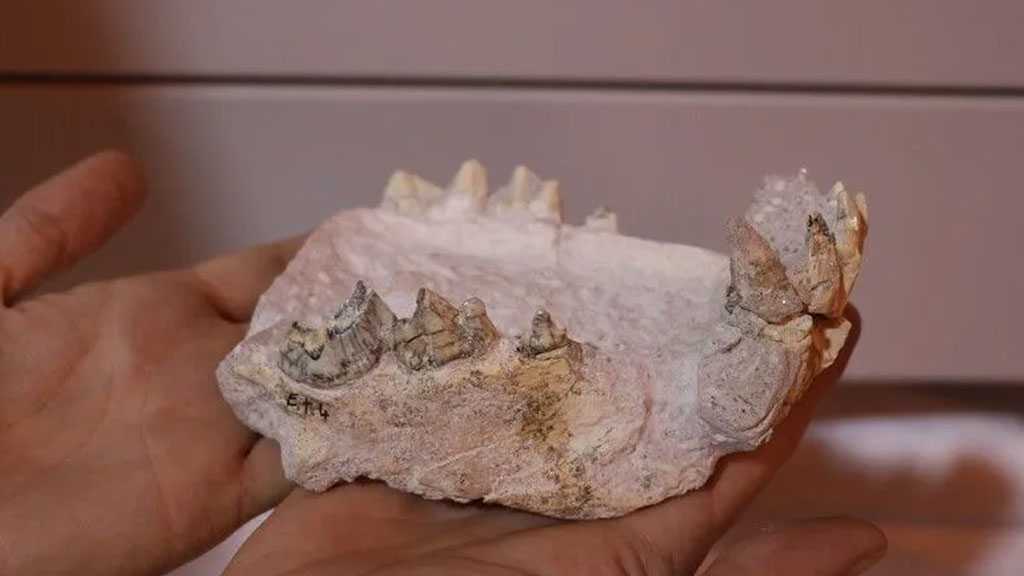
A fossil preserved in a museum in southwestern Turkey for decades has been identified as the remains of a saber-toothed cat that roamed the region approximately 2.5 million years ago, researchers have announced.
The fossil, discovered near Yakaköy village in 1989 and kept at the Burdur Natural History Museum, belongs to Homotherium latidens, an extinct species of large predatory feline.
A research team led by Alper Yener Yavuz, an associate professor of anthropology at Burdur Mehmet Akif Ersoy University, began examining the specimen in 2023.
Speaking to Anadolu, Yavuz said geological and anthropological examinations revealed that the fossil, which includes a largely intact jaw, represents the most complete saber-toothed cat specimen identified in Anatolia, the Asian part of modern-day Turkey.
Using geological and faunal dating techniques, researchers determined that the fossil dates back approximately 2.5 million years.
According to Yavuz, the animal stood approximately 1.2 meters [4 feet] tall at the shoulder and measured around 2 meters [6.6 feet] from head to tail.
Its size made it slightly smaller than a modern lion but considerably larger than a jaguar.
Unlike predators that relied primarily on ambush tactics, Homotherium latidens was adapted to pursue prey over longer distances.
Yavuz explained that the animal possessed a wider nasal cavity, allowing it to take in greater amounts of oxygen and maintain efficient breathing while running.
“Including our study, only four specimens of this kind are known in Turkey so far,” he said.
Researchers are planning additional field surveys across Burdur and neighboring Isparta province to uncover further evidence of the region's prehistoric wildlife.
The identification provides valuable insight into the ancient ecosystem of Anatolia and contributes to scientific understanding of the distribution and evolution of saber-toothed predators.
It also highlights the scientific importance of museum collections, where fossils preserved for decades can yield significant discoveries through modern research techniques.
Comments
- Related News