The Tidal Wave Effect of Tehran’s Nuke Swap

Iran's declaration of its acceptance of a nuclear swap deal with Turkey and Brazil triggered a series of reactions over the globe.
On its side, Iran says the new nuclear declaration leaves no excuse for the "other side" to block the nuclear fuel swap whilst Tehran seeks cooperation rather than confrontation.
Following tripartite talks between Iran, Turkey and Brazil, Tehran announced a nuclear declaration on Monday whereby Tehran would send some 1,200 kg of its low-enriched uranium to Turkey in exchange for a total of 120 kg of higher enriched uranium.
The declaration came as part of an earlier plan to supply fuel for the Tehran Research Reactor which produces medical isotopes for cancer patients. Tehran seeks to be provided with concrete guarantees over the fuel delivery.
Iranian Foreign Ministry Spokesman Ramin Mehmanparast told reporters on Tuesday that Iran expected a logical response from the other side involved in the swap.
"Now, the world community is awaiting Vienna group's measure and we hope that they do not delay any longer," he said.
"If Western countries continue to invent excuses, it will be known that they are not looking for a solution and a logical approach to the issue," the official added.
Mehmanparast said that Iran's readiness to exchange its low-enriched uranium on Turkey's soil was a major step toward "creating an atmosphere of cooperation instead of confrontation."
He said Iran was optimistic about the declaration, hoping that a final agreement on the plan could set stage for nuclear cooperation.
The declaration stipulates that Ankara hold Tehran's low-enriched uranium and return it if Iran does not receive the higher enriched uranium from either France or Russia in a specific time period.
Meanwhile, the White House angrily rejected the announcement, with Press Secretary Robert Gibbs promising to continue the push for sanctions.
Other US officials mocked the deal as a ploy, and one official termed it "too little too late," even though the deal was materially the same one the US has been demanding Iran agree to for the past six months. Another official demanded that Iran submit the deal to the IAEA for consideration.
Though the US seems determined to continue on with its calls for sanctions it seems unlikely that they will be able to successfully sell the sanctions, ostensibly to punish Iran for refusing to accept the third party enrichment deal, now that they have accepted the deal.
Moreover, while the US fancies itself as having veto power over this matter the deal doesn't really involve them directly or indirectly. Turkey will take possession of 1,200 kg of Iran's low enriched uranium and, assuming Russia and France come through with the pledged rods for producing medical isotopes, will turn it over to those nations. If they don't, Turkey will return the uranium to Iran.
At the end of the day all the US condemnations in the world are likely to change nothing, and whether or not they manage to stop France from cooperating in the exchange several members of the UN Security Council will likely be persuaded that the diplomatic process still has a chance or, if it does not, that it isn't Iran's fault.
China, on its side, welcomed a nuclear fuel declaration Iran released in talks with Brazil and Turkey, signaling that it may oppose a US-led drive to impose sanctions on Tehran.
Beijing said it hoped the deal would lead to a peaceful resolution of the Iranian nuclear dispute.
"We attach importance to and support this agreement," Chinese Foreign Ministry Spokesman Ma Zhaoxu said on Tuesday.
"We hope this will help promote the peaceful settlement of the Iranian nuclear issue through dialogue and negotiations," he added.
The Venezuelan President Hugo Chavez says trilateral nuclear meeting between Iran, Brazil and Turkey was a big blow to imperialism and hegemony.
Chavez made the remark in a phone conversation with his Iranian counterpart on Tuesday.
"Venezuelan Revolution will back Islamic Republic's efforts to fight against Imperialism and reform oppressive structures," Chavez said.
The Venezuelan president further expressed his deep sorrow for not attending the G15 summit despite previous arrangements.
"It was quite hard for me not to take part in such an important summit," he asserted.
The US and its European allies have been trying to impose another round of sanctions against Iran at the UN Security Council. They have been seeking Beijing and Moscow's support to push through the embargoes.
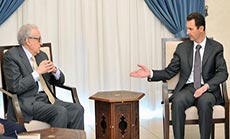
However, the new declaration released by Iran's President Mahmoud Ahmadinejad, Barzil's President Luiz Inacio Lula da Silva and Turkey's Prime Minister Recep Tayyip Erdogan seems to have turned the tables as Russia has also welcomed the declaration.
Comments
France’s Hollande in Qatar for Warplane Deal
11 years ago
Iraq Police Dismantles Al-Qaeda Protest Site
12 years ago