Palestinian farmers mourn loss of land to barrier
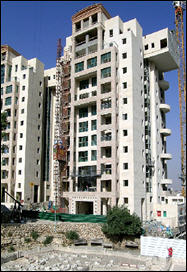
Source: AFP, 5-12-2005.
JAYYUS, West Bank--Prosperity is a memory in the ramshackle Palestinian village of Jayyus, which has seen most of its valuable fertile land amputated from farmers and suppliers by "Israel's" separation barrier.
From his hilltop village, Abu Azzam can see his 175 dunums (43 acres) of avocados, mangoes, peaches, apples and apricots on the other side of the fence.
Three years ago, he employed more than 2,000 workers. Today, only he and his wife have permits to tend the rotting farm.
"My 58-year-old wife has to do the work of a 28-year-old. Jayyus has lost 75 percent of its land, but 90 percent of its income," he said.
"Israel's" deeply controversial fence severs Palestinian territory and isolates communities across the West Bank in the name of protecting "Israel" and Jewish (Zionist) settlements.
But a new human rights report accuses "Israel" of deliberately routing the barrier, not to maximise security but to expropriate Palestinian land to expand and develop new Jewish (Zionist) settlements, the case of Jayyus included.
Palestinians have argued for years that the route of the barrier, often jutting deep inside their territory, intends to pre-empt the borders of their promised future state and grab some of their most productive land.
Only those Palestinians who can prove ownership of the land, much of which has remained in families since the Ottoman Empire when land went undeclared to avoid higher taxes, qualify for access permits.
Town merchants from Ramallah and Hebron (al-Khalil) no longer buy Jayyus produce, forcing farmers to flog their goods for nothing on the local market, sinking ever deeper into economic depression.
Seventy to 80 percent of residents have their diet supplemented by food aid. Young people are leaving the village for elsewhere in the West Bank or abroad.
None of Abu Azzam`s children live at home.
In the distance, "Israel's" high-rise coastal resorts shimmer in the haze, the promise of a different world.
In the bygone days when he made a good living, Abu Azzam educated all his seven children at university. Today he finds it hard to make ends meet without handouts from his sons and brothers.
"Israel" opens an access gate to permit holders 12 hours a day, but Abu Azzam has been told it will soon close, forcing him on a 13-kilometre (eight-mile) detour, on foot or donkey (no cars allowed) to tend his land.
"I`m sure 70 percent of farmers will stop accessing their farms and it will be very easy for "Israel" to take the land," he said.
Sarit Michaeli, a spokeswoman for "Israeli" rights group B`Tselem, said land untended for about three years reverts to "state land," making future Palestinian access nearly impossible.
The security fence shadows Jayyus to the west, several kilometers deep within the West Bank, incorporating the small Jewish settlement of Zufim and large swathes of empty land.
A report by B`Tselem and fellow rights group Bimkom says the extra land expropriated by the barrier is earmarked to build an industrial area and Nofei Zufim, a new settlement of 1,200 housing units six times the size of Zufim.
If the fence had shadowed the contours of even Zufim, although the international community deems all Jewish settlements on Palestinian territory illegal, then most Jayyus farmers would have hindered access to their land.
"The expansion plans are what really make the route here devastating," said Jessica Montell, executive director of B`Tselem.
"The situation in Jayyus is extremely dire," she added.
Although the Zufim case is before the Supreme Court, B`Tselem officials are wary about the chances of a high-court ruling ordering planners to reconsider a similarly obstructive route around Alfe Menashe from materialising for years.
The separation barrier -- part electric fencing, barbed wire and enormous cement wall -- surrounds 55 settlements including 12 in annexed east Jerusalem (al-Qods) and will stretch around 700 kilometers (450 miles) when completed by end-2006.