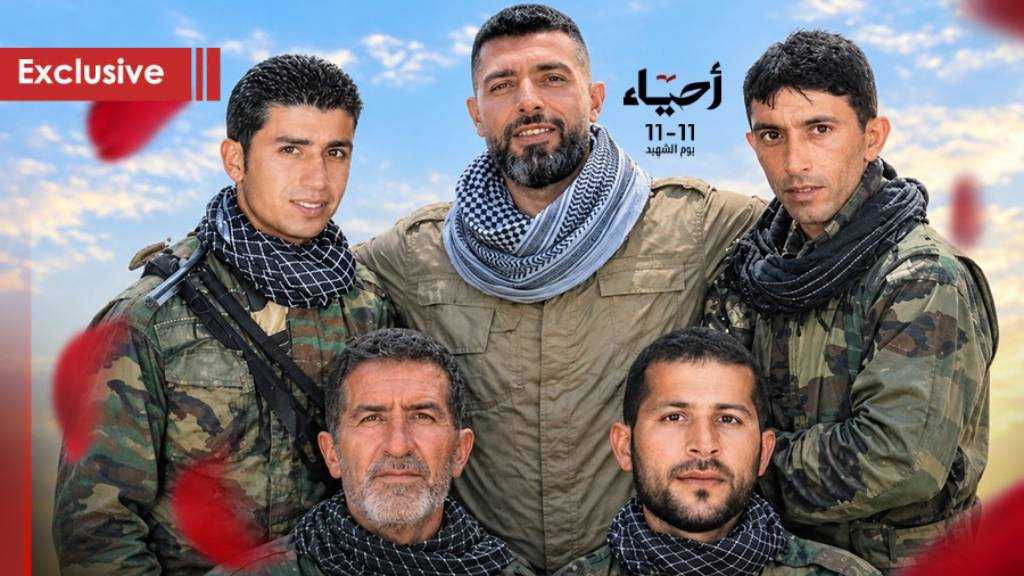
Five Moons: Five Brothers Who Gave Their Lives on the Path to Victory and Liberation
By Hassan Shreim
How noble are the families who offer a martyr. And how much more so a family that has given five of its sons, at different points in time, as martyrs. Their story remains a testament to a home once bound by love, where a lifetime of shared experiences shaped every detail, before successive years of loss left behind an emptiness that only memories can fill.
Love united the five sons of Hajj Ali Ghrayyeb–the martyrs Hussein, Haitham, Hassan, Qassem and Ahmad–in a brotherhood that went beyond the ties of blood. Together, they formed a family in which different personalities complemented one another, each brother had his own role, and laughter filled every corner of the home, despite their differing temperaments. Growing up between Bazourieh, Tayr Harfa and Naqoura, the five brothers were raised in a family rooted in faith and solidarity. They grew up as companions of the land and the sea, carrying in their hearts a love for their homeland and the Ahl al-Bayt [peace be upon them]. Each left his own distinct mark on the memories of those who knew him.
Through the memories of their mother, Hajjeh Nada Haidar [Umm Hussein], those days come alive again. She recalls her sons together, as though they were one body that could never be separated.
Hussein, the eldest, was like a father to his younger brothers. He cared for them, stood by them and served as their guide, carrying their worries with love and a deep sense of responsibility.
Haitham, meanwhile, was a man of the land, a farmer known for his cheerful spirit. His contribution went beyond working his fields; he also volunteered in mine clearance operations to protect others, placing people’s safety above all else.
Hassan had a different bond with the sea. A quiet fisherman, he combined tenderness with selflessness and was deeply moved by the suffering of others, even to the point of crying when someone else was in pain.
Qassem, who remained unmarried, was known for his elegance, but it was not limited to his outward appearance. He was equally refined in spirit, quietly helping those in need without letting anyone know. His mother says the family only discovered the extent of his generosity and kindness after his martyrdom, when people began coming to the house in tears, sharing stories of how he had secretly supported them, never expecting thanks or anything in return.
Ahmad, the youngest, was the joy of the family and the one with the brightest smile. Loved by young and old alike, he combined a lighthearted nature with impeccable manners. To the younger children, he was both a brother and a beloved companion, while the older members of the family found comfort and companionship in his presence.
Their mother sums up those days through images that remain etched in her heart: days when the brothers gathered around the ordinary details of everyday life, building a shared story out of love and laughter, before one farewell followed another and their faces gradually disappeared from the family home.
The First Loss: Haitham, Hassan and Qassem
On August 6, 2006, during the July War, the southern town of Naqoura became the site of the family’s first devastating loss. The three brothers–Haitham, Hassan and Qassem–were martyred together after spending 23 days under siege in the town, during which they transported supplies, ammunition and resistance fighters.
That day, the stories of the three brothers came to an end at the same moment. The family lost, all at once, the cheerful farmer, the tenderhearted fisherman and the elegant man whose smile and polished appearance concealed acts of kindness that his family knew nothing about until after his death.
The loss was especially devastating for a mother who had lost three sons in a single day, as well as for the surviving siblings and their families, who continue to revisit those memories whenever they think back to that time.
Among the lasting memories of Haitham is the story of his son Hussein, who was too young to experience much of life with his father. He says he takes pride in his name and in being his father’s son. One of the few childhood memories that remains with him is his father’s joy on the day of the prisoner-capture operation, when he heard his voice celebrating in the neighborhood.
Hussein never had the chance to know his father as closely as he would have wished. Instead, he began collecting his photographs and listening to family stories about him, trying to piece together his personality through the memories he left behind.
What he misses, he says, is not one particular moment, but everything he never had the opportunity to experience with his father. He wishes his father could have been there throughout the different milestones of his life, even on the day his mother passed away.
News of Haitham’s martyrdom arrived at dawn, while the family was asleep. At the time, being a child, he was too young to understand what it meant to lose his father. Over the years, photographs and family stories became his closest connection to the father who was gone in body but remained present in his name, his memories and the pride he feels in being his son.
Huda, the wife of martyr Hassan, also remembers a kindhearted and tender man who felt other people’s pain deeply and would even cry over their suffering. He was known for his generosity, willingness to help and spirit of sacrifice.
Huda recounts that she lost contact with him during the war and knew nothing about his whereabouts until she received the news of his martyrdom. She accepted it with patience and submission to God’s will. Today, she finds traces of him in their children, seeing his features in their faces and remembering him through their actions and the small details of their daily lives.
The Second Loss: Hussein
Eighteen years passed after the family’s first devastating loss before they faced the second: the martyrdom of Hussein, the eldest brother, who had carried the responsibility of looking after his siblings and family and had always been a source of unwavering support to those around him.
On October 7, 2024, Hussein was martyred in the town of Zibqin, following a long journey that began in 1992 and spanned the July War and the War of Support.
His wife, Mona, recalls him through the everyday details that made up their life together. She describes him as a loving, loyal and courageous man who was loved by both children and adults. People would turn to him to resolve their problems, knowing they would find honesty and support. His own life was simple, revolving around work, family, relatives and friends.
On his days off, he would begin the morning with a cup of coffee before tending to the garden. He would then spend the rest of the day among relatives and friends. Playing with his grandchildren was one of his greatest pleasures, bringing him happiness and a sense of peace.
But Mona holds on to one final meeting that remains deeply etched in her memory.
On September 21, 2024, she went to see him in Zibqin, and the two spoke at length. Before they parted, he asked her to take care of herself and the children. When she asked whether he was saying goodbye, he replied: “Only God knows whether we will meet again.”
Those words became the last memory she had of that encounter. Two days later, the Uli Al-Ba’s War began, and fifteen days after that, Hussein was martyred.
Since his departure, the family home has never been the same. The man everyone had relied on for support and security was gone. His advice and words, however, remain part of the family’s daily life. Mona revisits them whenever she longs for his presence, finding in those memories the strength to carry on with the children.
The Third Loss: Ahmad
The final chapter in the story of the five brothers came with Ahmad, the youngest, who had brought laughter and cheerfulness into the family home and left behind memories that capture the meaning of closeness and tenderness.
On March 31, 2026, Ahmad was martyred in the town of Hinniyeh, in the Tyre district, completing the story of the five brothers.
His wife, Haneen, recounts that Ahmad was not only a husband and father, but also a friend and a refuge for his family. He was exceptionally close to his four daughters and his son. His daughters had grown accustomed to telling him all about their day before sharing anything with their mother, while his son was his constant companion, accompanying him wherever he went, whether to the coffee shop, the family gathering place or visits to relatives.
His youngest daughter, five-year-old Razan, held a particularly special place in his heart. She was his little darling, whom he affectionately called “Habibi” [my love]. He would always leave a bag of sweets for her in his wardrobe, so she could find it whenever he returned home.
It was a small gesture, Haneen says, but one that revealed the tenderness of a father who knew how to turn the simplest things into moments of happiness that would remain in his children’s memories.
Behind the imposing presence he commanded was a kind heart that never turned away anyone in need.
Haneen recalls one incident that captures this side of his character. Ahmad once came across a young man collecting plastic bottles. When he learned that the man was trying to earn enough money to buy milk for his daughter during the crisis, Ahmad gave him all the money he had, even though his own family needed milk as well. He did not hesitate to help another father, refusing to let his own family’s needs prevent him from seeing someone else’s hardship.
Ahmad was also a trusted figure among the younger men in the family, particularly the sons of martyrs, who would turn to him for help in resolving their problems. He was deeply devoted to his mother and sisters and placed great importance on the religious and moral upbringing of his children.
He would remind them to remain steadfast in their prayers, particularly the dawn prayer, as well as the Du’a al-Ahd, the Ziyarat Ashura and reading the Holy Quran.
Haneen says their children are now following the path he had hoped for them. His son, despite being only nine years old, speaks and thinks with a maturity that makes anyone who meets him feel he is much older than his years.
Alive with Their Lord, Receiving Sustenance
Five brothers are gone, but their story has not ended.
Their mother, Hajjeh Nada, says she received the news of each of her sons’ martyrdom with gratitude to God and acceptance of His will. She finds comfort in the belief that they are together, alive with their Lord and receiving sustenance.
Yet faith in God’s decree does not erase the ache of separation, nor can it make family gatherings what they once were. The faces that once filled the home are gone, but every corner still holds something of their memory. Every photograph opens the door to another story, and every conversation brings their laughter back to life.
Today, the family gathering is no longer complete as it once was. But the story of the five brothers continues to unite them. With every remembrance, they bring one of the brothers back to mind, and with every story, they pass a part of his legacy on to the next generation.
The love that once bound them together remains alive, even though their bodies are no longer there.
Click here to read in Arabic