The Father of Martyrs… A Martyr Himself
By Fatima Salameh
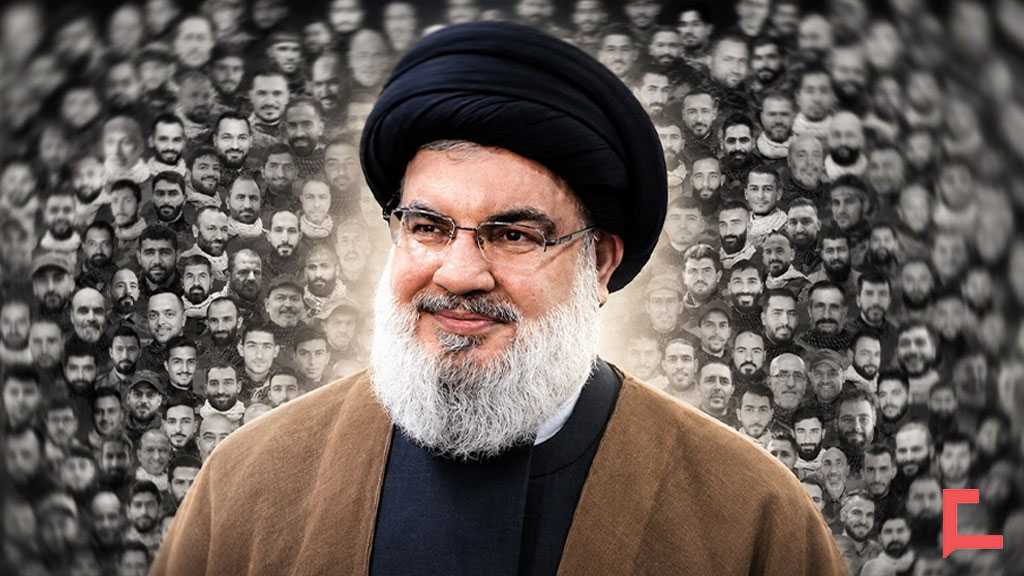
On November 11, 2023, the Sayyed of the Nation’s Martyrs, martyred Sayyed Hassan Nasrallah, appeared in what would be his final speech marking Hezbollah Martyr Day. At the time, few could have imagined that this would be his last appearance on an occasion for which they had grown accustomed to awaiting his address. Nor could they have imagined that the man who honored the martyrs and congratulated their families on being part of the Caravan of Light would, less than a year later, himself become a martyr.
In that speech, Sayyed addressed the families of the martyrs with words of profound appreciation and loyalty, revealing something of the special bond he shared with them. He said:
“Today, on Martyr Day, I extend my congratulations to all the families of the martyrs for belonging to this caravan, the Caravan of Light, the caravan of the masters of existence, the caravan of those whom God Almighty has chosen and selected, appointing them as martyrs in the company of the prophets and awliya (saints) (peace be upon them). I acknowledge their steadfastness, resilience, sincerity, devotion, loyalty, sacrifice, renunciation of worldly life and all its temptations, and their constant readiness to give.”
For Sayyed, commemorating Hezbollah Martyr Day each year was never simply an annual occasion to remember the martyrs and recount their lives. It was a day on which he revisited familiar faces and memories and renewed his pledge to those who had given their lives along the path of resistance. He paused to reflect on their sacrifices and those of their families. To him, the martyrs were not merely figures to be remembered in a speech; they were a living part of his heart and his journey. That is why his words on the occasion were more than expressions of tribute. They reflected the special place the martyrs held in his heart. He honored their memory, addressed their families and praised their patience and steadfastness, fully aware that martyrdom leaves behind families, children and responsibilities.
These sentiments were deeply intertwined with his personal life and his own journey. The Sayyed, a man who lived the life of the martyrs in every detail, devoted his life to serving God and the cause in which he believed, making it the center of his existence and the guiding principle behind his choices and sacrifices.
For him, jihad was never merely a position or a passing phase. It was a path on which he committed everything he had, even offering his own son, Sayyed Hadi, as a martyr along the way. He also lost lifelong companions and friends, one after another, as they joined the ranks of the martyrs in defense of the same cause. He lived among them, bid them farewell and carried their memories with him, continuing along the very path they had chosen and believed in, until he too joined them as a martyr.
For many, news of Sayyed Hassan Nasrallah’s martyrdom was almost impossible to believe. Perhaps it was the last thing they had expected. Of course, it was not surprising that a man who had devoted his entire life to this path would attain martyrdom. He had lived alongside the martyrs, carried their cause and honored their sacrifices until his final moments. Yet the shock lay in the loss of a man whose supporters had grown accustomed to seeing him as a constant presence, an unwavering source of strength who would never be absent. To them, his presence represented the continuation of the journey, making the news of his martyrdom almost impossible for many to comprehend.
Perhaps a phrase he addressed to his supporters in one of his final speeches in 2024 took on an entirely different meaning after his martyrdom. He said: “Until we meet in martyrdom…”
At the time, the words did not simply pass through the ears of his supporters. They struck a chord in their hearts, and many paused to reflect on them. Some wondered what the Sayyed meant by this meeting and what kind of appointment he was making with them. Few could have imagined that martyrdom itself was the meeting he was speaking of, or that his words would become a final farewell, bringing to a close the journey of a man who had spent his life remembering the martyrs and recounting their stories.
But Sayyed’s story with the martyrs cannot be told solely through his personal sacrifices, his martyred son, the companions who preceded him in martyrdom, or his own eventual joining of their ranks after a lifetime spent remembering and honoring them.
There is another dimension to this story, one that goes beyond the martyrs themselves to those they left behind. It is a story revealed through the details of his relationship with their families and children, and the fatherly love, care, protection and attention he showed them.
Among the many qualities and meanings associated with Sayyed, whose personality and journey seem too vast for words to capture fully, one title stands out above the rest: “Father of the Martyrs.” It encapsulates the journey of a man who did not simply remember the martyrs in his speeches, but remained present in the lives of those they left behind. He asked about them, followed their affairs and treated their children as though they were his own.
The man who had given his own son and companions as martyrs did not consider martyrdom the end of his relationship with them. He remained part of their families’ lives, taking their children under his wing, following their circumstances and giving them the kind of attention that led many to see him as a father figure after their own fathers were gone.
The Martyrs’ Trust: Their Children in Sayyed’s Care
Perhaps nothing reveals the depth of this relationship more clearly than the accounts shared by the children and families of martyrs about his presence in their lives. His concern was neither occasional nor limited to special occasions; it extended into the smallest details of their everyday lives.
Sayyed’s relationship with the families of martyrs was never confined to offering condolences or comfort in moments of grief. It extended to following up on their circumstances and the details of their lives. Many children of martyrs came to feel that he was not simply a leader who offered them consolation after their fathers’ deaths, but a father and a safe haven in whose presence they found reassurance, affection and a sense of belonging.
He treated the children of martyrs with particular warmth, making sure they felt they were not alone and that, although their fathers were gone, their families had not been left outside the circle of care and attention.
This relationship was not merely emotional or sentimental. It was reflected in his continued follow-up, his questions about their lives and his interest in whatever concerned them, even the smallest matters.
According to people closely familiar with these matters, Sayyed was well-informed about many aspects of the lives of the martyrs’ families. He knew the details of their households so well that it seemed as though he lived alongside them.
They would turn to him with personal and everyday concerns, seeking his advice on decisions affecting their children’s futures, education and university specializations. They would ask him where their children should pursue their studies, which academic fields they should choose and seek his opinion on important decisions. He never treated such questions as passing details. Instead, he gave them his time and attention and followed up on the decisions and their consequences.
The messages he received from the children of martyrs were filled with affection and spontaneity. They would send him their drawings and write simple notes expressing their love and longing to meet him, sometimes asking him to grant a small wish or send them a modest gift.
According to those familiar with these details, Sayyed made a point of reading their letters, looking at their drawings, responding to them and fulfilling whatever requests he could, no matter how simple they might seem.
For him, these small gestures were part of a fatherly relationship that went beyond simply asking how they were doing. It meant listening to their wishes, sharing their interests and bringing happiness into their hearts.
His concern was not limited to the children of martyrs. It also extended to the children of resistance fighters and to some of the fighters themselves, who would ask him for small, symbolic gifts. He would do his best to fulfill their requests.
Simple as these gestures may have been, they carried a meaning far greater than the gifts themselves: they reflected his determination to ensure that none of these people felt distant from him, and that each one held a special place in his attention and care.
As for the martyrs, they were the very heartbeat of Sayyed. They were always present in his thoughts, his speeches and his prayers. Their names and stories stirred his emotions, bringing tears to his eyes whenever one of them was remembered, a song honoring their memory was played, or footage showed the farewell ceremonies for martyrs and the sacrifices of their families.
Such moments never passed before him without leaving an impression. They brought back faces, names and sacrifices, revealing the depth of the bond that connected him to the martyrs and to those they had left behind.
Until the day came when the righteous servant joined the Caravan of Light as a great martyr, a heroic and courageous leader.
And so, the “Father of the Martyrs” became a martyr himself.
Comments
The Father of Martyrs… A Martyr Himself
14 minutes ago