Palestinians mark six decades of exile from homeland

Source: Compiled by Daily Star, 16-05-2008
Palestinians protested across the Occupied Territories and the region on Thursday to mark the 60th anniversary of the Nakba, or catastrophe, of the birth of ‘Israel' and the exodus of hundreds of thousands of refugees. The commemoration of the Nakba - the expulsion or flight of at least 760,000 people from their homeland - came as US President George W. Bush marked the creation of the Jewish (Zionist) state with an address to the ‘Israeli' Parliament.
‘Israeli' troops fired live rounds to break up a rally at the border between Gaza and ‘Israel', while sirens sounded across Ramallah as thousands joined a protest demanding the right of return for some 4.5 million UN registered refugees in camps across the Middle East.
Demonstrators waved Palestinian flags and released 21,915 black balloons - one for each day since ‘Israel's' creation - to darken the skies over Occupied Jerusalem ahead of Bush's speech at the Knesset.
"On this good and beloved land live two peoples. One celebrates its independence and the other grieves in the commemoration of its Nakba," Palestinian President Mahmoud Abbas claimed in a televised speech. "‘Israel's' security is linked to our independence and our security, and the continuation of the occupation and the persistence of the Nakba will not bring security to anyone."
About 3,000 people gathered in the heart of the northern Occupied West Bank city of Nablus holding keys - both real and symbolic - to abandoned houses in what is now ‘Israel' and burning a US flag to protest Bush's visit.
For most observers the fate of the refugees lies at the core of the decades-old Middle East conflict and has bedeviled past peace efforts as ‘Israel' has refused to allow any to return.
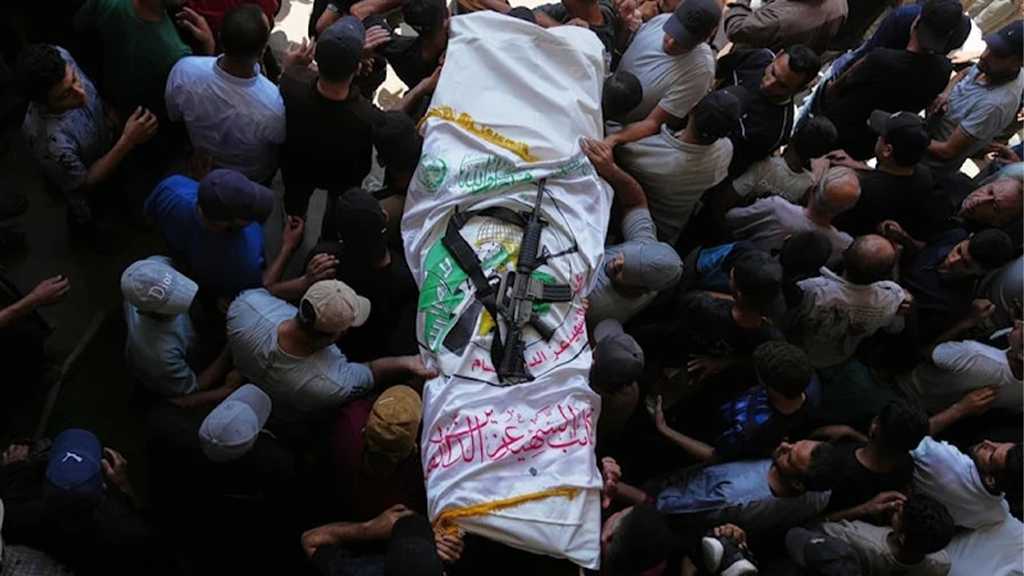
In the besieged Gaza Strip, where Hamas seized power nearly a year ago, supporters of the Islamist movement marched to the Erez crossing with ‘Israel' to protest what they derided as the "new Nakba" - a crippling months-old blockade of the territory.
Since Hamas took power last June, ‘Israel' has sealed Gaza off to all but very limited humanitarian supplies. Two-thirds of the 1.5 million people in impoverished territory are refugees, the vast majority of them living off UN food handouts.
Hundreds of demonstrators marched to a gathering point a few kilometers from the crossing, waving Palestinian flags and green Hamas banners and demanding that ‘Israel' lift the crippling blockade.
Dozens of members of the Hamas-run police force in Gaza sealed the main road to the crossing, but later in the afternoon dozens of women and children walked toward the border, with some of the children throwing rocks.
‘Israeli' troops fired live rounds and launched tear-gas bombs to disperse the group before it reached the crossing, according to witnesses. An ‘Israeli' attack helicopter was also seen opening fire with a chain gun near the crowd of protestors. A 13-year-old Palestinian boy was wounded in the leg.
The army had earlier mobilized to prevent any "provocative acts" and ‘Israel' has previously warned Hamas against marching on the border.
The army "is planning to take strong measures against any provocative acts of Hamas that may cause damage to the security of ‘Israel'," Major Avital Leibovich told AFP ahead of the demonstration.
Arab members of the ‘Israeli' Parliament boycotted the US president's address, and Palestinians expressed outrage at the decision to hold the event on their Nakba Day.
As Bush received a standing ovation at the start of his speech, three Arab MPs entered the chamber and held up pictures of Iraqi and Palestinian children killed by US and ‘Israeli' troops, with a sign blaming their deaths on Bush.
Bush is "responsible for the deaths of hundreds of thousands of people in the region," said Jamal Zahalka, one of 10 MPs from Arab-led political parties.
"His speech ... shows complete indifference to the Nakba of the Palestinian people and its suffering," he added.
Elsewhere in the Middle East, around 100 people held a demonstration in central Cairo to commemorate the anniversary of the Nakba. The demonstrators gathered outside the Journalists Syndicate in the capital, waving banners reading "The liberation of Palestine is a sacred duty" and celebrating "60 years of resistance" amid a heavy security presence. Many waved Palestinian flags and some were seen carrying pictures of Hizbullah's leader, Sayyed Hassan Nasrallah, as well as flags of the Lebanese resistance movement.
Meanwhile, in Damascus, tens of thousands of people joined a march through the streets of the Syrian capital to voice their support for the Palestinian people and mark the anniversary of the Nakba. The protesters poured into Youssef al-Azmeh Square, chanting anti-'Israeli' slogans and holding banners, Syrian and Palestinian flags, as well as photos of Syrian President Bashar Assad.
In Iran, scores of people attended a candlelight vigil held in Felesteen (Palestine) Square in Tehran to protest 60 years of "‘Israeli' crimes" against the Palestinian people.