Trump’s Aid Halt Announcement Leaves “Israel” Reeling
By Staff, Agencies
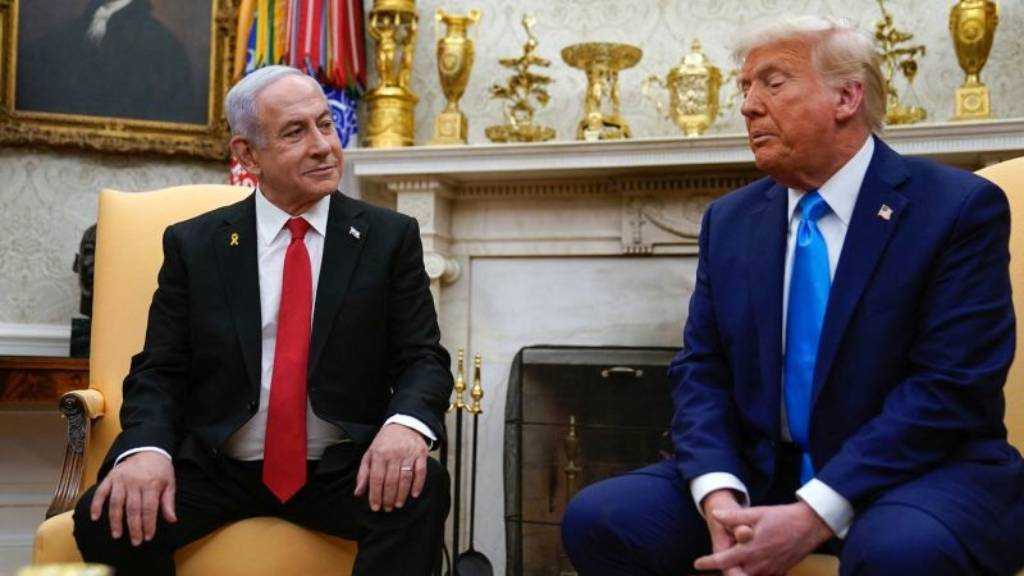
US President Donald Trump’s announcement of an agreement with Prime Minister Benjamin Netanyahu to halt American aid to “Israel” has left the “Israeli” establishment in disarray.
The announcement, which concerns aid worth $3.8 billion a year, followed Trump’s claims that "Israel" had become a prosperous “country” that no longer needed the money, though it could continue to buy American weapons.
Trump tied the announcement to criticism from Democratic candidates over the spending of American taxpayers’ money on the “Israeli” occupation. According to “Israeli” media, the move was read as an attempt by Trump to deprive his opponents of an electoral argument over funding for "Israel".
Trump said the initiative came from Netanyahu, who has repeatedly voiced his wish to phase out reliance on American military aid over roughly 10 years as part of his drive to build “Great Sparta”, an “Israeli” entity able to bolster its military and economic independence.
The announcement raised questions about the nature of the understanding between the two sides, particularly because Trump spoke of ending the aid at the end of 2026, while the current agreement, dating back to the Obama administration, provides for it to continue until the end of 2028.
According to “Israeli” reports, “There has been no official ‘Israeli’ confirmation of the timing or the mechanism for implementation, and it remains unclear whether the decision would cover joint funding for missile ‘defense’ systems.”
The announcement prompted surprise and confusion in the Security and Finance ministries, as well as in the “Israeli” military and the wider security establishment. Two “Israeli” officials were quoted as saying they had received no advance warning, despite ongoing talks with Washington on the forthcoming “security agreement”.
It came about two weeks after an “Israeli” delegation visited the United States to discuss future procurement plans covering tanks, ammunition, communications, electronics, maintenance and protection.
According to Channel 12, the Finance Ministry was caught off guard by Trump’s statement, having planned the 2027 and 2028 budgets on the assumption that the aid would continue until the current agreement expires.
Sources in the ministry warned that halting the funding, given existing procurement commitments, would force the government to secure alternative resources.
Although Washington’s general direction toward reducing or ending the aid was known, the scope of the halt and the mechanism for carrying it out remain unclear. The financial repercussions therefore depend on what is actually implemented, amid rising military spending and the obligations that come with it.
The announcement also raised questions within the security and military establishment over whether Trump meant to cancel the current agreement or to change the model of security cooperation gradually, and whether Netanyahu had reached an understanding of this magnitude without consulting the professional bodies, the Finance Ministry, the government and the security cabinet.
Channel 12’s correspondent in Washington said Netanyahu had proposed to Trump, when they met at Mar-a-Lago in December 2025, that aid be reduced starting with the next agreement rather than ending the current one.
He noted that Trump was surprised by the proposal at the time and that “Israeli” advisers had warned Netanyahu against raising it.
He offered two possible explanations for the latest announcement: either Trump was imprecise about the date, or there is an undisclosed understanding to end the agreement two years early.
Channel 12’s political affairs commentator said the concern is not necessarily the reduction in aid but Trump’s decision to announce it on Election Day, which suggests he regards the move as “popular”.
The channel’s political correspondent noted that the message to American voters may matter more than the decision itself, since Trump is presenting the halt in funding to "Israel" as a response to a domestic American demand.
Maariv’s political affairs commentator said the issue goes beyond the loss of financial aid and reflects a decline in the strategic alliance with the United States, long one of the pillars of "Israel’s national security”.
He also held Netanyahu responsible for that decline, arguing that he had helped weaken relations with Washington.
Haaretz’s military affairs commentator focused on the regional implications. He argued that Washington’s distancing, or its appearance of retreating from support for "Israel", could erode "Israel’s" standing and image among countries in the region and undermine the message Netanyahu sought to entrench through his relationship with Trump and American military cooperation.
Noah Hacker, deputy head of the policy department at the so-called “Israel Democracy Institute” said the most significant risk includes a shift in how the Republican base views aid to "Israel".
He pointed to remarks by Vice President JD Vance that Washington no longer treats its support as a “blank check” but expects "Israel" to take American interests and policies into account.
An economic commentator at “Yedioth Ahronoth” said halting the aid would not amount to an economic catastrophe but would place a heavy burden on the “Israeli” government. It could add about 15 billion “shekels” [about $5 billion] to the 2027 budget deficit, requiring tax increases or cuts in spending on welfare, health, education and infrastructure.
Comments