Sheikh Qassem: Any Force Operating Outside the Framework of Resolution 1701 Will Be Considered an Occupying Force
By Staff
Hezbollah Secretary-General Sheikh Naim Qassem has made the party’s position clear on the proposed replacement of UNIFIL, stressing that any international decision must remain within the framework of UN Security Council Resolution 1701 and the November 27, 2024 agreement.
“Any attempt to replace it with the Framework Agreement is rejected. This agreement is neither constitutional nor legal; it was imposed under pressure and coercion,” he said.
He stressed that Hezbollah would consider any international force deployed in Lebanon to be legitimate only if it operated under the authority of the United Nations and within the framework of Resolution 1701. “Anything outside that framework, regardless of its name or designation, will be considered an occupying force,” he declared.
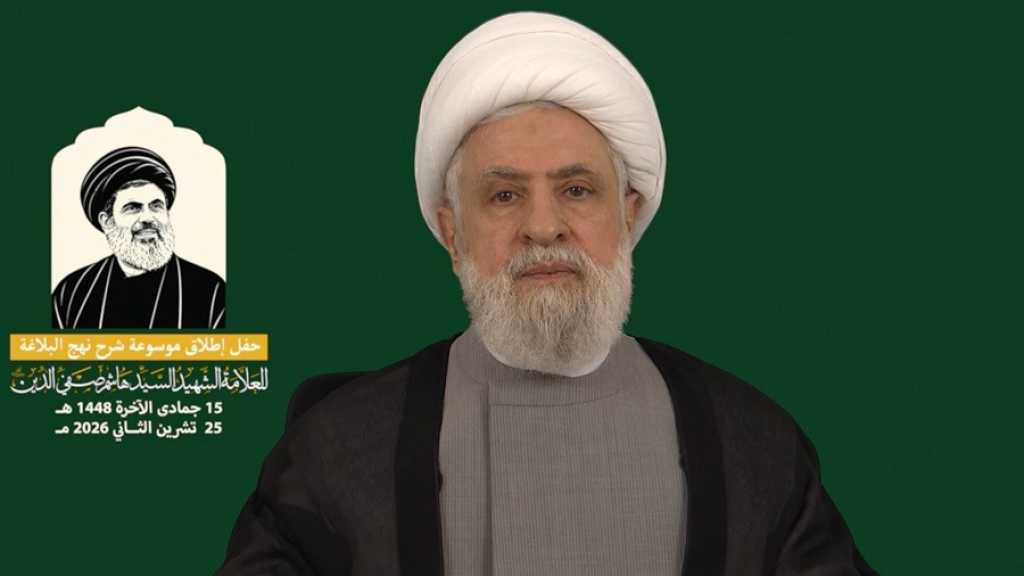
Speaking at a ceremony held on Wednesday evening, November 25, 2026, to launch the encyclopedia Commentary on Nahj al-Balagha, authored by the late Sayyed Hashem Safieddine, Sheikh Qassem addressed several political and national issues.
He affirmed that “the five young men from Batroun are not guilty of anything. They were in their own country, moving around their homeland, and there are no charges against them. They must be released immediately. As for the young men from Dahr al-Baidar, they are members of the resistance, as we have openly declared. Their activities are legitimate, and they were engaged in entirely routine preparations for the resistance.”
Sheikh Qassem stressed that “this country belongs to all of us. We are partners, and no one has the right to squander it or surrender its rights. We exercise patience to preserve national unity and civil peace, but there are limits to how much injustice we can endure. When we sense danger approaching, we will confront it and defend our existence and our rights.
“We will not allow the ‘Israeli’ project to be realized, either directly or through its proxies after it has failed to achieve its objectives, whatever form those proxies may take. We are prepared to make the ultimate sacrifices to defend our existence and that of Lebanon, and to confront those who sow discord and seek to destroy the country.”
Commenting on the President’s speech marking Independence Day, Sheikh Qassem said that “the President equated the brutal ‘Israeli’ aggression, backed by a savage United States, with the honorable, noble, popular and national Lebanese resistance. He placed the occupying force, which attacks, destroys, kills and pursues genocide, on the same footing as its own people, who suffer, endure and have made enormous sacrifices.
“Shouldn’t the President stand with his people? Even if they make mistakes, he should stand by them and seek ways to prevent hostility between the different segments of society, and between the people and the state. Instead, the approach has been to seek an end to hostility with the Israeli enemy while taking steps that deepen divisions at home.”
He added: “When an Independence Day speech becomes the subject of major controversy among broad segments of Lebanese society, it means that the speech was out of place. The fact that these remarks have exposed such deep disagreement and division among Lebanese people shows that they were inappropriate. All those genuinely concerned about Lebanon, its unity, independence and sovereignty have said that this was an unsuitable speech, delivered at the wrong time and in the wrong context.”
We have accepted the Taif Agreement and its Constitution
Sheikh Qassem said: “As Hezbollah, we have accepted the Taif Agreement and the Taif Constitution as the social and political compact governing all Lebanese. They are the common reference point that brings us together and the framework through which those who stray from the principles of one nation, equal citizenship and adherence to the Constitution can be brought back on course.
“The Constitution, not individuals, is the ultimate authority. And what does the Constitution say? It states: ‘The President of the Republic is the Head of State and a symbol of the unity of the homeland. He shall safeguard the Constitution and preserve Lebanon’s independence, unity and territorial integrity in accordance with its provisions.’
“This is a great responsibility. It is a unifying responsibility, one that requires accountability and safeguards independence.”
Sheikh Qassem then asked who was attacking Lebanon. “Isn’t it ‘Israel’, the brutal enemy? Isn’t it the United States, the tyrant that supports the enemy with all its capabilities? And aren’t there regional countries that operate behind the scenes, inciting against the resistance and the people while granting Israel gains under various pretexts? What exactly is the United States pressuring the Lebanese authorities to do?”
He added: “It is pressuring them to make concessions in favor of the ‘Israeli’ enemy. If the issue were truly about implementing agreements, the Lebanese authorities implemented the November 27, 2024 agreement, while ‘Israel’ did not. The authorities, together with the resistance, the people and the army, implemented the ceasefire, but the firing never stopped.
“So why is the United States pressuring the Lebanese authorities and political forces? It is doing so to advance ‘Israeli’ interests.”
He emphasized that “the resistance in Lebanon is a legitimate, national, moral, humanitarian and honorable force, one that deserves the highest respect and appreciation.”
He noted that the resistance, together with its community, people and supporters, has borne enormous costs to protect Lebanon and prevent harm to its various components.
“This resistance has lost more than 10,000 martyrs over the past two years, including fighters, men, women, children and civilians. Hundreds of thousands of homes have been destroyed, and there are 30,000 wounded, in addition to prisoners. These people come from all walks of life. All these sacrifices were made so that Lebanon could be liberated and we could hold our heads high.”
Sheikh Qassem continued: “I remind you that the Sayyed of the Nation’s Martyrs, Sayyed Hassan Nasrallah [may God have mercy on him], would always say: ‘We are prepared to bear more, but be careful: we do not want the rest of the Lebanese to suffer, and we do not want to inconvenience the other components of Lebanese society.’
“Of course, this makes the cost higher. Nevertheless, there was always a commitment to protecting the rest of the Lebanese. On many occasions and during numerous operations, even when we refrained from carrying out certain operations, the primary reason was to protect the other components of society, despite the enormous price we ourselves were paying. This deserves recognition.”
He added: “We have not heard words of praise, gratitude or prayers for mercy, not for the sake of those who made the sacrifices, but because such gratitude would demonstrate that those expressing it possess a genuine sense of national responsibility and appreciate the sacrifices being made.”
He stressed: “We are not asking anyone for a reward. We believe our reward lies with Almighty God.”
The Hezbollah Secretary General said that Lebanon faces one problem and one threat: “the attacking ‘Israeli’ enemy, which occupies land, continues its aggression, kills and commits genocide. That is the problem facing Lebanon. The resistance, meanwhile, is a response to that problem.
“The resistance emerged because the state and the army were unable to fulfill their duties in confronting the enemy due to the lack of sufficient resources and capabilities. The resistance is therefore filling a massive gap. It is carrying out a duty for which the state was primarily responsible, but which it was unable to fulfill. In light of this shortfall and incapacity, the resistance took on that responsibility.”
He affirmed that the resistance is what prevents “Israel” from enjoying stability, curbs its objectives and lays the groundwork for its eventual withdrawal from Lebanon.
“This slander against the resistance and its sacrifices is unacceptable. It is an attempt to evade responsibility following the authorities’ failure to safeguard sovereignty through their conduct. We understand the state’s limitations, but what is incomprehensible is that the country’s major political forces should become involved in steps that serve the Israeli project, which has failed to achieve its objectives.”
He added: “Do not give us empty rhetoric. Sovereignty is not a song; it is something demonstrated through action. National unity is not a slogan; it is a way of conducting affairs that produces unity. Confronting the ‘Israeli’ enemy is not a slogan either; it requires concrete action. Tell me what you are doing in your capacity as an official, wherever you may serve. That is what matters.”
He asked: “Have unconditional concessions and surrender become the defining characteristics of this administration? Consider the Framework Agreement, which stripped Lebanon of everything and gave ‘Israel’ everything it wanted, and more. Go and see and listen to what various officials are saying. Listen to the political forces and the different components of society, both at home and abroad, and hear how they assess the Framework Agreement. One must take stock of the situation.
“This brings us to the Independence Day speech, which turned the presidency into a party to the dispute and divided the Lebanese along deep political lines instead of bringing them together.”
Iran: A model of honor
Sheikh Naim Qassem said: “Iran is a model of honor and of standing up for the oppressed around the world. We take pride in our relationship with the Islamic Republic of Iran and support its position. We affirm the need to remain united in confronting American tyranny and the ‘Israeli’ occupation.
“The Islamic Republic of Iran was the one that stopped the ‘Israeli’ aggression against Lebanon within its current borders. The Framework Agreement came after the aggression and under bombardment, yet the attacks continued and the agreement achieved nothing.”
He noted that the Islamic Republic has tied its agreement with the United States to ending all forms of aggression on every front, with Lebanon being the first.
“This places a major burden on the Islamic Republic. It is a tremendous sacrifice and a contribution to strengthening Lebanon. And instead of thanking the Islamic Republic, we criticize it?
“Let us criticize those who promote giving ‘Israel’ concessions, pressure Lebanon to make concessions to ‘Israel’ and condition support on Israel getting everything it wants. By God, we wish we could hear them criticize the ‘Israeli’ enemy or call for its withdrawal according to a clear and structured timetable. Instead, their criticism is always directed against the resistance.”
He stressed that Iran was the one that stood by Lebanon and supported it.
“We are not working for Iran; Iran is working for us and bearing the burdens on our behalf. Everyone knows this. Yes, we make sacrifices for our country, our independence, our dignity and our honor.
“The Islamic Republic of Iran, under the leadership of Imam Ayatollah Sayyed Mojtaba (may his shadow endure), together with the Iranian people and officials, is convinced that this honorable resistance in a country that deserves to live with dignity and honor must be supported, even if that means bearing losses, sacrifices and various other costs.
“We should thank Iran. That is why we say: Iran, thank you, until our last breath. Know that you hold a special place in our hearts and that, God willing, you occupy the highest standing in humanity because of your position in Lebanon, Palestine and the region, and your support for the resistance.”
Five points for restoring sovereignty
Sheikh Qassem affirmed that sovereignty begins with the liberation of all Lebanese territory.
“There are two fundamental principles that must guide our country: sovereignty and independence. There can be no sovereignty without liberation, and no independence under foreign subordination.
“The only threat facing Lebanon today is ‘Israeli’ aggression, and we must all confront it. We will accept no substitute for full and uncompromised sovereignty, which can only be achieved through five points:
- An end to the aggression.
- An ‘Israeli’ withdrawal and the deployment of the Lebanese army south of the Litani River.
- The release of prisoners.
- Reconstruction of the destroyed villages.
- The return of residents so they can resume their normal lives.”
He noted that these steps are what would restore sovereignty. “As long as ‘Israeli’-American occupation and aggression persist, there can be no sovereignty. We must draw up plans to achieve it.”
He added that independence cannot be achieved while Lebanon remains under American tutelage and the interference of certain regional countries acting alongside it.
“Independence cannot be achieved by submitting to dictates issued by an American ambassador who incites discord and internal conflict, insults the presidency and threatens sanctions. American tutelage must be brought to an end in order to protect Lebanon’s independence and prevent its fragmentation and destruction. This tutelage will destroy Lebanon if it continues, as will those who heed its instructions.”
Sheikh Qassem insisted that Lebanon’s political authorities are responsible for confronting aggression, protecting the people and reclaiming the land.
“No one is saying that the resistance bears this responsibility. No, the authorities are responsible, and they must fulfill their duties. We will hold them accountable for the failures and concessions that have taken place. If they are incapable, that is understandable and we can make allowances for it. But when they are capable, even to some extent, the situation is different.”
He asked: “Isn’t the government capable of filing a complaint with the UN Security Council? Isn’t it capable of speaking out against the aggression every day? Isn’t it capable of engaging with visiting foreign envoys and urging them to join it in condemning the Israeli enemy, rather than allowing itself to be put under pressure to make concessions to that enemy?
“Today, the authorities say they want sovereignty to be in their hands. Fine. But where is that sovereignty while the Israeli enemy remains on our land?”
He pointed out that the political authorities had ordered the Lebanese army to withdraw when “Israeli” forces entered, regardless of the justifications given. This, he said, demonstrated the authorities’ inability to protect the country’s sovereignty.
“If they are incapable of safeguarding sovereignty, why are they turning inward and pressuring the resistance to prevent it from confronting ‘Israel’ and stopping its aggression from escalating?”
Sheikh Qassem added that since 1989, when the Taif Agreement was reached, occupation had remained the threat endangering Lebanon’s sovereignty.
He stressed that the authorities are responsible for preparing and equipping the Lebanese army to defend the country’s territory, including through the allocation of funds from the state budget.
“Any assistance conditioned on provoking internal strife must be rejected. We do not want aid that fuels internal conflict. We want those who will help defend our land.”
The Commentary on Nahj al-Balagha series: A major achievement
Turning to the launch of the major publication series Commentary on Nahj al-Balagha, the work of the late Hujjat al-Islam Sayyed Hashem Safieddine, Sheikh Qassem described it as a significant achievement.
He said it was important to recognize the figure who had made such an important contribution to the Islamic library and Islamic thought through this commentary, its vision and the considerable experience behind it.
Sheikh Qassem highlighted the prominent role of religious scholars within Hezbollah, describing Sayyed Hashem Safieddine as an embodiment of this scholarly tradition.
He said Sayyed Safieddine represented a continuation of the legacy of Sheikh Ragheb, Sayyed Abbas, the Sayyed of the Nation’s Martyrs Sayyed Hassan Nasrallah, Imam Khomeini, Imam Khamenei and Imam Musa al-Sadr. This entire scholarly tradition, he said, was reflected in Sayyed Safieddine’s contributions.
He explained that Sayyed Hashem possessed a distinctive scholarly personality, characterized by faith, precision and the ability to present ideas in a sound, systematic and comprehensive manner. At the same time, he devoted considerable attention to education, upbringing and the teaching of this great Islamic tradition.
His character, Sheikh Qassem said, was distinguished by authenticity. He consistently emphasized cultural guidance and educational principles, personally overseeing these ideas to ensure that genuine Islamic authenticity was upheld.
Sheikh Qassem also spoke about Sayyed Hashem’s insistence that the work of writing the commentary on Nahj al-Balagha be undertaken collectively.
“This is extremely important because collective work draws on the ideas and convictions of others, particularly distinguished scholarly figures,” he said, referring to Sheikh Khalil Rizq, Sayyed Ali Abbas al-Mousawi and Sayyed Ali Abdel Moneim Murtada.
Together, under Sayyed Safieddine’s leadership, the four scholars formed an important research group that produced the commentary, a project that began in 2011.
“This was an enormous undertaking. When work is carried out collectively, it becomes more precise and achieves the comprehensiveness required,” he said.
The Hezbollah Secretary General emphasized the central place of Imam Ali (peace be upon him) in Islamic thought and contemporary education.
“Our Imam Ali (may God’s peace be upon him) is the compass for sound and correct teachings and systematic interpretation. He is the gateway to the knowledge of the Prophet Muhammad (peace and blessings be upon him and his family). He is renowned for Nahj al-Balagha, a work whose influence has spread far and wide among Muslims and beyond. Even today, it remains vibrant and continues to offer profound insight.”
He explained that choosing Sayyed Hashem to undertake the commentary was an inspired decision because of the book’s capacity to shape and develop the human person.
Sheikh Qassem also highlighted the distinctive approach Sayyed Hashem employed in drawing conclusions, which combined the illuminating and clearly defined substance of the original text with a contemporary understanding shaped by the rich experience Sayyed Hashem Safieddine had gained throughout his leadership and career.
“May God have mercy on him. He was a true school of education and learning. Such are our leaders, such are those who guide this resistance-oriented and loyalist movement, and such are those who work day and night to confront the challenges of resistance and politics, all from a foundation of authentic and pure religious conviction.”
Comments