Sheikh Damoush Announces Hezbollah Housing Assistance Program for Displaced Lebanese
By Staff, Agencies
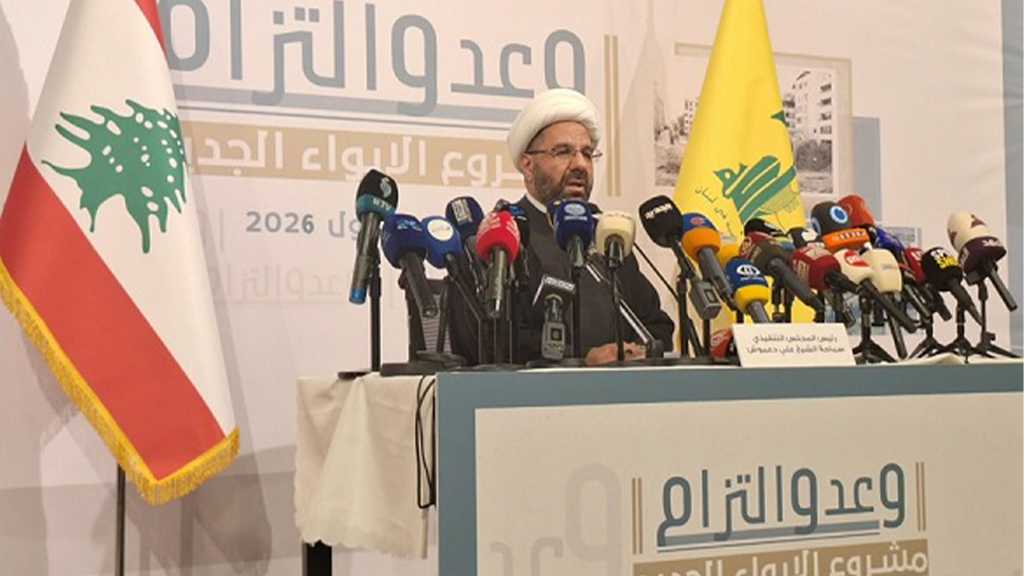
Statement by Hezbollah Executive Council Chairman Sheikh Ali Damoush at a press conference announcing the housing assistance program at the Ghobeiry Municipality Center in Beirut’s southern suburbs on October 13, 2026.
The Chairman of Hezbollah’s Executive Council, Sheikh Ali Damoush, stressed during a press conference held by Hezbollah to announce its housing assistance program at the Ghobeiry Municipality Center in Beirut’s southern suburbs that resistance remains a national necessity that cannot be abandoned as long as occupation, aggression and Zionist ambitions over Lebanese territory persist.
He said that through its actions and sacrifices, the resistance had achieved heroic feats that prevented the enemy from occupying southern Lebanon and had provided the country with an exemplary demonstration of the defence of its very existence.
“If this enemy has managed to occupy and destroy some villages, raze them to the ground and reach certain positions, this does not mean that it has become capable of establishing a permanent presence on our land,” he said. “The role of the resistance is different from that of conventional armies. Its mission is to wear down the occupation until it is driven out of our country. This resistance, through its actions and sacrifices, has achieved heroic feats that prevented the enemy from occupying southern Lebanon and presented the nation with an exemplary demonstration of the defence of its very existence.”
He added that the military developments on the ground, which resulted from a particular balance of power, did not in any way mean accepting a logic of surrender or submission. Such balances of power could change, he said, noting that Lebanon had experienced similar circumstances in the past, which had subsequently changed through the determination of its people.
Damoush added that, since November 27, 2024, the authorities had failed, or had been deliberately or inadvertently unable, to provide the means necessary to protect national sovereignty. Consequently, they could not prevent the Lebanese people from exercising this human, moral and legal right.
He called on the authorities to put an end to a series of gratuitous concessions and violations of the Constitution and the National Accord, and to return to the embrace of their people rather than placing their hopes in external options aimed at undermining the foundations of Lebanon and depriving it of its freedom, sovereignty and stability.
He urged the Lebanese to recognise the gravity of the current phase facing their country, put the national interest above factional and partisan considerations, and embrace dialog and rapprochement instead of inflammatory and hateful rhetoric that deepens divisions and widens the distance between the different components of Lebanese society. Whatever happens, he said, Lebanon will remain a country for all its citizens.
He reaffirmed Hezbollah’s commitment to building a strong and just state based on national partnership, as stipulated in the National Accord Document. Such a state, he said, should reassure all its citizens, assume full responsibility for its people and support the option of liberation through all available means, as affirmed in that document.
Damoush said that reconstruction and the provision of shelter for displaced people were the responsibility of the Lebanese state. This humanitarian and national issue, he stressed, must be kept separate from all political calculations, and the government must not approach it on that basis, as doing so would widen the gap between the state and its people.
He noted that the government had yet to take concrete steps towards addressing the issue, whether by seeking to secure funding, allocating the necessary budget appropriations or completing the official executive framework through the approval of a mechanism for assessing damage and calculating compensation payments. The proposed text for this mechanism, he said, remained in government drawers and had not yet been made public.
He continued: “We in Hezbollah, and out of our religious and moral responsibility, will continue to serve our people and make every possible effort to safeguard their dignity and honor. Whatever we do or provide, we remain inadequate in the face of a mother of a martyr who proudly holds up her son’s photograph, proud of what she has given and prepared to sacrifice even more; in the face of a child who pledges to his martyred father that he will continue along his path; and in the face of a displaced family that has lost everything it owns but has not lost its faith, determination or will, and refuses to relinquish its legitimate right to resist the occupier.”
He explained, “Our efforts were not a substitute for the state’s obligations, nor were they intended to secure any political or popular gains. Rather, they represented a religious and moral pledge to a patient and steadfast population.
“We are making considerable efforts to fulfil this commitment. Our people know this and are following our efforts with patience and confidence. In this sense, we are not obliged to disclose the total amount of money allocated to each of the scheduled installments.”
Addressing the Lebanese people, he said: “You truly are, as the Sayyed of the Nation’s Martyrs described you, the noblest, most esteemed and most honourable of people. You have astonished the world with the magnitude of your sacrifices and driven the enemies of our country to despair over the possibility of defeating your resolve.
“You have shown patience and endured ‘Israeli’ aggression as well as considerable harm inflicted internally. You have remained the most committed to your country, its civil peace and the coexistence of its people. No one has managed to divert you from the path in which you believe: a united Lebanon, in which all can live with dignity and honor.”
He also addressed those who had adopted what he described as losing positions based on illusions and wishful thinking, who had bet on Hezbollah’s weakness and its retreat from its rights, unleashed hateful and inflammatory rhetoric, and assumed that it would be unable to confront the enemy and the consequences of its aggression.
He called on them to reconsider their erroneous calculations, failed bets and desperate, unethical attempts to undermine the morale of the Lebanese people by exploiting the suffering caused by displacement.
He also criticised those who had placed their hopes in what he described as an unjust American blockade and promoted it, believing that sanctions and a barrage of false media coverage would prevent Hezbollah from working to secure the conditions necessary for resilience.
He added that certain official institutions, acting on decisions made by external parties, had also worked to implement the blockade in an attempt to prevent aid from reaching those affected. However, all these attempts had failed in the face of the determination of the Lebanese people. None of these measures had prevented us from fulfilling our responsibility to alleviate the suffering of our people.
“Today, we once again demonstrate that we are a resistance movement that does not abandon its responsibilities and that sets an exemplary standard in shouldering them. We will do whatever is necessary to ensure that our people remain dignified and hold their heads high, and, God willing, they will continue to do so.”
He announced that, in line with the commitment renewed by Hezbollah Secretary-General Sheikh Naim Qassem to provide financial assistance to the Lebanese people who had made great sacrifices, the party was launching a housing assistance program for displaced people and those whose homes had been destroyed or severely damaged and rendered uninhabitable.
He explained that the program was designed to provide direct assistance to people who had been forced to leave their primary residences because their homes had been destroyed or damaged and who had no alternative accommodation.
The program would provide assistance for renting a home for beneficiaries and their families, as well as purchasing household furniture, following the model of the programme implemented after the “Israeli” aggression in 2024. The assistance and eligibility criteria had been determined according to available resources. Otherwise, all of our people deserve to receive every possible form of assistance, and no amount of support could fully repay what they were owed.
As a first phase, the program would provide housing and furniture allowances to the following categories:
1. Owners of residential units in buildings that have been completely or partially demolished, where the residential units themselves have been totally destroyed.
2. Owners of residential units in buildings designated for total or partial demolition, based on the findings of specialized technical inspection committees.
3. People displaced from occupied border areas or areas adjacent to them, who have been forced to leave their villages, regardless of whether their homes have been destroyed, damaged, or left intact. These areas include all villages, towns, and cities under “Israeli” occupation or adjacent to occupied areas that are effectively under occupation, where residents cannot live because the occupying forces prevent them from returning or because of the dangers imposed by the occupation.
4. Owners of residential units that have sustained structural damage or extensive non-structural damage rendering them unfit for habitation.
Damoush clarified that assistance would be available to families for whom these properties served as their permanent primary residences, rather than summer homes, secondary residences, or properties left vacant because their owners lived abroad, provided they did not own another home that could serve as an alternative to their primary residence.
He said the maximum housing assistance for eligible families would be:
● Beirut and the southern suburbs: US$14,000 per residential unit.
● Areas outside Beirut and the southern suburbs: US$12,000 per residential unit.
The assistance would be divided into a furniture allowance of US$8,000, set at the same amount for all areas, and a rental allowance of US$6,000 for Beirut and the southern suburbs and US$4,000 for other areas.
These were the same amounts adopted under the housing assistance program following the September 2024 aggression.
The total assistance would be paid to each eligible beneficiary over one year in four installments, distributed every three months.
The first installment would amount to US$3,500 for beneficiaries in Beirut and the southern suburbs and US$3,000 for those in other areas.
The program would cover all eligible beneficiaries requiring housing assistance as a result of both the September 2024 aggression and the March 2026 aggression.
He stressed that assistance would be provided in all Lebanese areas affected by the aggression, with beneficiaries treated on humanitarian grounds and as citizens of one country, regardless of their sectarian or political affiliations.
“We regard everyone as belonging to one country and one people. Our hand will remain extended to everyone who has suffered harm as a result of the Zionist aggression against our country, regardless of their political position. We will remain faithful to our longstanding commitment, as we have always been, whenever a humanitarian need arises among the people.”
Damoush said Hezbollah’s specialized units and organizational areas had conducted a comprehensive survey of displaced people in villages and towns across southern Lebanon, the southern suburbs, and other areas, completing the task to a high professional standard.
Specialized committees had been established and were continuing to complete the enumeration and assessment of residential units eligible for housing assistance, and we now have a clear picture of the number of eligible units and the amounts required.
He explained that a flexible mechanism had been adopted for conducting surveys, preparing beneficiary lists, and distributing assistance.
Housing survey committees in all affected areas—including Beirut, southern Lebanon, and the Bekaa Valley—would identify eligible residential units using a standardized survey form prepared by Mimaar Company.
The forms would then be submitted to the company’s management, which would prepare the nominal lists of eligible beneficiaries and forward them, together with payment orders, to the relevant areas.
Local offices would designate authorized centers where beneficiaries could make enquiries and collect their assistance, establish the dates for the distribution of payment orders, and notify beneficiaries through appropriate channels when and where to collect them.
Payments would be disbursed according to the designated schedule, following the collection of the necessary signatures confirming receipt of the allocated amounts.
Damoush noted that the government had yet to introduce a program providing direct assistance to affected people. He said that the measures it had undertaken, such as rubble removal and certain construction projects, concerned infrastructure and did not directly assist those who had suffered losses.
He considered the scale of domestic and international solidarity, along with popular mutual support, to be a decisive factor in addressing the displacement crisis and reconstruction. Having witnessed many examples of such solidarity in the previous phase, he said, Lebanon would need to see much more of it during the current and coming phases, given the scale of the project and the need for all parties to combine their efforts on the ground and in practice.
Sheikh Damoush expressed his gratitude and appreciation to everyone who had provided shelter, support or assistance, or contributed to alleviating the effects of the aggression, describing their actions as an expression of national solidarity.
Addressing the public, particularly residents of areas that form the resistance’s social base, he said: “We are all partners in sacrifice, steadfastness, cooperation, and mutual support. We therefore call for the highest possible level of solidarity with those displaced from their homes.
“It is unacceptable for some people to rush to raise rents or the prices of household furniture on the pretext that Hezbollah will cover the costs. Such practices would increase the burden on displaced families, particularly as the announced program provides assistance in installments rather than as a single payment.”
He added: “I say to our dear people, the people of dignity, pride and loyalty: this project has begun, and, with God’s help, we will complete it. With your cooperation, we will be able to bring it to completion as quickly as possible, God willing.”
Sheikh Damoush said the initiative had been launched under the slogan “Promise and Commitment” to reassure those whose homes had been destroyed or damaged that the promise made by Sayyed Hassan Nasrallah, the Sayyed of the Nation’s Martyrs, the plans of the late Sayyed Hashem Safieddine, his martyred companion, and the commitment of Hezbollah Secretary-General Sheikh Naim Qassem would all be fulfilled, God willing.
With God’s blessing and driven by our moral, religious, and national duty towards the Lebanese people, we have launched the initiative.
Whatever we provide, we cannot fully repay our people for what they have given. They are a people who have made great sacrifices and shown extraordinary courage, and they deserve every possible effort to safeguard their dignity and honor.
We are confident that we could succeed in this new challenge by relying on God, remaining sincere in our commitment, and working diligently. He praised the efforts of all committees and working teams, as well as the cooperation of the Lebanese people, whose patience, endurance and understanding of the circumstances in which the work was being carried out deserved recognition.
In conclusion, he said: “Through our sincerity towards Almighty God, our country, and our people in Lebanon, and through hard work, we will demonstrate that reconstruction triumphs over destruction and humanity triumphs over barbarism.
“To all those who bet that Hezbollah would be unable to heal people’s wounds and provide them with shelter, your bet is misplaced and doomed to failure. Here is Hezbollah, thanks to the blood of its righteous martyrs and the efforts of those who remain faithful, once again taking the initiative to demonstrate the sincerity of its promise.
“It stands, as it has on every previous occasion, alongside its steadfast people, who have never abandoned this resistance. The resistance, in turn, has never abandoned them and never will. It will continue to mobilize all its available resources to safeguard their dignity and honor.”