The Will to Live: When Resistance Becomes a Culture
By Mohamad Hammoud
A Market Against Destruction
In Lebanon, where repeated wars have uprooted families and devastated livelihoods, a bottle of olive oil or a jar of honey can signify more than commerce. At Beirut’s Souk Ardi exhibition, farmers, artisans, and small producers brought the fruits of their labor into a space once damaged by war. Their presence reflects a culture of Resistance that extends beyond armed confrontation into the ordinary acts of cultivating land, preserving traditions, and rebuilding lives.
Organized by the Jihad al-Binaa Development Association, the exhibition opened on October 29 at the Sayyid al-Shuhada Complex in Beirut’s southern suburbs under the slogan “I Remain on My Land.” The complex had been damaged during the war and subsequently rebuilt. Choosing this location was itself symbolic: a place associated with destruction became a marketplace, illustrating how communities reclaim damaged spaces for work, exchange, and collective life.
The Land as Livelihood and Identity
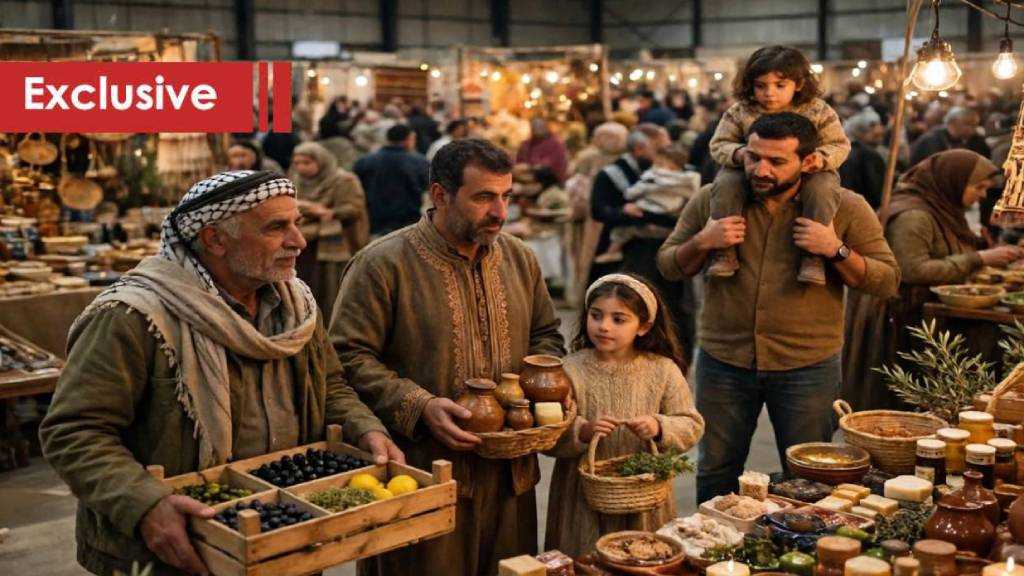
Olive oil, thyme, honey, preserves, dried foods, and handmade crafts filled the stalls. Yet the significance of these products lies in the people and places behind them. A November 1 ZNN report described exhibitors arriving from the South, the Beqaa, Hermel, Keserwan, Mount Lebanon, and Beirut. Different in their circumstances, they shared a determination to keep producing rather than allow hardship to sever their connection with their work and communities.
For farmers in southern border villages, that determination carries particular weight. Damaged fields, displacement, disrupted roads, and insecurity make even a routine harvest uncertain. Safir al-Shamal reported on October 28 that exhibition organizers highlighted participation from border communities despite war-related difficulties. Bringing agricultural products to Beirut under such conditions turns a commercial journey into a visible assertion that rural livelihoods have not disappeared.
But steadfastness is more than an emotional attachment to the soil. Olive trees require care, crops require markets, and households require income. Without these foundations, remaining on ancestral land becomes increasingly difficult. The farmer who cultivates again is therefore preserving both a livelihood and the possibility that the next generation can remain connected to its village.
Resistance Beyond the Battlefield
Souk Ardi reveals how Resistance becomes embedded in the everyday culture of a community. The farmer who replants, the craftswoman who resumes production, the merchant who creates a market for village goods, and the builder who repairs a damaged home each contributes to a collective determination to endure. Teachers keeping schools open and medical workers caring for patients reinforce that same spirit, demonstrating how Resistance finds expression across different walks of life.
In communities repeatedly exposed to war, these efforts form part of a shared culture of steadfastness, where defending the land is inseparable from sustaining life upon it. Souk Ardi brings that culture into view, connecting agricultural production, traditional craftsmanship, and economic activity with a determination to preserve identity, dignity, and continuity across generations.
That connection is reflected in the organizers’ public message. According to the Association for Municipal Action, Hezbollah official Sheikh Ali Damoush used the opening to call for government support for farmers, manufacturers, and craftspeople, including compensation for war losses. His appeal underscored the importance of strengthening local production and providing the resources necessary for communities to rebuild and expand their economic activities.
A November 2 Al-Binaa report described producers, including women selling homemade foods and crafts, whose participation linked family income with dignity and belonging. Their work illustrates how the culture of Resistance can be expressed through productive labor, transforming the determination to survive into practical contributions to community life.
The Will to Live
The resilience displayed at Souk Ardi also highlights the importance of supporting communities determined to remain on their land. Agricultural assistance, reconstruction, accessible markets, and functioning infrastructure strengthen the foundations of that determination. Together, community initiatives and institutional support can help transform steadfastness into sustainable livelihoods and opportunities for future generations.
Souk Ardi’s deeper significance lies in this convergence of determination and everyday labor. Its stalls represent the capacity of people to sustain life after destruction. The farmer, seller, artisan, and customer each plays a different role, yet together they preserve the social and economic ties that keep communities connected to their land and heritage.
Here, Resistance is not merely a response to war. It is also expressed through the insistence that land will be cultivated, skills passed down, markets reopened, and ordinary life continued.
Comments