Mossad Chief Pushes US for Joint Strikes on Iran as CENTCOM Chief Meets “Israeli” Leaders
By Staff, Agencies
Mossad Director Roman Gofman has urged US officials to consider renewed joint military strikes against Iran, as senior American and “Israeli” military and intelligence officials intensify consultations amid escalating regional tensions.
According to a report published on November 18, Gofman discussed potential joint attacks on Iran during a recent visit to Washington and Miami, where he met with senior US officials, including CIA Director John Ratcliffe and President Donald Trump’s special envoy Steve Witkoff.
During the meetings, Gofman reportedly presented “Israeli” intelligence assessments concerning Iran, with particular emphasis on its nuclear program, while advocating closer coordination between Washington and Tel Aviv over possible military action.
Former “Israeli” minister Ron Dermer also reportedly visited the United States to lobby for a joint attack, reflecting Prime Minister Benjamin Netanyahu’s concerns that the opportunity for renewed military action against Iran could be diminishing.
The diplomatic push comes after Trump postponed plans for further attacks following a meeting with Qatar’s prime minister, who is involved in diplomatic efforts between Washington and Tehran. Gulf Arab leaders have urged the US president to avoid another military confrontation, warning that Iran could retaliate against regional states.
A White House official said Trump considers the existing economic pressure on Iran sufficiently effective to avoid major military operations for now. However, the official stressed that all options remain available to prevent Iran from obtaining nuclear weapons.
Neither the CIA nor Netanyahu’s office publicly commented on Gofman’s reported meetings.
The discussions also come amid uncertainty over Washington’s longer-term military commitment to the region. Reports indicate that concerns have emerged in the “Israeli” entity over the possibility that the United States could reduce its military presence in the Middle East before the end of the year.
Despite a ceasefire that has been in place since April, tensions and clashes involving Iran and the United States have continued. Trump has alternated between threats of further military escalation and statements favoring an end to hostilities, while American officials have indicated that the president has yet to settle on a definitive course of action.
Meanwhile, assessments by the “Israeli” military indicate that Iran does not currently pose an imminent threat requiring immediate military action. European officials have also questioned claims that the Iranian government is close to collapsing, raising doubts about the potential effectiveness of another military offensive.
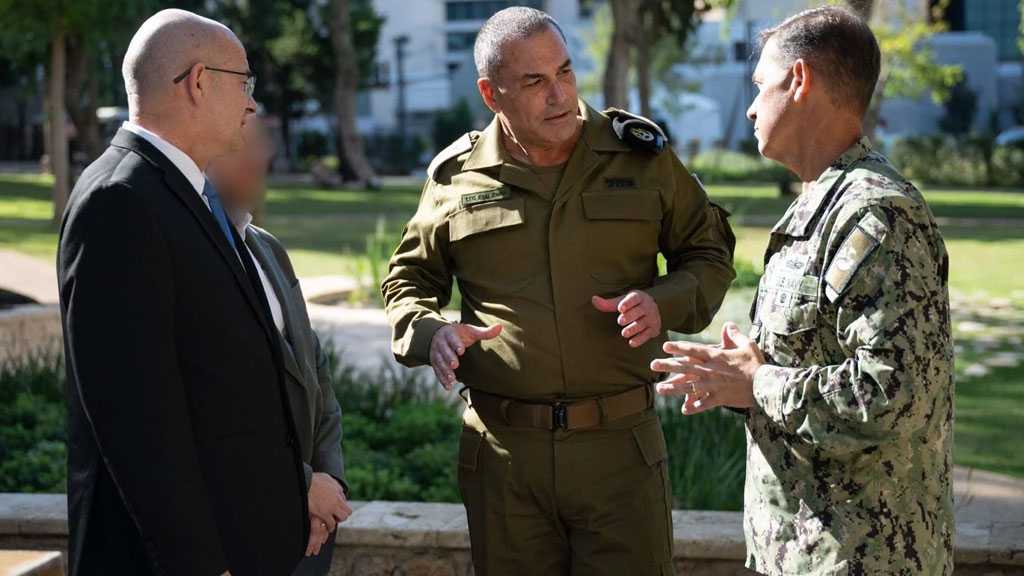
Against this backdrop, US Central Command [CENTCOM] chief Admiral Brad Cooper held separate high-level discussions with senior “Israeli” military and intelligence officials on Wednesday.
According to a statement by the “Israeli” occupation forces [IOF], Cooper met with IOF Chief of Staff Lieutenant General Eyal Zamir and Mossad Director Roman Gofman in a trilateral meeting focused on regional developments and what the parties described as shared security challenges.
Cooper and Zamir subsequently reviewed the regional situation alongside senior commanders from both militaries, including IOF Air Force chief Major General Omer Tishler.
The meeting took place as Washington maintains a substantial naval deployment in the region. CENTCOM announced on Monday that the USS Theodore Roosevelt was operating in the area, bringing the number of American aircraft carriers deployed there to three, alongside the USS George H.W. Bush and USS George Washington. More than a dozen US destroyers were also deployed.
The military consultations coincided with escalating developments around the Strait of Hormuz. Iran’s Army announced early Wednesday that its combat drones had struck US Patriot air defense systems and launch platforms at Ali Al-Salem Airbase in Kuwait in retaliation.
Iranian media also reported drone strikes against a US military installation in Bahrain, identified by Fars News Agency as Sheikh Isa Airbase, claiming that several American personnel were wounded. Iranian outlets additionally circulated an image showing a large fire at a US military installation in Kuwait.
Separately, the Islamic Revolution Guards Corps [IRGC] announced on Tuesday that a fourth oil tanker had caught fire after striking a naval mine near Ghanem Island, off the coast of Oman.
The IRGC said the vessel had been navigating an unauthorized maritime route and remained engulfed in flames, with the fire illuminating the island’s coastline. The force described the frequency of naval mine incidents in the area over the preceding two weeks as unprecedented, arguing that the latest explosions exposed what it called the falsehood of American claims that the Strait of Hormuz remained open.
Amid the growing confrontation, US Vice President JD Vance told Fox News host Laura Ingraham on Monday that Trump would not allow the war against Iran to become a “forever war.”
Vance said he had full confidence that Trump would bring the conflict to an end, stressing that Washington would not accept a 10- or 15-year commitment, or even a two-year one. However, he provided no specific timetable or conditions for ending the war.
The lobbying by Gofman and Dermer, combined with Cooper’s meetings with “Israeli” military and intelligence leadership, highlights the continuing coordination between Washington and Tel Aviv as the Trump administration weighs its next steps toward Iran amid military escalation, diplomatic negotiations and growing regional security concerns.
Comments