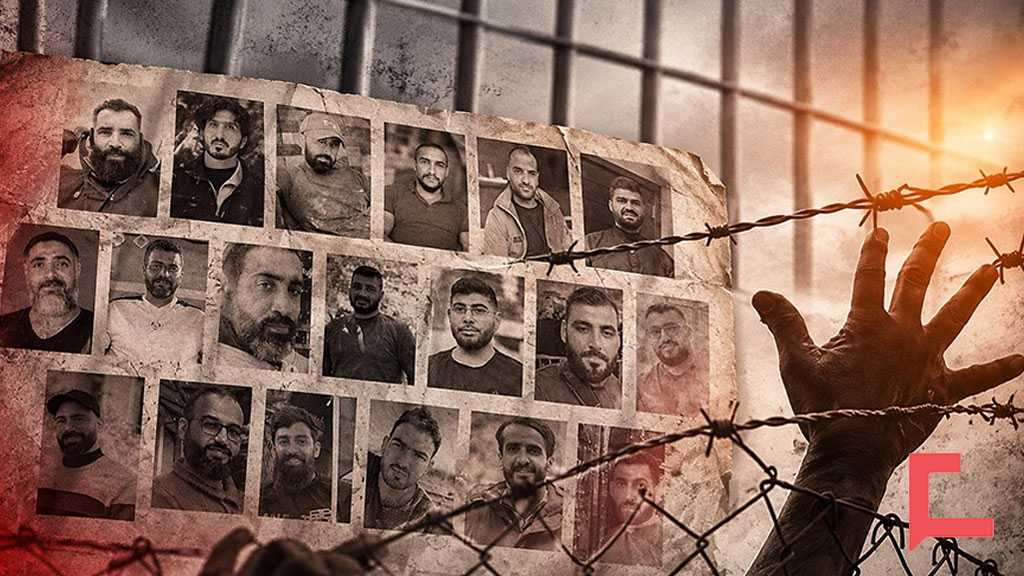
Mobilization Planned for December 10 in Support of Lebanese Detainees in “Israeli” Entity
By Mustafa Awwadheh
The issue of Lebanese and Palestinian detainees held in “Israeli” occupation prisons is not limited to the suffering of families waiting for their loved ones to return. Nor should it remain confined to limited activities involving detainees’ relatives and a handful of concerned organizations.
It is a national and humanitarian cause tied to dignity, rights and collective responsibility. It calls for action that goes beyond traditional sit-ins and statements, towards popular, human rights and political mobilization at both the local and international levels.
As the enforced disappearance of Lebanese detainees continues, alongside the denial of family visits and access to information about their conditions, the need to unite Lebanese and Palestinian efforts and keep their cause at the forefront of public attention becomes increasingly urgent, away from political and partisan divisions.
In this context, the Khiyam Centre for the Rehabilitation of Victims of Torture is continuing its meetings with political forces and various organizations in preparation for a major mobilization on 10 December, coinciding with International Human Rights Day.
Speaking to Al-Ahed News, Mohammed Safa, head of the Khiyam Centre for the Rehabilitation of Victims of Torture, stressed that the political and national meetings are primarily aimed at establishing the detainees’ cause as a general national issue, rather than one that concerns only their families or any particular political party or organization.
Safa explained that one of the main outcomes of these meetings was a shared conviction among the political forces contacted of the need to place the issue of Lebanese and Palestinian detainees at the top of the list of priorities. This stems from the shared suffering of detainees inside “Israeli” occupation prisons, where they face torture, violations and deprivation of even their most basic rights.
He pointed out that the plight of Lebanese detainees is particularly grave given their continued enforced disappearance and the lack of clear information about their physical and psychological conditions, in addition to the denial of access to them by the International Committee of the Red Cross [ICRC], as he confirmed.
He added that this reality places an even greater responsibility on political, human rights and humanitarian organizations to act, uncover their fate and follow up on their conditions, ensuring that their cause does not remain outside the sphere of public attention.
Safa explained that the center’s meetings had revealed a willingness among various political forces to come together around this issue, despite their differing political and partisan affiliations. He stressed that detainees represent common ground that should take precedence over disagreements, and that their suffering must become a cause embraced by Lebanese and Palestinians from all backgrounds.
December 10 mobilization to go beyond traditional sit-ins
Regarding the planned mobilization on 10 December, Safa explained that the event would not be merely a conventional solidarity gathering or sit-in limited to speeches and remarks. Instead, preparations are underway for a large-scale and distinctive event that will go beyond previous forms of mobilization, both in terms of participation and the nature of its activities and messages.
He noted that the date was chosen to coincide with International Human Rights Day, which encompasses all issues relating to human rights and dignity in Lebanon and around the world. He stressed that the cause of Lebanese and Palestinian detainees is a fundamental issue in this context and cannot be separated from the broader system of human rights and freedoms.
He added that preparations for the event are focused on broadening participation beyond Palestinian factions and political parties to include organizations, associations, institutions and kindergartens. This will allow different segments of society to take part and transform the mobilization into a collective national expression of solidarity with the detainees.
Safa revealed that the final program would be announced on 2 December during a press conference to be held at the Lebanese Press Syndicate, where details of the activities, participating organizations and other aspects of the event will be outlined.
Among the activities being prepared is an exhibition of photographs and children’s drawings featuring messages of solidarity addressed to detainees behind bars. The initiative aims to convey feelings of solidarity to them and reaffirm that they have not been forgotten, and that people are following their cause and working for their freedom.
Safa explained that such initiatives have an important psychological and morale-boosting impact on detainees. Recalling previous experiences, he said detainees had watched sit-ins and demonstrations organized in their support on television screens, giving them the sense that their cause remained alive and that people were standing by them.
He added that receiving a message or even a piece of paper from outside prison could make a prisoner feel that the world had not abandoned him and that his suffering remained a matter of concern and attention.
A national cause that must not remain confined to detainees’ families
Comparing the upcoming mobilization with previous sit-ins, Safa emphasized that he did not seek to diminish the importance of any solidarity activity organized in support of detainees, whether by the center or other organizations. He noted that sit-ins outside the Red Cross, the United Nations Economic and Social Commission for Western Asia [ESCWA] headquarters and other locations are held almost monthly and play an essential role in keeping the issue alive in the public consciousness.
However, he pointed out that such activities often remain limited in terms of participation, largely involving the families of detainees and missing persons. This makes it necessary to move towards a broader phase of engagement involving society, its institutions and its various organizations and associations.
He said the detainees’ cause does not belong solely to their families, their children or their siblings. Rather, it is a national cause that every citizen should feel responsible for, viewing each prisoner as their own brother or son and assuming the same responsibility towards them as their families do. He stressed that limiting solidarity to detainees’ relatives does not reflect the magnitude of the issue or the extent of the suffering endured by detainees inside prisons.
He explained that what is needed is to transform scattered activities into a broad national outcry involving political parties, Palestinian factions, civil society organizations and various associations. Such mobilization would strengthen pressure to uncover the fate of detainees, improve their detention conditions and work towards securing their release.
Safa stressed that the importance of this initiative lies in moving the issue beyond limited activities and placing it within a broader framework of national unity, one that reflects the scale of the detainees’ suffering. In his view, the current stage requires larger and more inclusive action at both the national and international levels.
From popular mobilization to international human rights accountability
The center’s program is not limited to solidarity events and popular mobilization. Safa also revealed that a parallel human rights track is being pursued alongside preparations for the event, with the aim of bringing the issue of Lebanese and Palestinian detainees before international human rights institutions.
He explained that the center intends to submit a human rights memorandum to the UN Secretary-General addressing the detainees’ case and the violations and suffering they endure. This will be followed by further steps directed towards the International Committee of the Red Cross and the Office of the UN High Commissioner for Human Rights, placing these bodies before their responsibilities to monitor detainees’ conditions and exert pressure to ensure that their rights are upheld.
He noted that the initiative also includes preparing a proposal for submission to the United Nations Human Rights Council as part of efforts to follow up on “Israeli” violations against detainees, broaden international attention to their plight and move beyond expressions of solidarity and statements.
He added that the center is coordinating with another international body as part of a global campaign, allowing local efforts to be linked with the international human rights process and strengthening the chances of bringing the detainees’ suffering to the attention of bodies capable of exerting pressure and ensuring accountability.
Safa emphasized that popular, political and human rights initiatives must complement one another, so that solidarity does not remain confined to a particular occasion or sit-in but develops into an ongoing campaign that places the detainees’ cause at the forefront of national and international attention, follows their suffering, demands that their fate be revealed and calls for their rights to be guaranteed.
He concluded by stressing that the detainees’ cause is a collective responsibility and that taking action on their behalf is a national and humanitarian duty that cannot be abandoned. He expressed hope that the December 10 event would mark a significant step towards unifying efforts and broadening participation, sending a clear message that Lebanese and Palestinian detainees are not alone, and that their cause will remain alive in the conscience of society and within the human rights movement until they obtain their rights and freedom.
Comments