Pentagon Yet to Decide which Syria Militants to Receive US Cash, Heavy Weaponry, Training
Local Editor
Two weeks after US warplanes began bombing in Syria against so-called "Daesh" [ISIL] positions, the Pentagon is still far from taking the next steps towards tackling the militants, The Guardian revealed on Monday.
 Despite American officials warning for weeks now that the Daesh extremist group poses a dire risk to the Middle East and the security of the United States and its allies, representatives for the Pentagon acknowledged to The Guardian paper that efforts to organize a trained army to go up against the militants have yet to materialize.
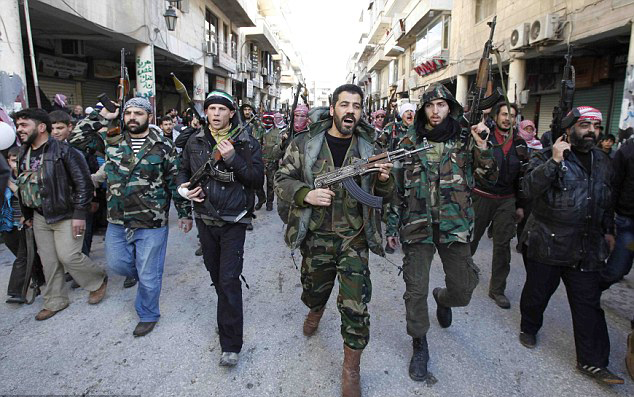
The US Department of War and America's President Barack Obama convinced Congress last month [September] to approve a measure that authorizes the US government to fund, train and equip so-called "moderate" militants in Syria in order to provide anti-Daesh forces with the resources.
However, a spokesperson for the Pentagon told the Guardian for an article published on Monday that exactly who will lead those militant forces remains unresolved.
"The Pentagon leadership has yet to make critical decisions about building the proxy [militant] force central to its plan for taking territory away from the [extremist] army," The Guardian said.
"No decision has been made as to who will lead the program," commander Elissa Smith, the Pentagon spokesperson, told the Guardian.
Spencer Ackerman, the American journalist who wrote Monday's piece, moreover reported that, "The Pentagon has yet to even assign a US officer to the task of determining which [militants] are trustworthy and capable enough to comprise that force."
"Once selected for the training, the [militants] will be led by Major General Michael Nagata, a special-operations veteran. The supposedly [so-called] "moderate" Free Syrian Army is expected to form the kernel of the proxy force," Ackerman continued.
"But the Pentagon, which hopes to field an initial force of nearly 5,000 to fight ISIL out of its Syrian strongholds, has yet to determine which [militants] amid Syria's panoply of mostly...[militant] groups are eligible to receive US cash, heavy weaponry and Nagata's expertise. ISIL commands as few as 20,000 [militants], and as many as 31,000, according to public US estimates," he said.
Indeed, American lawmakers have only approved a plan that will put weapons and resources into the hands of a militia merely one-fourth of the size of ISIL's militants.
Late last month [September], however, Pentagon officials acknowledged during a press conference that an infantry of up to 15,000 militants may need to be trained in order to actually pose a problem to the Daesh militants.
Now weeks down the road, the Guardian reported that America's efforts have hardly advanced past those preliminary planning stages and are now deadlocked by deciding who exactly will engage against Daesh in the US-led campaign.
"We will vet thoroughly, not just at the beginning of the program, but also do continuous monitoring," a Pentagon official who asked not to be identified told Ackerman.
However, for some in the US, rushing to put weapons into the hands of any group abroad raises questions, especially with regards to what the US-trained militants might do if they decide to use their arms against the Syrian government.
"I've never been satisfied that we're not going to end up fighting people that we've armed at some point in the future," Rep. Mick Mulvaney told Time Magazine recently.
Source: News Agencies, Edited by website team
Comments
US Military Faces Strain as Iran War Continues
one month ago