"Israel" to build homes in east al-Quds

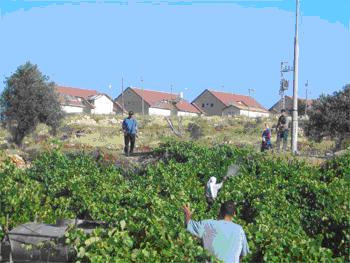 Source: AP, 4-12-2007
AL-QUDS - "Israel" said Tuesday it is seeking bids to build more than 300 new homes in Arab east 'Jerusalem' (al-Quds) neighborhood, drawing Palestinian condemnations that the move is undermining the newly revived peace talks held last week in Annapolis, Md.
A Housing Ministry spokesman said 307 units would be built in Har Homa, a Zionist neighborhood in east Jerusalem.
"Israel" captured the eastern part of the city in the 1967 Mideast war and annexed the area. The Palestinians claim east 'Jerusalem' (al-Quds) as the capital of a future state.
Palestinian negotiator Saeb Erekat said he sent an urgent message to Secretary of State Condoleezza Rice, asking her to block the project from moving forward.
"This is undermining Annapolis," he said, referring to the U.S.-hosted summit, where "Israel" and the Palestinians relaunched peace talks.
The two sides agreed to base their peace talks on the U.S.-backed "road map," a peace plan that calls on "Israel" to halt all settlement construction.
The Palestinians consider any construction in the West Bank and east Jerusalem to be settlement activity. "Israel" says the settlement freeze does not apply to Jerusalem.
"'Israel' makes a clear distinction between the West Bank and Jerusalem," said Mark Regev, spokesman for Prime Minister Ehud Olmert. "'Israel' has never made a commitment to limit our sovereignty in Jerusalem. Implementation of the first phase of the road map does not apply to Jerusalem."
In a rare interview, Defense (War) Minister Ehud Barak also rejected calls from some members of his Labor Party to talk to Gaza's Islamic Hamas rulers, telling Army Radio that "Israeli" troops had killed 27 Gaza militants in the past 10 days and would continue to aggressively chase down those operating under Hamas' watch.
"I do not agree with the assessment that the time has come to talk to the Hamas. Now is the time to kill those who carry out attacks and those firing Qassams (rockets) and mortars," Barak said.
Early Tuesday, an "Israeli" airstrike on a Hamas police post in central Gaza killed three militants and wounded a fourth, Hamas and Palestinian medical officials said. The army confirmed the attack.
Barak, a former military chief, has repeatedly hinted that "Israel" was on the verge of invading Gaza to stop the nearly daily rocket fire at towns in southern "Israel".
Analysts have speculated that Barak wanted to wait until the conclusion of the Annapolis conference. But when asked about the army's plans, Barak ruled out an immediate broad operation.
"The moment has not arrived yet and I hope that it does not arrive, but it is true that we are preparing and need to prepare for a wide range of possibilities," he said. "Every day that passes, we get closer to a widescale operation in Gaza, but we are not eager for it."
Hamas, an Islamic occupation resistance movement committed to deterring "Israel's" expansion over remaining Palestinian territory, took control of Gaza's security in June after overrunning the rival Fatah forces of US backed Palestinian President Mahmoud Abbas.
"Israel" has tried to bolster Abbas, who now rules from the West Bank, and isolate Hamas. But "Israeli" airstrikes and pinpoint ground operations have failed to halt the rocket and mortar fire from Gaza, which have severely disrupted life in southern "Israel". While smaller groups have fired most of the rockets, "Israel" holds Hamas responsible for the attacks.
With frustration mounting, a number of "Israeli" officials and retired generals, including some within Barak's centrist Labor party, have called recently for "Israel" to negotiate directly with Hamas.
Olmert, like Barak, rejects dialogue with Hamas, which "Israel" and the U.S. consider a (so-called) 'terrorist' group.
Hamas officials said the calls for dialogue were not serious. "'Israel' is practicing a series of crimes and continuous escalation against our people," said Taher Nunu, Hamas government spokesman in Gaza.
"Israel" is wary of launching a major ground incursion because of the high number of casualties it would likely cause, both to soldiers and Palestinian civilians. "Israel" also is concerned about damaging fledgling peace talks with Abbas.
Abbas claims to have authority over the Gaza Strip but in reality, he wields little control over militants there, raising questions about his ability to carry out a peace agreement.
"Israel", on the other hand, has balked at carrying out its commitments to halt West Bank construction or remove several dozen unauthorized settlement outposts, fearing a confrontation with Zionist settlers.
In the interview, Barak said he supports a proposal offering compensation to Zionist settlers beyond "Israel's" separation barrier in the West Bank who leave their homes voluntarily. The contentious barrier is meant to enclose main settlement blocs "Israel" plans to retain in a final peace agreement, where two-thirds of the settlers live. The others, about 80,000, could claim compensation if they leave.
"We are not dragging anyone out of their home, but a fair country gives the option to its citizens to make a decision about their fate," he said. "This is the basic relationship between a country and its 'citizens' (settlers)."
An official in the prime minister's office said Olmert was considering the proposal.


France’s Hollande in Qatar for Warplane Deal
11 years ago
Iraq Police Dismantles Al-Qaeda Protest Site
12 years ago