- Home
- ISLAMIC RESISTANCE
- SECRETARY-GENERAL
-
Full Speeches
- Speeches-2000
- Speeches-2006
- Speeches-2007
- Speeches-2008
- Speeches-2009
- Speeches-2010
- Speeches-2011
- Speeches-2012
- Speeches-2013
- Speeches-2014
- Speeches-2015
- Speeches-2016
- Speeches-2017
- Speeches-2018
- Speeches-2019
- Speeches-2020
- Speeches-2021
- Speeches-2022
- Speeches-2023
- Speeches-2024
- Speeches-2025
- Speeches-2026
- Speech-Reports
- SG
-
Full Speeches
- Voices
- Ten Day Dawn
- The Biggest Crime
- Martyr Leaders

Pezeshkian Calls for Compensation Over War-Related Environmental Damage
By Staff, Agencies
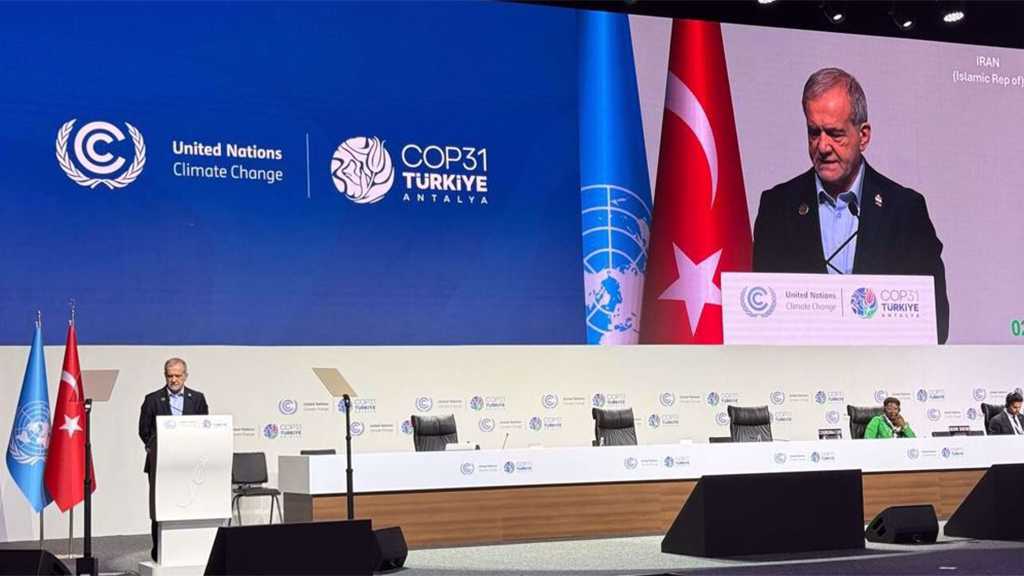
Iranian President Masoud Pezeshkian has called for international action to document and compensate for environmental damage caused by US-“Israeli” attacks on Iran, warning that armed conflicts undermine global efforts to combat climate change.
Addressing the 31st United Nations Climate Change Conference (COP31) in Turkey on Wednesday, Pezeshkian described the environment as a “silent victim of wars,” stressing that the destruction of natural resources, air, water and ecosystems could have consequences lasting for generations.
He said US and “Israeli” attacks on Iran had caused significant environmental damage alongside their human and economic toll, releasing substantial quantities of pollutants and greenhouse gases into the atmosphere.
Citing assessments, Pezeshkian said an attack on fuel facilities in Assaluyeh, southern Iran, had released approximately 500,000 tonnes of carbon dioxide, while strikes on fuel storage facilities in and around Tehran had generated emissions estimated at one million tonnes.
He argued that such destruction contradicted international efforts to reduce greenhouse gas emissions, noting that military operations involving fuel consumption, explosions, infrastructure destruction and widespread fires could undermine years of climate action.
The Iranian president also said protected areas and environmental ranger stations had been targeted during the attacks, describing the damage as a loss to the shared natural heritage of present and future generations.
Pezeshkian called for stronger international mechanisms to document environmental destruction resulting from military operations, prevent similar incidents and hold those responsible accountable.
He also highlighted Iran's efforts to expand renewable energy despite economic sanctions and restrictions on access to international financing and technology. According to Pezeshkian, Iran's renewable power generation capacity had increased from approximately 1,250 megawatts to more than 6,150 megawatts over the previous two years.
He added that clean electricity generation had exceeded 4.5 billion kilowatt-hours this year, preventing an estimated 2.5 million tonnes of carbon dioxide emissions.
Pezeshkian stressed that climate commitments must remain binding during both peacetime and war, urging international organizations to strengthen mechanisms for assessing and compensating for environmental damage caused by military operations.
He also invoked the position of the martyred Leader of the Islamic Revolution, Ayatollah Seyyed Ali Khamenei, on unconventional weapons, including nuclear arms, warning of their consequences for agriculture, human life and future generations.
Concluding his address, Pezeshkian underscored the inseparable relationship between peace and environmental protection, stating: “Peace is a prerequisite for protecting the environment, and environmental protection is a prerequisite for lasting peace.”
Comments
- Related News