Iran Turns the Tables: Break the Blockade or Risk a Regional War
By Mohamad Hammoud
Breaking the American Strategy of Attrition
For more than four decades, Iran has endured American sanctions, embargoes, and military threats intended to force the Islamic Republic into submission. Yet neither economic pressure nor military confrontation has secured that objective. Now, Washington is attempting through an oil blockade what earlier sanctions and attacks failed to achieve.
Tehran, however, refuses to remain indefinitely trapped between war and peace. Following Supreme Leader Ayatollah Sayyed Mojtaba Khamenei’s call to end that uncertainty, Iranian officials have argued that permanent economic strangulation cannot be accepted as the price of avoiding another war. Reuters reported Monday that Foreign Ministry spokesman Esmaeil Baqaei called the blockade military aggression and pledged to confront it through available means.
Meanwhile, President Donald Trump has returned to his familiar language of threats, warning of renewed military strikes after the New Year and that Iranian vessels challenging the blockade could be sunk. Those warnings sharpen the question underlying Tehran’s response: can Washington enforce its siege without provoking the confrontation it claims to want to avoid?
Operation Fereydoun: Washington’s Dilemma
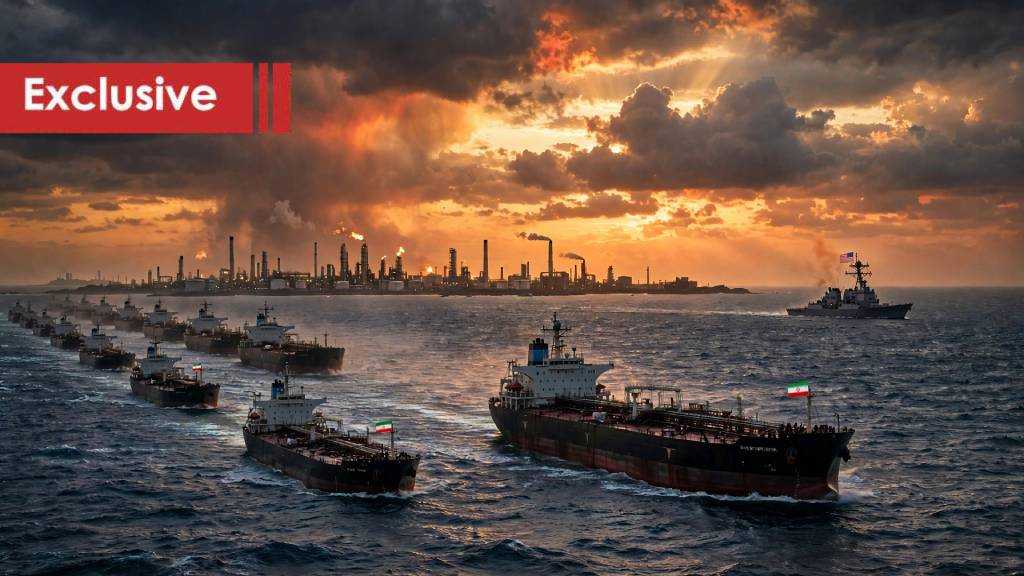
According to Euronews, shipping data and satellite reports suggest more than fourteen Iranian tankers have assembled near Kharg Island, the country’s principal crude export terminal. Fars News Agency promoted a proposed breakout called Fereydoun, invoking a legendary Persian hero associated with resistance to tyranny. Yet Iran’s Tasnim News Agency reported Monday that Baqaei dismissed accounts of an imminent convoy as speculation.
Even without a confirmed departure, events at sea have intensified the stakes. The Times of India carried an allegation that American forces struck an Iranian tanker in the Gulf of Oman. Separately, ABC News reported that British maritime authorities were investigating an incident involving a tanker and military forces. Neither account independently establishes an American strike on a Fereydoun vessel.
Still, the strategic dilemma is unmistakable. Letting Iranian oil shipments pass could weaken the blockade’s credibility; using force against them could trigger retaliation, turning economic coercion into a wider military confrontation.
The Regional Cost of Confrontation
That risk is not hypothetical in its regional setting. Reuters reported Iranian claims of drone attacks on American radar facilities in Bahrain. Al Jazeera also reported a fire at a Bahraini industrial facility following an attack attributed by Bahrain to Iran. These developments illustrate how quickly confrontation can reach military installations and civilian infrastructure beyond Iranian territory.
The Strait of Hormuz amplifies that threat. Iran's ability to disrupt maritime traffic means that enforcing the blockade could endanger oil exports from Saudi Arabia, the United Arab Emirates, Qatar, Kuwait, Oman, and Bahrain. Washington may possess overwhelming military superiority, but protecting every installation, tanker, and shipping route against sustained retaliation presents a fundamentally different challenge.
China Enters the Equation
Such disruption would also reach China, long Iran’s principal oil customer. Before the blockade, Chinese purchases provided Tehran with substantial export revenue; intercepting cargo destined for Chinese refiners could therefore turn a bilateral confrontation into a dispute affecting Beijing’s energy interests.
China need not intervene militarily for that pressure to matter. Washington’s defense of freedom of navigation would face closer scrutiny if its naval forces restricted commercial shipments bound for a major trading power.
The Nuclear Question and “Israel”
The consequences could extend beyond conventional warfare. Repeated American and "Israeli" attacks have intensified debate within Iran over whether the late Imam Sayyed Ali Khamenei's religious prohibition against nuclear weapons should remain in place.
Although Tehran has not officially reversed the fatwa, advocates of nuclear deterrence argue that conventional military capabilities alone cannot guarantee national security against nuclear-armed adversaries. Further attacks could strengthen those arguments, potentially producing the very outcome Washington claims its military pressure is intended to prevent.
Meanwhile, Iranian warnings of devastating retaliation against "Israel," including threats to return it to the Stone Age, underline another danger: a confrontation beginning with an oil tanker could escalate into a regional war threatening critical infrastructure far beyond the Gulf.
Washington’s Choice
Operation Fereydoun confronts Washington with a costly dilemma. Allowing Iranian tankers through would undermine the blockade, while attacking them could trigger regional retaliation, disrupt Gulf oil supplies, and send energy prices soaring.
For Trump, the consequences could reach American households through higher gasoline prices, rising inflation, and mounting economic pressure. Escalation could also strain relations with China and intensify Iran’s nuclear deterrence debate.
The question is no longer whether America can attack Iran, but whether Trump can afford an economic crisis at home and a wider war abroad to enforce his blockade.